
The best multi-use car charger depends on how many devices you need to power and whether you prefer built-in cables or charging ports. The SUPERONE is best for drivers who want retractable cables and multiple connection options; the 90W four-port adapter suits buyers seeking a port-based design. DreamBee adds a voltage display, while two other listings advertise 168W and 145W output but provide limited feature details here.
| Charger | Best for | Key distinction |
|---|---|---|
| SUPERONE 99W | Reducing cable clutter | Two retractable cables and six charging connections |
| 90W 4-Port Adapter | Using separate charging cables | Two USB-C and two USB-A ports |
| DreamBee 108W | Built-in cords and voltage monitoring | Retractable cables and voltage display |
| 168W 4-in-1 Adapter | Buyers considering a high-output listing | Product title states 168W |
| 145W Retractable Adapter | Buyers considering retractable charging | Product title states 145W |
SUPERONE 99W Retractable Car Charger

The SUPERONE is best for drivers who want to charge several devices without carrying as many separate cords. Its listed six-in-one setup includes two retractable cables, three USB-C ports, and one USB-A port. The product description specifies a 30W PD USB-C cable and a 12W USB Apple cable, alongside 15W USB-C ports and a 12W USB-A port.
The cables extend to 80 centimeters and retract for storage. The compact body is described as measuring 2.14 inches long and 1.31 inches wide, with an exposed height of 3.17 inches. These details make it a practical option for buyers who prioritize organized storage, including drivers working with limited cabin space.
- Best for: Families or carpoolers who want built-in cables plus extra ports.
- Why it was selected: It combines multiple connection types with retractable cords.
- Consider: The listing specifies different power levels by cable and port, so do not assume every connection provides the same charging speed.
90W Four-Port USB-C Car Charger

This 90W adapter is best for drivers who already have charging cables and want a conventional port-based setup. It has two USB-C ports and two USB-A ports, with the listing describing simultaneous charging for up to four devices. The product information cites PD and QC charging and states maximum outputs of 45W for each of those charging types.
The stated device range includes phones, tablets, power banks, cameras, and GPS navigation devices. That broad list may help buyers who need to charge different kinds of USB-powered equipment in one vehicle. Check the device’s charging requirements and cable connection before relying on a particular fast-charging mode.
- Best for: Drivers who prefer to bring their own cables and need four ports.
- Why it was selected: The listing clearly identifies its port count, port types, and stated total output.
- Consider: It does not provide integrated retractable cords, so cable organization is up to the user.
DreamBee 108W Retractable Car Charger

The DreamBee is best for buyers who want built-in retractable cables and a display that reports vehicle voltage. Its listed six-in-one configuration includes two retractable USB-C cables rated at 30W, an iOS retractable cable rated at 18W, and additional USB-C and USB-A ports. The listing says it can charge up to six devices simultaneously.
The two retractable cords are described as 31.5 inches long. The charger also has a voltage display, a 15A fuse, and a case made from aluminum alloy and ABS. Its description says a built-in chip and fuse are intended to help prevent overcharging, overheating, and short circuits.
- Best for: Drivers who value integrated cords and want a voltage readout.
- Why it was selected: It combines multiple charging connections with a feature for monitoring vehicle voltage.
- Consider: The listing explicitly says the charger is for charging only and cannot be used for CarPlay.
168W Four-in-One USB-C Car Charger

This charger is best considered by buyers searching for a multi-use adapter with a high output figure in its product title. The available product information identifies it as a 168W, four-in-one USB-C car charger and cigarette-lighter adapter. The supplied details do not specify its number of USB-C or USB-A ports, individual port output, charging protocols, or whether it includes cables.
- Best for: Shoppers comparing listings that advertise a 168W total output.
- Why it was selected: Its title identifies it as a multi-use car charger and gives a stated output figure.
- Consider: Confirm the port layout and per-port output in the current listing before choosing it; those details are not available in the supplied specifications.
145W Four-in-One Retractable Car Charger
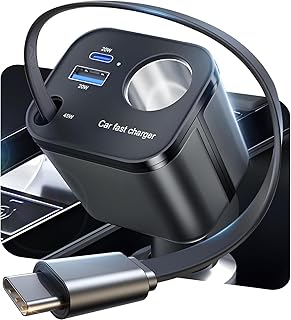
The 145W model is best for shoppers who specifically want to compare a retractable car charger advertised as four-in-one. Its product title also identifies it as a USB-C cigarette-lighter adapter. The information provided for this comparison does not detail the included cable types, cable length, port count, individual output levels, or supported charging protocols.
- Best for: Buyers looking for a retractable design and a stated 145W output.
- Why it was selected: The title makes both its retractable format and multi-use positioning clear.
- Consider: Verify the exact port and cable configuration in the listing, because the supplied specifications do not describe those features.
Buying Guide: How To Choose A Multi-Use Car Charger
How many devices do you need to charge?
Start by counting the devices likely to charge at the same time. A charger with four ports may suit a driver and passengers who bring their own cables. A six-in-one design with integrated cords and additional ports may be more useful when several passengers share the vehicle or when different connector types are needed.
Check whether the advertised simultaneous-device count includes built-in cables as well as ports. A product described as six-in-one may combine both kinds of connection. The total number of connections alone does not tell you how much power each one can provide while all are in use.
Do you want built-in cables or separate ports?
Retractable cables can reduce loose cords in a console or glove compartment. They are useful when you regularly charge devices with the connector types already built into the charger. Compare cable length with where passengers sit, and check which connector each cord uses.
A port-only adapter offers more flexibility if you already own suitable cables or want to replace a cable without replacing the charger. It also lets you choose cable lengths independently. The trade-off is that separate cords can become tangled or get left behind.
What does the wattage number tell you?
A wattage figure describes an advertised power level, but it does not by itself tell you how quickly every connected device will charge. Check the output listed for each port or cable, the supported charging standards, and how power is shared when multiple devices are plugged in.
For example, the SUPERONE description lists different power levels for its cables and ports. The 90W adapter lists PD and QC outputs. Compare those details with the requirements of your phone, tablet, or other device rather than choosing solely by the largest total number in a product title.
Which ports and charging standards do your devices use?
USB-C and USB-A are different connector types, so make sure the charger matches the cable you plan to use. A USB-C port does not mean every device will charge at the same speed. Fast charging depends on the device, cable, and charging standard working together.
Check product descriptions for supported protocols such as PD, QC, or PPS when those are relevant to your device. Do not assume that a broad compatibility list guarantees a particular charging speed. When specifications are unclear, confirm them in the current product listing before buying.
Would a voltage display or compact body help?
A voltage display may appeal to drivers who want a readout while using the charger. The DreamBee listing identifies this feature, but shoppers should treat it as a display and not assume that it diagnoses every vehicle or battery issue. Its listing also specifies a 15A fuse and a protective chip.
Physical size matters if the vehicle’s power socket is close to a cup holder, gear selector, or other controls. Compare the charger’s listed dimensions and shape with the available space. Integrated cables can also affect how easy the unit is to reach from the driver or passenger seat.
How should you compare products with incomplete specifications?
Look for clearly stated port counts, cable types, per-port output, total output, and simultaneous charging information. If a listing gives only a total wattage or a phrase such as “four-in-one,” do not infer the exact port layout or charging behavior. Verify details on the product page and in the device manufacturer’s charging requirements.
For everyday use, the strongest match is the charger whose connections fit your devices and whose layout suits your cabin. Choose retractable cables for tidier storage, a multiport adapter for cable flexibility, or a model with a voltage display if that feature is a priority.
Frequently Asked Questions
What is a multi-use car charger?
A multi-use car charger powers multiple devices or offers more than one connection type from a vehicle power socket. Depending on the model, it may use USB-C ports, USB-A ports, built-in cables, or a combination.
Can one car charger power several devices at once?
Some models are designed for simultaneous charging. Check the stated device count and how the charger distributes power across its ports and cables. Charging speed can differ when multiple devices are connected.
Are retractable car chargers better than port-only chargers?
Retractable models can help keep built-in cords organized, while port-only models let you use separate cables of your choice. The better option depends on whether you prioritize tidier storage or cable flexibility.
Does a higher wattage always mean faster charging?
No. A device’s charging speed also depends on its supported charging standard, the charger’s output at the specific connection, the cable, and whether other devices are using the charger.
Can a car charger support Apple CarPlay?
Do not assume that a charging accessory supports CarPlay. The DreamBee listing specifically says its charger is for charging only and cannot be used for CarPlay. Check a product’s stated data-transfer and vehicle compatibility features separately.
What should I check before buying a car charger?
Confirm that it fits your vehicle’s power socket, has the right connector types, provides suitable output for your devices, and offers enough simultaneous connections. Review dimensions and cable length if the charger has integrated cords or a display.