
The TC Electronic Crescendo is the clearest fit for guitarists seeking an automatic volume swell pedal: its sensitivity and attack controls shape the rise of each note without requiring a foot movement. The Rowin Slow Hand is another automatic-swell-style option, while the Volume (X) Mini and passive volume-expression pedal offer manual control rather than automatic note swells. The Pure Boost is a different kind of effect and is best considered only if you want a clean level boost, not a swell.
| Product | Best suited for | Type of control |
|---|---|---|
| TC Electronic Crescendo | Adjustable automatic note swells | Automatic attack and sensitivity |
| Rowin Slow Hand | Slow-gear-style volume shaping | Automatic effect, based on product name |
| Volume (X) Mini Pedal | Compact manual volume control | Foot-operated volume pedal |
| Passive Volume & Expression Pedal | Manual volume and expression duties | Passive foot controller |
| Pure Boost | Increasing signal level | Boost and EQ controls |
TC Electronic Crescendo Auto Swell

Best for: Guitarists who want automatic, adjustable volume swells for sustained or violin-like lines. This is the most directly relevant product in this group because its listed features specifically describe rolling volume swells and controls for sensitivity and attack.
The two-knob interface gives players direct access to sensitivity and attack. Sensitivity is relevant to how the effect responds to the incoming playing signal, while attack sets how quickly the volume rises. The listed attack control is intended to create nearly violin-like guitar lines, making this pedal a focused option for shaping note beginnings without manually moving a volume pedal for every note.
Choose this if you want to adjust the swell’s response and attack from the pedal itself. It is a better match for automatic note shaping than a conventional volume pedal, which depends on foot movement. The product information does not specify other controls, so players seeking detailed tone shaping or a range of added effects should confirm the full feature set before choosing.
Limitation: The provided description identifies only two controls, sensitivity and attack. It does not establish additional effects or a manual expression function.
Rowin Digital Slow Hand Slow Gear Pedal
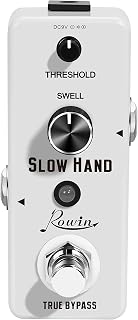
Best for: Players looking for a slow-gear-style effect that can be combined with reverb or delay. The product name describes it as a digital Slow Hand or slow gear pedal for electric guitar and bass, which makes it relevant to automatic-style volume shaping. Its name also references combining the effect with reverb or delay.
Unlike a foot volume controller, a slow-gear-style pedal is intended to shape the onset of notes electronically. That makes this a possible alternative for players who want swelling note attacks as part of a pedalboard effect chain. The listing name also states that it has true bypass, but the supplied information does not give control details or explain exactly how the effect responds.
Choose this if you are comparing slow-gear-style effects and want a product whose name explicitly references reverb or delay combinations. It may suit players exploring atmospheric guitar or bass textures, but the provided product data is less detailed than the Crescendo’s feature description.
Limitation: No feature list was supplied beyond the product name. Check the product listing for its controls, power requirements, and operating details before purchase.
Volume (X) Mini Pedal

Best for: Guitarists who want a compact manual volume pedal rather than automatic note swells. The product name identifies it as a mini volume pedal, so it is relevant as a foot-operated alternative for shaping level during a performance.
A manual volume pedal lets the player control level with foot movement. This differs from an auto-swell effect: the player determines when and how quickly the level changes instead of relying on an automatic attack response. That hands-on control can be useful for gradual fades, level adjustments, or performance gestures, depending on the pedal’s actual configuration.
Choose this if compact size and direct foot control matter more than automatic note-by-note swells. It is not the closest match for someone specifically seeking an automatic volume swell effect. The supplied product data does not list its dimensions, connections, power needs, or additional functions.
Limitation: Only the product name was provided, so details such as input and output arrangement, construction, and compatibility cannot be confirmed here.
Passive Volume And Expression Pedal

Best for: Players who need manual volume control and an expression-pedal function in one passive foot controller. The listed features include dual-function operation, no power requirement, a silent tread, a non-slip design, and 1/4-inch input and output connections for effects, pedalboards, and amp control.
This is a more versatile manual-control choice than a pedal identified only as a volume pedal, because its description explicitly includes expression functionality. Its passive design means the product is described as requiring no power. The silent tread and non-slip design are also stated features, although the supplied information does not explain the mechanism or how expression operation is configured.
Choose this if you want one foot controller for volume and expression-related tasks, and if manual control is suitable for your playing. It is better suited to hands-on level changes than automatic swells. Confirm that its connection arrangement matches the intended instrument or equipment before adding it to a setup.
Limitation: This is not described as an automatic swell effect. The listing also does not provide specific expression compatibility details in the supplied features.
Pure Boost Clean Boost Pedal

Best for: Guitarists or bassists who want a clean boost with tone-adjustment controls, not an automatic volume swell. The listed features include a boost of more than 20 dB, plus or minus 15 dB two-band EQ, a metal enclosure, and true bypass.
A boost pedal serves a different purpose from an auto-swell pedal. The described boost is intended to raise signal level, while the two-band EQ provides adjustment of two frequency ranges. Those functions may be relevant to players building a broader signal chain, but they do not create the gradual note attack that defines an automatic swell effect.
Choose this if your priority is clean signal boost and EQ shaping. Avoid it as a substitute for an auto-swell pedal if you need notes to fade in automatically. The product description lists features but does not specify the boost control range beyond the stated figure or explain how the EQ is voiced.
Limitation: It is a boost pedal, not a volume-swell pedal, so it does not meet the primary search intent on its own.
Buying Guide: How To Choose An Auto Volume Swell Pedal
Do you want an automatic swell or a manual volume pedal?
This is the first distinction to make. An automatic swell pedal shapes the start of a note electronically, creating a gradual rise in volume without requiring a foot movement for each note. A manual volume pedal changes level as the player moves its treadle. Both can create fades, but they work differently and suit different playing habits.
For automatic note shaping, the TC Electronic Crescendo is the clearest match among these five products because its listed features specifically describe volume swells and attack adjustment. The Rowin product is also relevant by name as a digital slow-gear-style pedal, but the supplied information does not describe its controls. The two volume pedals provide manual control instead.
What do attack and sensitivity controls change?
Attack controls the time it takes for a note’s volume to rise. A longer attack can make the onset feel smoother and more gradual; a shorter attack makes the rise less prolonged. The Crescendo listing explicitly identifies an attack control and a sensitivity control, so it offers adjustments related to how the swell responds and how its rise is shaped.
Because the supplied product information does not define the exact response range, avoid assuming that two pedals with similar labels will behave identically. Look for a product description or manual that explains the controls if you need a particular swell speed or response to different picking strengths.
When is a manual volume pedal the better choice?
A manual pedal is the better fit when you want to control level continuously with your foot. It can be used for fades or expressive level changes while playing, but it requires physical movement. The Volume (X) Mini is identified as a mini volume pedal, while the passive volume-and-expression model is described as a dual-function controller with 1/4-inch input and output connections.
Do not assume a manual volume pedal will create automatic swells. If the goal is a consistent rising attack on individual notes, prioritize an effect described as an auto-swell or slow-gear pedal.
Should you consider size, power, and connections?
The product names and features provide limited setup information. The passive volume-and-expression pedal is specifically described as requiring no power and having 1/4-inch input and output connections. The Rowin product name references true bypass, but the supplied data does not state its power requirements. The Crescendo’s supplied features do not specify its power arrangement or connections.
Check the full product information for power supply needs, cable routing, enclosure dimensions, and any requirements for expression control. A “mini” label indicates a compact product category but does not provide exact dimensions, so measure the available pedalboard space rather than relying on the name alone.
Is a boost pedal a substitute for an auto-swell?
No. A clean boost raises signal level, and the Pure Boost listing also describes two-band EQ. Those features can help adjust level and tone, but they do not indicate automatic volume shaping or a gradual note attack. Treat a boost pedal as a separate effect unless the manufacturer’s complete product details explicitly state otherwise.
Frequently Asked Questions
What does an auto volume swell pedal do?
An auto volume swell pedal gradually raises a note’s volume after it is played, softening the initial attack. It can create sustained, smooth, or violin-like note shapes without requiring the player to move a volume pedal for every note.
Which product here is the clearest automatic-swell choice?
The TC Electronic Crescendo is the clearest match based on the supplied features. Its description specifically mentions rolling volume swells and sensitivity and attack controls.
Is a slow-gear pedal the same as a volume pedal?
No. A slow-gear-style effect is intended to shape note attacks electronically, while a conventional volume pedal changes level through foot movement. The Rowin product is named as a digital Slow Hand or slow-gear pedal, but its supplied information does not explain its exact operation.
Can a passive volume pedal make automatic swells?
Not based on the supplied description. A passive volume pedal is controlled by the player’s foot, whereas an automatic swell requires an effect that changes the note’s volume envelope electronically.
Does a clean boost create a volume swell?
A clean boost raises signal level; it is not described as an automatic swell effect. The Pure Boost’s listed features are boost and EQ controls, so it should not be selected as a direct replacement for an auto-swell pedal.