
The best speakers for making beats are powered studio monitors that fit your workspace and let you hear mix details clearly. The PreSonus Eris 3.5 is best for a compact, balanced stereo setup; the Mackie CR3.5 is better for producers who want a simple tone control; and the M-AUDIO BX3 suits buyers who prioritize a wired connection. Ortizan C7 and OHAYO speakers offer multiple input options for people who also use their desktop speakers for everyday listening.
| Product | Best For | Key Difference |
|---|---|---|
| PreSonus Eris 3.5 | Compact music production | 50 watts and a stated 80 Hz–20 kHz range |
| Mackie CR3.5 | Desk-based mixing | On-speaker tone knob |
| Ortizan C7 | Flexible desktop connections | Bluetooth 5.3, USB, RCA, and 3.5 mm AUX |
| M-AUDIO BX3 | Wired monitoring | 3.5-inch Kevlar woofers and latency-free wired connection |
| OHAYO 60W | Music and general computer audio | Multiple inputs and front volume control |
PreSonus Eris 3.5 Powered Studio Monitors

The PreSonus Eris 3.5 is a compact powered pair for producers who want speakers designed for music production as well as everyday desktop audio. Its 50 watts of built-in amplification and 3.5-inch woven-composite woofers make it a practical choice for a small desk or home studio.
- Best for: Beatmakers who need a stereo pair for a desktop setup and value stated frequency-range information.
- Why it stands out: The product lists an 80 Hz–20 kHz range, a 1-inch silk-dome tweeter, and a 3.5-inch woofer. These details help shoppers compare its driver size and published range with other compact monitors.
- Also suited to: Gaming, movies, streaming, and general listening, according to the product description.
Limitation: The listed low-frequency limit is 80 Hz, so buyers focused on deep bass should consider how they will check low-end decisions on other playback systems. The product information does not specify a subwoofer.
Mackie CR3.5 Studio Monitors

The Mackie CR3.5 is a pair of 3.5-inch studio monitors sized for desks and small studios. Its most clearly differentiated feature is a tone knob that lets users adjust voicing from the desk without navigating menus.
- Best for: Producers who want a compact pair and an accessible, physical tone adjustment.
- Why it stands out: The manufacturer describes the speakers as intended to let listeners hear a mix or stream without flattering it. That makes them relevant to buyers looking for monitors for production rather than speakers selected only for casual playback.
- Better for: A small work area where a simple control on the speaker is useful.
Limitation: The supplied product details do not state the power output, frequency range, or connection types. Compare those specifications with your audio interface or computer before choosing.
Ortizan C7 Powered Studio Monitors

The Ortizan C7 is a compact active speaker pair for home studios and desktop setups that need several ways to connect. Listed inputs include USB, RCA, 3.5 mm AUX, and Bluetooth 5.3, so it can serve a production desk that also handles phones, tablets, or other audio sources.
- Best for: Beatmakers who want wired input choices alongside wireless playback for non-production listening.
- Why it stands out: The product describes a built-in 24-bit DAC for digital audio over USB, plus a 3.5-inch carbon-fiber mid-bass driver and a 0.75-inch silk-dome tweeter.
- Also suited to: Content creation, gaming, TV audio, and general desktop use, as described by the manufacturer.
Limitation: Bluetooth is convenient for playback, but the product details do not identify it as a production-monitoring connection. For making timing-sensitive decisions, check the signal path and use a wired connection when appropriate.
M-AUDIO BX3 Wired Studio Monitors

The M-AUDIO BX3 is a compact wired pair aimed at recording, mixing, streaming, gaming, and music production. Its product details highlight a latency-free wired connection and 3.5-inch Kevlar woofers designed for smooth, punchy bass response.
- Best for: Producers who prefer a direct wired connection for desktop monitoring.
- Why it stands out: The manufacturer describes the BX3 as bi-amplified and specifies 3.5-inch Kevlar low-frequency drivers. The listing also includes a music production software suite.
- Better for: A setup where wired monitoring is a priority and the included software is relevant to the buyer.
Limitation: The supplied details do not list wireless connectivity or a frequency range. Buyers who need Bluetooth or want to compare published bass extension should verify the full specifications before purchase.
OHAYO 60W Computer Speakers
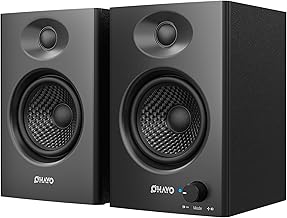
The OHAYO pair is designed for computer audio, music, and gaming. The listed inputs include Bluetooth 5.3, 3.5 mm AUX, RCA, and USB, while a front-panel volume knob provides an easy-to-reach control for desktop use.
- Best for: Buyers who want one compact pair for beatmaking and general computer listening.
- Why it stands out: The product lists 30 watts per speaker, a 3-inch carbon-fiber full-range driver, a 0.75-inch carbon-fiber silk-dome tweeter, and a rear bass port. It also specifies an MDF enclosure and an integrated sound card.
- Useful distinction: Its broad input selection may suit a desk shared by a computer and other audio sources.
Limitation: The product details emphasize computer, music, and gaming use rather than a stated frequency range or dedicated mixing features. Producers should compare its monitoring specifications with their needs before relying on it for mix decisions.
Buying Guide: How To Choose Speakers For Making Beats
Speakers for beatmaking are often called studio monitors. Their role is to let you hear the elements of a track, such as kick, bass, vocals, and high-frequency details, while you create and adjust a mix. A useful choice depends on your room, listening position, audio connections, and the kind of work you do. A feature list alone cannot establish how a speaker will sound in your specific space.
Do you need studio monitors or computer speakers?
Choose monitors when your main goal is producing, recording, or mixing. These products are described for studio or music-production use, though their features differ. General computer speakers can be convenient for music and entertainment, but check whether the manufacturer provides details relevant to monitoring, such as driver size, frequency range, and connection options. A speaker advertised for several uses may still require you to evaluate its suitability for accurate mix decisions.
What speaker size works for a small desk?
All five products in this selection use compact designs, with several specifying 3.5-inch drivers and the OHAYO listing a 3-inch full-range driver. Smaller speakers can be easier to place on a desktop, but driver size by itself does not tell you how much bass you will hear. Consider the available desk space, the distance between the speakers, and whether you can listen from a consistent position.
How important is bass response for beatmaking?
Bass is central to many beats, so consider how the speakers describe their low-frequency drivers and whether the listing states a frequency range. The PreSonus listing gives an 80 Hz–20 kHz range, while the M-AUDIO listing describes a punchy response from its Kevlar woofers. The other supplied details include driver and port information but do not provide a frequency range. If the deepest bass is important, plan to check your mix on additional playback systems rather than assuming a compact pair reveals every low-frequency detail.
Which connections should you look for?
Start with the outputs available on your computer, audio interface, or other source. The Ortizan C7 and OHAYO list USB, RCA, 3.5 mm AUX, and Bluetooth options; the M-AUDIO BX3 emphasizes wired monitoring. The supplied Mackie and PreSonus details do not specify connection types, so verify the complete specifications before buying. Bluetooth can make everyday playback convenient, while a wired connection may be a better fit for a production workflow where you want a direct signal path.
Should you choose a tone knob or a simpler setup?
A physical tone control can make adjustments accessible without menus. The Mackie CR3.5 specifically lists a tone knob for changing voicing from the desk. The other products highlight different priorities, including input flexibility, driver materials, or wired monitoring. Choose a control feature only if it supports your workflow; for mix decisions, also pay attention to whether you are changing the sound in a way that could affect how you judge the track.
How should you compare the five options?
- Choose PreSonus Eris 3.5 if you want a compact stereo pair with a stated frequency range and 50 watts of built-in amplification.
- Choose Mackie CR3.5 if a desk-accessible tone knob is the most useful differentiator for your setup.
- Choose Ortizan C7 if you need multiple wired inputs as well as Bluetooth playback.
- Choose M-AUDIO BX3 if you prefer wired monitoring and value its listed Kevlar woofers and included software suite.
- Choose OHAYO if you want a desktop-focused pair with several input types and a front volume knob.
Before ordering, verify the product’s current input and output details, physical dimensions, and placement requirements. Confirm that you have the cables and source connections your setup needs. For any compact speaker, also consider how you will cross-check bass-heavy decisions on headphones or other playback systems.
Frequently Asked Questions
Are studio monitors good for making beats?
Yes. Studio monitors are designed for audio work such as music production and mixing. The five products here include compact pairs described for studio, recording, or music-production use, but their specifications and connections vary.
Can I make beats with 3.5-inch speakers?
Yes. Compact speakers with 3.5-inch drivers can be used for beatmaking in a desktop or small-room setup. Driver size does not, by itself, show how deeply a speaker reproduces bass, so check the listed frequency information and cross-check low-end decisions on other systems.
Are Bluetooth speakers suitable for beatmaking?
Bluetooth can be useful for casual playback, but check whether it fits your production workflow. The Ortizan C7 and OHAYO list Bluetooth 5.3 as well as wired inputs. For monitoring, consider using a wired connection when you want a direct path from your audio source.
Do I need an audio interface to use studio monitors?
It depends on the speaker’s inputs and the outputs available on your computer or other audio source. Check the complete connection specifications for the speaker and your equipment before buying. The supplied details do not provide every connection type for every model.
Can compact monitors reproduce deep bass?
Compact monitors may have limits in low-frequency reproduction, but the available product data does not establish the performance of every model at deep bass frequencies. Check for a published frequency range, and compare bass-heavy mixes on additional playback systems.