
The best adaptive fast charging car charger depends on how many devices you need to power and which charging standard they support. The Samsung dual-port charger is best for compatible Samsung devices, while the 63W PPS/PD model is better for faster charging across phones, tablets, and some laptops. For multiple passengers, consider the three-port 130W or 150W options; the LISEN 90W model adds a retractable cable for a tidier cabin.
| Product | Best For | Key Listed Feature |
|---|---|---|
| Samsung Dual Port Adaptive Charger | Samsung users wanting an included Type-C cable | Two ports, up to 15W each |
| 63W PPS/PD Charger | Samsung fast charging and mixed devices | 45W USB-C and 18W USB-A |
| 130W Three-Port Charger | Charging several devices | Three ports and voltage display |
| 150W Three-Port Charger | Drivers seeking a flush-fit design | Flush fit and all-metal construction in the title |
| LISEN 90W Charger | Back-seat reach and cable management | Retractable 60-inch cable and three-device charging |
Samsung Dual Port Adaptive Fast Charger

This Samsung car charger is best for drivers who want a straightforward charger for compatible Samsung fast-charging devices and prefer an included Type-C cable. Its listed features specify two ports and up to 15W of fast charging for each, making it a practical choice when charging a phone and another device at the same time.
The product is described as compatible with all Samsung fast-charging devices and as including original retail packaging. Choose it if your priority is a Samsung-oriented charger with a cable included, rather than a higher-output adapter marketed for laptops or newer super-fast charging standards.
- Best for: Samsung users seeking dual-port charging and an included Type-C cable.
- Why it was selected: It directly targets adaptive fast charging and lists two 15W charging ports.
- Consider: Its listed output is lower than the higher-wattage options in this guide.
Before buying, check that the cable connector and charging rate suit your device. “Adaptive Fast Charging” does not mean every connected device will charge at the same rate; charging depends on the device and its supported charging protocol.
63W PPS And PD Three-Port Charger

This 63W charger is best for drivers who want a high-output USB-C port for compatible Samsung devices while retaining a USB-A port for another accessory. The listed specifications include a USB-C Power Delivery 3.0 port with up to 45W output, PPS support up to 45W, and an 18W USB-A port with QC 3.0.
The product description identifies support for Samsung Super Fast Charging 2.0 and 1.0 on listed compatible devices. It also describes use with iPad Pro, iPhone 15 and 16, and some MacBook models. These are protocol- and device-dependent capabilities, so confirm your particular device’s requirements before relying on a specific charging speed.
- Best for: Samsung users seeking PPS support, or drivers charging a phone alongside a USB-A device.
- Why it was selected: The 45W PPS/PD USB-C output and separate 18W USB-A output offer a useful split for mixed-device charging.
- Consider: The maximum output listed applies to the USB-C port; actual speed depends on the connected device and conditions.
Choose this model if a dedicated USB-C fast-charging port matters more than having three ports. Avoid assuming that every phone, tablet, or laptop will accept the full 45W; the device must support a compatible charging standard.
130W Three-Port Charger With Voltage Display

This three-port charger is best for drivers who need to power several devices on one trip. Its listing specifies two USB-C ports and one USB-A port, with up to 130W total output and automatic power distribution. The product description says it can charge phones, tablets, and a driving recorder simultaneously.
A digital display shows the vehicle’s voltage in real time, which may appeal to drivers who want to monitor that reading while traveling. The listing also describes PPS, PD, and QC fast-charging support and includes a 3-foot USB-C cable rated for up to 240W. The cable rating describes the cable’s stated capacity; it does not establish that a connected device will charge at that power.
- Best for: Families or rideshare drivers charging multiple devices from one car outlet.
- Why it was selected: It combines three charging ports, a voltage display, and an included USB-C cable.
- Consider: The 130W figure is the listed total maximum, not a promise that each port supplies that amount at once.
When charging multiple devices, check how the adapter distributes power across ports. A device’s charging speed can change when other ports are in use, and the listing’s estimated charging times should not be treated as guaranteed results for every setup.
150W Flush-Fit Three-Port Car Charger

This charger is best for shoppers who are specifically looking for a high-output, three-port model with a low-profile design. The product title identifies it as a 150W charger with three ports, an all-metal construction, and a flush-fit form. It is described as intended for newer iPhone, Samsung Galaxy, and Google Pixel devices.
The provided product information does not specify the output of each individual port, the exact charging protocols, or how the 150W maximum is divided when multiple ports are occupied. Those details matter when comparing it with chargers that list separate USB-C and USB-A outputs.
- Best for: Drivers who prioritize a flush-fit, all-metal design and multiple charging connections.
- Why it was selected: Its listed 150W maximum and three-port design address the needs of multi-device charging.
- Consider: Check the product listing for port-by-port output and protocol details before matching it to a fast-charging phone.
Choose this model if the physical design is a key factor and you are willing to verify the detailed output specifications. Do not assume that its 150W total rating means a single phone receives 150W or that all three ports deliver equal power.
LISEN 90W Charger With Retractable Cable
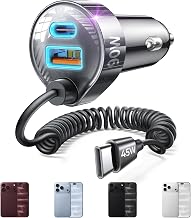
The LISEN 90W charger is best for drivers who want built-in cable reach for passengers and fewer loose cords around the console. Its product description lists a retractable cable that extends to 60 inches, a built-in 45W cable, and the ability to charge three devices at once. It is presented for use with phones, tablets, and earbuds.
The listing calls the charger 90W and describes charging a device from empty to 80% in 30 minutes. That is a product claim, not a guaranteed result: charging speed varies with the device, battery condition, cable connection, and other factors. The supplied information does not detail the output for every port or the full power distribution when three devices are connected.
- Best for: Road trips, back-seat passengers, or drivers who want a retractable cable.
- Why it was selected: Its long built-in cable and three-device capacity address reach and cable clutter.
- Consider: Check whether the retractable cable’s connector and listed output match the device you plan to charge.
Choose this model for convenience and cable management. If you need a specific Samsung charging mode or a precise port-by-port wattage, verify those details in the current product listing before purchase.
Buying Guide: How To Choose An Adaptive Fast Charging Car Charger
What does adaptive fast charging mean?
Adaptive fast charging refers to a charger and device adjusting power delivery to use a supported charging mode. The exact result depends on both ends of the connection: the car adapter must support a suitable protocol, and the phone or tablet must support it too. A high wattage number alone does not guarantee the fastest charging for a particular device.
Check the product’s stated protocols, such as PPS, USB Power Delivery, QC, or Samsung Adaptive Fast Charging, against the requirements for your device. If the listing only says “fast charging” without specifying a standard or output, look for more detailed information before buying.
How many ports do you need?
A single-port charger may suit a driver who charges one phone at a time. A dual-port option is more useful when a passenger also needs power. Three-port models are better for families or drivers who regularly charge a phone, tablet, and another accessory together.
Compare the total output with the output available at each port. A charger rated for 130W or 150W total does not necessarily provide that amount to one device, and the available power may be divided when several devices are connected.
Should you choose USB-C, USB-A, or both?
USB-C is common on newer phones, tablets, and many laptops, while USB-A can be useful for older cables and accessories. A charger with both types of port offers flexibility, but confirm the power specifications for each connection. Also check whether a cable is included and whether its connectors match your device.
Is a higher wattage always better?
No. The connected device controls how much power it accepts, and its supported charging protocol affects the rate. A higher-output charger can be useful if you charge different devices or want capacity for a tablet, but it does not force a phone to draw more power than it supports. Compare device compatibility and per-port output, not just the largest number in the product title.
What features matter for passengers and cable management?
For passengers in the back seat, cable length and placement can matter as much as output. The LISEN model lists a 60-inch retractable cable, while other options may require you to provide separate cables. Retractable designs can reduce loose cable clutter, but confirm that the built-in cable has the connector you need.
A voltage display, as listed for the 130W model, is a separate convenience feature from charging speed. Consider whether you will use it, and avoid treating a display reading as a substitute for professional diagnosis if you have concerns about a vehicle’s electrical system.
What should you check before ordering?
- Confirm your phone or tablet’s supported charging standard and maximum input.
- Check USB-C and USB-A port outputs, especially if you plan to charge several devices simultaneously.
- Verify whether a cable is included and whether its connector fits your device.
- Compare the charger’s physical design with the layout of your vehicle’s power outlet.
- For advertised charging times, treat them as estimates that may vary by device and conditions.
Frequently Asked Questions
Will an adaptive fast charger work with a phone that does not support fast charging?
It can still charge a compatible device, but the phone may charge at its standard supported rate rather than a fast-charging rate. The device and charger must support a compatible protocol to use a specific fast-charging mode.
Can I charge a Samsung phone with a USB-C PD car charger?
Many Samsung phones can charge from USB-C PD chargers, but the charging speed and supported mode depend on the phone model and the charger’s protocol. Check whether the charger lists PPS or the specific Samsung charging feature you want.
Does a 130W car charger deliver 130W to every port?
No. The 130W figure in the product listing is the stated total maximum. The output available to an individual device depends on the port specifications and how power is allocated when other ports are in use.
Can a car charger power a laptop?
Some higher-output USB-C chargers are listed for compatible laptops, including the 63W model in this guide. Confirm the laptop’s power requirements and the charger’s USB-C output; a laptop may charge slowly or not at all if the output or protocol is unsuitable.
Do I need to buy a separate cable?
Not always. The Samsung dual-port model lists an included Type-C cable, the 130W model lists an included USB-C cable, and the LISEN model describes a built-in retractable cable. Confirm the connector type and cable output meet your device’s needs.