
The best car socket to USB option depends on which way you need power to flow. For charging USB devices from a vehicle’s 12V socket, the JUNVANG offers four ports, the LISEN provides two ports in a two-pack, and the Anker is a compact dual-USB-A choice. If you need the reverse—powering a low-draw 12V accessory from a USB source—consider the WYMECT or FARSENSE adapter instead. These reverse converters have strict power limits and are not substitutes for a car charger.
| Product | Best For | Direction |
|---|---|---|
| JUNVANG 90W 4-Port Charger | Charging several USB devices | Car socket to USB |
| LISEN 69W Charger, 2 Pack | Two-port charging and a spare unit | Car socket to USB |
| Anker 320 24W Charger | Compact USB-A charging | Car socket to USB |
| WYMECT USB-to-12V Converter | Low-power 12V accessories | USB to car socket |
| FARSENSE Step-Up Converter | Low-power accessories with an on/off switch | USB to car socket |
JUNVANG 90W 4-Port Car Charger

Best for: Drivers who want to charge several USB devices from one vehicle power socket. This adapter plugs into the car’s cigarette lighter socket and provides two USB-C and two USB-A ports.
JUNVANG lists a combined maximum output of 90W, with PD output up to 45W and QC output up to 45W. Its four ports are intended to charge as many as four devices at once. The listed compatibility includes phones, tablets, power banks, cameras, and other USB-powered electronics.
Why it stands out: It offers the most ports among the selected car-to-USB chargers, making it useful when passengers need to charge different devices. The USB-C ports also suit newer devices that use USB-C charging cables.
Limitation: The maximum output is shared across a multiport adapter; the listing does not specify the output each port receives when all four are in use. Check your device’s charging requirements if you need a particular charging speed.
LISEN 69W Dual-Port Charger, Two Pack
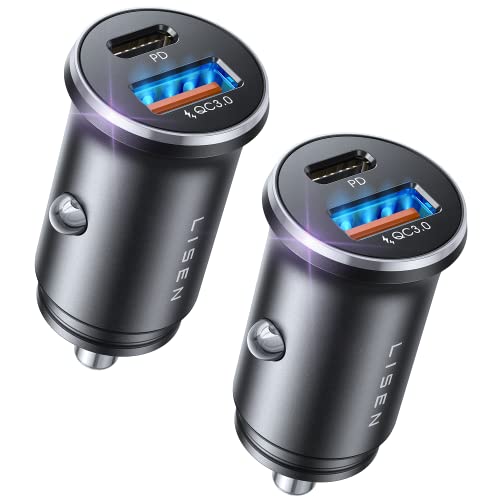
Best for: Buyers who want one USB-C port and one USB-A port in each charger, with two adapters included. Each unit connects to a car’s 12V socket and supplies USB charging.
The listing specifies a 36W USB-C PD port and an 18W USB-A QC port. It says one port delivers full speed at a time, with the design focused on everyday phone charging. The included two-pack can be useful for keeping a charger in more than one vehicle or holding a spare.
Why it stands out: Choose this if you need a straightforward two-port setup rather than four charging connections in one adapter. Its mix of USB-C and USB-A accommodates devices with different cable ends.
Limitation: The product description says one port delivers full speed at a time. Avoid choosing it if you need both connected devices to receive their maximum listed charging rate simultaneously.
Anker 320 Compact Dual-USB Charger

Best for: Drivers who prefer a small car charger with two USB-A ports. The compact design is intended to leave dashboard space accessible, and its aluminum-alloy surface gives it a metal finish.
Anker lists 24W combined output for charging two phones at the same time. This is a car-socket-to-USB charger, not a converter for powering a 12V accessory from a USB port. Its two USB-A outputs are suited to cables with USB-A plugs.
Why it stands out: It is the most compact option described here and makes a simple choice for users who do not need USB-C ports or four outputs. The blue LED is another listed feature that can make the adapter easier to locate in a dim cabin.
Limitation: The listing explicitly says it does not support Qualcomm Quick Charge. Choose a different model if your device depends on that charging standard or you need USB-C output.
WYMECT USB-to-12V Socket Converter
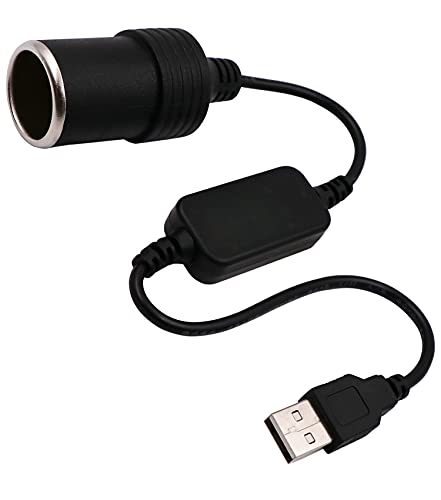
Best for: Someone who needs to power a low-draw 12V accessory from a USB power source, such as a suitable power bank. This adapter reverses the usual car-charger direction: it takes USB power and provides a female 12V cigarette-lighter-style socket.
WYMECT specifies a maximum output of 12V and 8W. The listing describes it as a way to power compatible car electronics using an extra USB power source. That low wattage is the key selection factor: the connected accessory must remain within the adapter’s stated limit.
Why it stands out: It is a simple option for buyers who need a 12V socket from USB rather than USB ports from a car socket.
Limitation: Do not use it with high-power equipment. The listing specifically warns against tire inflators, air compressors, car cleaners, and car refrigerators. It is not the right product for charging a phone from a vehicle’s 12V socket.
FARSENSE 12W USB-to-12V Converter

Best for: Buyers powering a low-power 12V accessory from USB who want an inline switch and voltage display. The listed examples include dash cams, GPS devices, and driving recorders.
This step-up converter accepts 5V USB input and provides a 12V female car socket. FARSENSE lists a maximum output of 12W, a three-foot cord, and a switch for turning the output on or off. The product information also describes a voltage display and built-in circuit protections.
Why it stands out: The longer cable and switch can be useful when the USB power source and accessory are not positioned together or when you want to turn the output off without unplugging the connection.
Limitation: The converter is limited to 12W maximum output. Confirm the accessory’s voltage and current requirements before use, and do not treat the voltage display as evidence that the adapter can run higher-power equipment.
Buying Guide: How To Choose The Right Car Socket To USB Adapter
Do you need USB power from your car, or 12V power from USB?
Start by identifying the direction of conversion. A conventional car charger plugs into the vehicle’s 12V socket and provides USB-A or USB-C output for phones and other USB devices. A USB-to-12V converter does the opposite: it takes power from a USB port and provides a 12V socket for a compatible accessory.
These product types are not interchangeable. If your goal is to charge a phone while driving, choose a car-to-USB charger such as the JUNVANG, LISEN, or Anker. If you have a USB power bank and a low-power accessory with a car-style plug, consider a reverse converter, while carefully observing its wattage limit.
How many ports do you need?
Count the devices you expect to charge at the same time, then check the port types each device’s cable requires. The JUNVANG has two USB-C and two USB-A ports. The LISEN has one USB-C and one USB-A port per charger, and the Anker has two USB-A ports.
More ports can reduce the need for separate adapters, but the total output may be divided among connected devices. Review the product’s stated output details and your devices’ requirements instead of assuming every port will deliver the maximum rate simultaneously.
Should you choose USB-C, USB-A, or both?
USB-C is a useful choice for devices and cables that use USB-C, while USB-A remains useful for older or existing cables. A mixed-port charger can serve devices with either connector. Before buying, check the connector at the charger end of your cable, not just the connector that plugs into your phone or accessory.
If all your charging cables have USB-A plugs, the Anker’s two USB-A ports may be sufficient. For a mix of cable types, the JUNVANG or LISEN provides both port formats.
What power limit should you check on a USB-to-12V converter?
Match the accessory’s power demand to the converter’s maximum output. The selected reverse converters list limits of 8W for the WYMECT and 12W for the FARSENSE. A device that requires more power may not operate properly, and the WYMECT listing specifically excludes several high-power appliances.
Check the accessory label or manual for its voltage, current, and wattage. If those details are not available or the required power exceeds the converter’s limit, do not assume that the adapter can safely run it.
Does cord length or an on/off switch matter?
A compact plug-in car charger keeps the connection close to the vehicle socket. A converter cable may provide more flexibility when powering a separate accessory. Among these selections, FARSENSE lists a three-foot cable and an on/off switch; the WYMECT listing does not provide the same switch or cable-length details.
Consider where the USB source and accessory will sit, whether the cable can reach without being pulled tight, and whether you need to switch the accessory off without unplugging it.
Frequently Asked Questions
What does “car socket to USB” usually mean?
It usually means a charger that plugs into a vehicle’s 12V socket and provides USB power for devices such as phones. That is different from a USB-to-12V converter, which supplies a car-style socket from a USB source.
Can I use a USB-to-12V adapter to charge my phone in the car?
No. A USB-to-12V adapter takes power from USB and outputs 12V through a car-style socket. To charge a phone from the vehicle, use a car charger that provides USB output.
Can a USB-to-12V converter run a tire inflator?
Not if the inflator exceeds the converter’s power limit. The WYMECT listing specifically warns that it does not support tire inflators, air compressors, car cleaners, and car refrigerators. Check the wattage required by any accessory before connecting it.
Is a four-port car charger always faster than a two-port charger?
No. The number of ports shows how many connections are available, not necessarily how quickly each device charges. Output can be shared, and charging speed also depends on the device, cable, and charger specifications.
Which option is best for charging USB-C and USB-A devices?
The JUNVANG and LISEN both provide USB-C and USB-A ports. Choose based on how many devices you need to connect and the output arrangement stated for the charger.