
The best 100-foot audio snake depends on how many channels you need and whether you want a simple multichannel cable or a stage-box splitter. The PRORECK 8-channel cable suits straightforward signal runs, while its circuit-board models add stage-box connections. For more inputs, consider the 16-channel PRORECK or On-Stage 12 x 4. The Seismic Audio 8-channel sub snake is designed for stage-to-mixer connections with individually shielded conductors.
| Product | Best for | Configuration highlighted |
|---|---|---|
| PRORECK 8-Channel Shielded Cable | Simple multichannel runs | 8 channels; color and number marks |
| PRORECK 8-Channel Circuit Board Snake | Compact stage-box setups | 8 channels; numbered connectors |
| Seismic Audio 8-Channel Sub Snake | Stage-to-mixer routing | 8-channel low-profile sub snake |
| PRORECK 16-Channel Circuit Board Snake | Higher input counts | 16 channels; numbered connectors |
| On-Stage SNK124100V2 | 12-send, 4-return layouts | 12 x 4 configuration |
PRORECK 8-Channel Shielded Cable
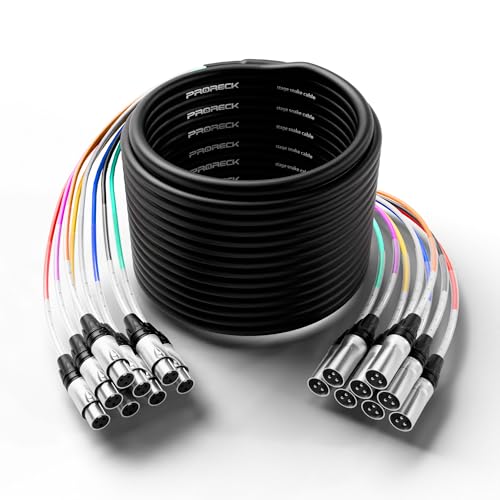
This PRORECK model is an 8-channel, 100-foot audio cable with XLR male-to-female connections. Its product details specify a copper core and shielding intended to help block electromagnetic and radio-frequency interference. Each cable is marked with matching numbers and colors, which can make channel identification easier during setup and teardown.
Best for: Buyers who need eight audio signal paths in a cable-only format, such as a multichannel studio or live-sound run. It is the most direct choice here for users who do not need the listing’s separate stage-box configuration.
Why it stands out: The combination of eight channels, shielding, and color-and-number markings addresses common needs in a 100-foot signal run.
Limitation: The listed details do not specify a stage box or a send-and-return layout. Confirm that the male-to-female connector arrangement suits the equipment at both ends.
PRORECK 8-Channel Circuit Board Snake
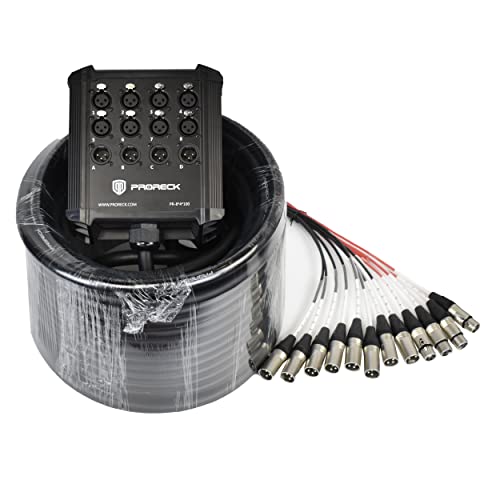
This 100-foot PRORECK snake is built around an 8-channel stage-box arrangement. The listing describes female XLR connectors on the box and male connectors on the fantail, and it says the box and fantail are numbered for identification. Its circuit-board design is described as supporting solid connector connections and reducing external noise.
Best for: Live-sound users who want a stage box and clearly numbered channel ends for connecting stage equipment to a mixing position.
Why it stands out: It offers a defined box-and-fantail layout rather than only a general cable description. That makes it easier to compare against a setup requiring a stage box.
Limitation: The feature description mentions four female XLR connectors and eight male XLR connectors, while also describing an 8-channel snake. Verify the connector count and routing against your intended setup before ordering.
Seismic Audio 8-Channel Sub Snake
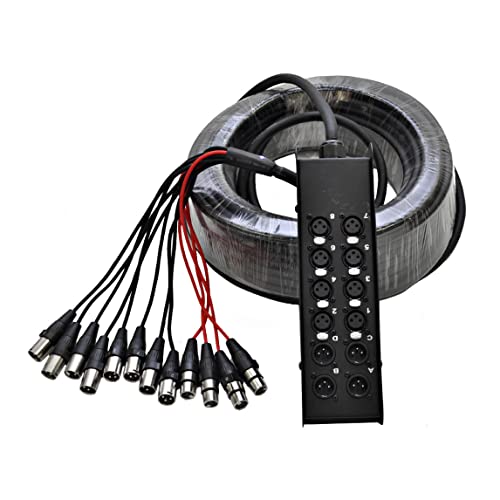
This Seismic Audio model is a 100-foot, 8-channel low-profile XLR sub snake. Its listed features include circuit-board technology, individually shielded pairs of heavy-duty conductors, and 25-gauge conductors. The product description says the XLR connectors on the returns are intended to connect with professional power amps and mixing consoles without converters or couplers.
Best for: Buyers who want a sub snake for stage-to-mixer routing and prioritize individually shielded conductor pairs.
Why it stands out: Its feature list provides more detail about conductor shielding and cable gauge than several other options. The low-profile design may also suit installations where a smaller stage-box footprint is useful.
Limitation: The supplied details do not give a full connector-count breakdown or describe every end of the cable. Check the product configuration against your signal flow before purchase.
PRORECK 16-Channel Circuit Board Snake

This 100-foot PRORECK model provides 16 channels and a stage-box-style layout. The listing describes female XLR connectors on the box and male connectors on the fantail. Both ends are numerically marked, and the circuit-board construction is described as providing a solid connector connection and reducing external noise.
Best for: Live performers, venues, or recording setups that need more than eight channels over a long run and want numbered connections.
Why it stands out: It offers twice the channel count of the 8-channel PRORECK circuit-board model while retaining the same basic numbered box-and-fantail approach.
Limitation: The feature listing says the cable has four female XLR connectors and 16 male XLR connectors, which may not explain the full channel routing at a glance. Confirm the exact connector arrangement for your mixer and stage equipment.
On-Stage SNK124100V2 12 x 4 Snake

The On-Stage SNK124100V2 is a 100-foot snake with a 12 x 4 configuration. Its listed construction features include hand-soldered, individually insulated XLR connectors, 100% oxygen-free copper wiring, and wire-mesh strain relief.
Best for: Buyers whose setup specifically needs a 12-send, 4-return channel arrangement rather than an equal number of paths in each direction.
Why it stands out: Its 12 x 4 format is clearly identified, and the feature list calls out connector insulation, OFC wiring, and strain relief—useful details when comparing construction.
Limitation: The supplied details do not specify the exact connector gender and count at each end. Confirm that the 12-send, 4-return layout matches your equipment.
Buying Guide: How To Choose A 100-Foot Audio Snake
How many channels do you need?
Start by counting the separate audio paths your setup requires. An 8-channel snake can suit a compact stage or a limited number of sources. A 12 x 4 layout offers 12 paths in one direction and four in the other, while a 16-channel model can serve a larger input setup. Channel counts alone do not describe the complete routing, so also check the number of sends and returns.
Plan for the equipment you expect to connect, not just the number of performers. Microphones, instruments, playback devices, and monitor or return paths can all affect the channel requirement. If you regularly change your setup, a higher channel count may provide more flexibility, but only if its connector layout fits the system.
Do you need a cable or a stage-box snake?
A straightforward multichannel cable is suitable when you need to carry signals between equipment with compatible connectors and do not need a stage box. A stage-box snake separates the connections at the stage end from the fan of connectors at the other end. That layout can make stage wiring more organized, but you should verify which connector genders and channel counts are on each end.
Pay attention to product wording such as “send,” “return,” “fantail,” and “stage box.” These terms describe different parts of the signal path. Do not assume that two products with the same channel count use the same connector arrangement.
What does shielding mean for a long run?
Shielding is a relevant feature when an audio cable runs near other electrical equipment or across a busy stage. Some of these listings describe shielding intended to reduce electromagnetic or radio-frequency interference. The Seismic Audio 8-channel model specifically describes individually shielded conductor pairs. These details help compare listed construction, but they do not guarantee performance in every environment.
Keep the cable routed carefully and avoid assuming that shielding can resolve every noise issue. Check the product’s stated construction and connector configuration, and consider how the cable will be positioned in your actual setup.
Are color and number markings important?
Markings help users identify channels without tracing every cable from end to end. Numbered connectors are useful when several channels connect to a stage box or mixer, while color markings can provide another quick visual cue. The PRORECK 8-channel cable lists both number and color marks; its circuit-board models list numerical identification.
For a fixed installation, labels can help keep the original channel plan consistent. For mobile setups, clear markings may make connections easier to check during setup and teardown. Confirm that the labeling scheme is present on the cable ends you need to identify.
Which construction details should you compare?
Compare the features actually specified: conductor shielding, copper wiring, circuit-board connections, connector insulation, and strain relief. The listings provide different levels of detail, so a missing specification should not be interpreted as proof that a feature is absent. Instead, use the information available to decide what needs further confirmation.
For example, the On-Stage listing calls out hand-soldered and individually insulated XLR connectors, 100% OFC wiring, and wire-mesh strain relief. The Seismic Audio 8-channel listing describes individually shielded conductor pairs and 25-gauge conductors. These are distinct feature sets rather than directly interchangeable claims.
What should you verify before ordering?
- Confirm that 100 feet is appropriate for the actual route, including enough length to reach around equipment and stage obstacles.
- Match the channel count to the number of sources and return paths in your system.
- Check connector gender, connector quantity, and which end connects to the stage box or mixer.
- Distinguish a cable-only snake from a stage-box or sub-snake design.
- Review the product’s stated shielding and identification features if noise management or fast setup matters.
- Resolve any ambiguity in the listed connector count before selecting a model.
Frequently Asked Questions
What is a 100-foot audio snake used for?
A 100-foot audio snake carries multiple audio signals between two locations, such as a stage and a mixing position. The number of channels and connector layout determine how many signals it can route and how it connects to the equipment.
Is an 8-channel snake enough for a small stage?
It can be enough when the total number of required audio paths is eight or fewer. Count both the sources and any required return paths, then check whether the product’s send-and-return configuration matches your setup.
What is the difference between a 12 x 4 and a 16-channel snake?
A 12 x 4 snake indicates 12 channels in one direction and four in the other. A 16-channel label indicates a 16-channel product, but the exact send-and-return layout should be confirmed in its specifications.
Does a stage box come with every audio snake?
No. Some products are described as cable-only snakes, while others specify a stage box, fantail, or sub-snake design. Check the product description and images to confirm which components and connector arrangements are included.
Why are audio snake connectors numbered or color-coded?
Number and color markings help identify individual channels during connection and troubleshooting. They can reduce mix-ups when multiple cables connect to a stage box or mixer.
Can a 100-foot snake prevent audio interference?
Shielding is designed to help reduce certain kinds of interference, and some listed models describe shielded conductors or EMI/RFI protection. Actual results depend on the cable, the surrounding equipment, routing, and the full audio system.