
For a room-filling TV setup, choose a system based on how many speakers you can place and connect, not just its advertised channel count. The ULTIMEA Aura A40 is best for buyers seeking multiple surround speakers, while the ULTIMEA Poseidon M60 suits shoppers who want a Dolby Atmos soundbar system. The Bobtot is a wired 5.1 option; the Saiyin and Aura A40 variants offer alternatives for simpler or app-controlled setups. These products are soundbar and home theater systems rather than a selection of traditional, large standalone speakers.
| Product | Best For | Notable Detail |
|---|---|---|
| ULTIMEA Poseidon M60 | Dolby Atmos soundbar shoppers | 5.1 channels, 300W, subwoofer |
| ULTIMEA Aura A40 | Buyers who want four surround speakers | 7.1-channel virtual surround sound |
| ULTIMEA Aura A40 (2026 Upgraded) | Shoppers comparing an updated A40 listing | 7.1-channel soundbar system with subwoofer |
| Saiyin Sound Bar | Buyers prioritizing bass controls and simple inputs | 5-inch subwoofer, adjustable bass |
| Bobtot Home Theater System | Buyers who prefer a wired 5.1 setup | Four-inch subwoofer, 400W peak power |
ULTIMEA Poseidon M60

The Poseidon M60 is a 5.1-channel soundbar system with Dolby Atmos, a subwoofer, and a stated 300W output. Its listed features also include VoiceMX, BassMX, app control, and Bluetooth 5.4. That combination makes it a relevant choice for buyers who want an all-in-one TV audio system with named dialogue and bass features rather than a traditional set of large standalone speakers.
Best for: Viewers looking for a Dolby Atmos soundbar system with a subwoofer and app control. It was selected because it combines surround-system positioning with several clearly listed functions and a current Bluetooth version.
- Choose this if: Dolby Atmos, a subwoofer, and VoiceMX or BassMX are priorities.
- Consider: It is a soundbar-based 5.1 system, not a set of large, independent floor-standing speakers.
The product name lists the channel format and headline functions, but the supplied information does not specify speaker placement, connection details beyond Bluetooth, or room-size guidance. Check the full listing for the connection and installation details that matter to your television and room.
ULTIMEA Aura A40 7.1-Channel Soundbar

The Aura A40 is a 7.1-channel virtual surround soundbar system with a subwoofer and four surround speakers. ULTIMEA describes three main channels for dialogue and four surround speakers for front and rear sound placement. The system has 330W peak power, app control, and optical, AUX, and Bluetooth connections.
Best for: Buyers who want more separate surround speakers than a basic soundbar provides. It was selected for its four-speaker layout and stated surround-level adjustments, which give shoppers more placement options to consider.
- Choose this if: You can accommodate front and rear surround speakers and want 13 adjustable surround levels.
- Plan for: The two front surround speakers connect by cable, and the rear speakers use a rear surround cable. The rear-right speaker pairs wirelessly with the soundbar, but it still requires power.
This is a virtual surround system, so its 7.1-channel description should not be mistaken for a receiver-based system with seven full-size, independent speakers. The supplied directions also include a manual re-pairing procedure if the rear speaker does not connect.
ULTIMEA Aura A40 2026 Upgraded

This listing names a 7.1-channel virtual surround system for smart TVs, with a subwoofer, four surround speakers, app control, and optical, AUX, and Bluetooth connections. It is identified as an “2026 Upgraded” version of the Aura A40. The supplied product information does not provide additional specifications to distinguish this listing from the other Aura A40.
Best for: Shoppers who specifically want to compare the 2026 Upgraded A40 listing with the other A40 option. It was selected because its stated multi-speaker layout and connection types match buyers looking for a surround-focused TV system.
- Choose this if: You want a 7.1-channel soundbar package with four surround speakers and app control.
- Check before buying: The provided listing details do not explain what has changed in the upgraded version or confirm its speaker wiring arrangement.
Do not assume the upgraded model has different performance, accessories, or setup requirements based on its name alone. Compare the full listing’s specifications and included components with the other A40 before choosing between them.
Saiyin Sound Bar With Subwoofer
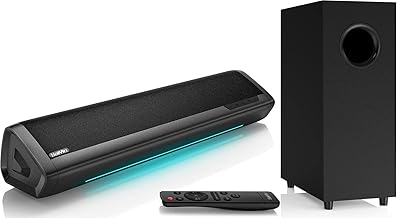
The Saiyin system pairs a soundbar with a five-inch subwoofer and dual bass reflex ports. Its listed connections are optical, AUX, and Bluetooth 5.3. It also offers adjustable bass and a volume indicator. The supplied product name does not specify a channel count or identify separate rear surround speakers.
Best for: Buyers who want a subwoofer and bass adjustment without choosing a system advertised with several surround speakers. It was selected as a simpler comparison point for shoppers whose main priorities are bass control and common wired or Bluetooth inputs.
- Choose this if: Adjustable bass, a volume indicator, and optical, AUX, or Bluetooth input fit your setup.
- Consider: The available information does not list dedicated rear speakers or a surround-channel format.
That limitation matters if your goal is sound from behind the seating area. Confirm the full product listing for supported TV connections and included accessories before planning installation.
Bobtot Wired 5.1 Home Theater System

The Bobtot is described as a 5.1 home theater surround system with a four-inch subwoofer and 400W peak power. The product name lists satellite speakers and support for ARC, optical, and Bluetooth input. Its wired configuration makes it a different type of choice from the virtual surround soundbars in this group.
Best for: Buyers who want a wired 5.1 satellite-speaker system for a TV or projector. It was selected because it provides a clearly stated channel format and multiple named input types.
- Choose this if: A wired satellite-speaker arrangement and ARC, optical, or Bluetooth input suit your installation.
- Plan for: A wired system requires more attention to cable routes and speaker placement than a soundbar-only setup.
The available information does not give the satellite speaker dimensions, cable lengths, or a detailed setup diagram. Check those details if you need to place speakers far from the TV or conceal cables across a room.
Buying Guide: How To Choose Large Surround Sound Speakers
“Large surround sound speakers” can refer to physically large speakers, a room-filling home theater system, or simply a setup with multiple surround channels. The five products here are soundbar-based systems or compact home theater packages; their names do not establish that they are large floor-standing speakers. Decide which meaning matters before comparing channel counts or output figures.
Do you want a soundbar or separate speakers?
A soundbar system places much of its audio hardware in a bar near the television and may add a subwoofer or separate surround speakers. This can suit buyers who want a TV-focused package. A satellite-speaker system uses separate speakers around the room, which can offer more flexible physical placement but requires planning for cables and power.
Among these options, the Aura A40 listings specify four surround speakers, while the Bobtot is described as a wired 5.1 satellite system. The Poseidon M60 is a 5.1 soundbar system. Compare the actual speaker arrangement, not just the channel number, when deciding how much room the system will occupy.
How many speakers can your room accommodate?
Measure the available space around the TV and seating area. Consider whether there are usable positions beside or behind the seats, whether speaker cables can reach those locations, and whether nearby outlets are available where required. The Aura A40’s listed setup includes wired front surround connections and a rear surround cable; the rear-right speaker pairs wirelessly with the soundbar but needs power.
If you cannot place speakers behind the seating area, a system with several physical surround speakers may be harder to install as intended. If you prefer fewer components, compare soundbar-based options and verify exactly what speakers are included in the listing.
Which connections should you check?
Match the system’s inputs to the TV, projector, or other source you plan to use. The Aura A40 lists optical, AUX, and Bluetooth. The Bobtot listing names ARC, optical, and Bluetooth input. The Saiyin lists optical, AUX, and Bluetooth 5.3; the Poseidon M60 lists Bluetooth 5.4. Check the complete product specifications for the exact connection method you intend to use.
Bluetooth can be useful for wireless audio from a compatible device, but the listed Bluetooth version does not by itself confirm every TV connection requirement. If you want to connect through a television port, verify that both devices support the same connection and that the relevant cable is included or available.
How should you compare power and channel claims?
Compare power figures only when the same measurement type is stated. The Aura A40 lists 330W peak power, and the Bobtot lists 400W peak power. The Poseidon M60 is described as a 300W soundbar system. A peak-power figure is not the same as a directly comparable continuous-output measurement, so do not use these numbers alone to predict sound quality or room coverage.
Channel labels also need context. The Aura A40 is described as a 7.1-channel virtual surround system, while the Bobtot is a wired 5.1 system. Look for details about the actual speaker layout and whether the system uses separate surround speakers. A larger channel number does not automatically mean a better fit for every room.
What role does the subwoofer play?
A subwoofer handles bass as part of a sound system. The listed products include subwoofers, but their stated sizes and other details vary: the Saiyin identifies a five-inch subwoofer, and the Bobtot identifies a four-inch subwoofer. The Poseidon M60 and Aura A40 listings name a subwoofer without giving its size in the supplied details.
Choose based on the product’s documented features and your space. If bass adjustment is important, the Saiyin explicitly lists adjustable bass, while the Poseidon M60 lists BassMX. The supplied information does not provide a direct comparison of their bass performance.
Should you choose wired or wireless surround speakers?
“Wireless” can describe a connection between certain components, not necessarily a cable-free installation. The Aura A40’s product information says the rear-right surround speaker pairs wirelessly with the soundbar, while also describing wired connections between other speakers. It also states that the rear-right speaker requires power. Check each system’s wiring and power needs before deciding that it will reduce cable clutter.
Frequently Asked Questions
Which option is best for a 7.1-channel setup?
The two ULTIMEA Aura A40 listings are identified as 7.1-channel virtual surround systems. The first listing provides more detail about its four surround speakers and connection arrangement. Compare the full specifications before choosing between the standard and 2026 Upgraded listings.
Which system is wired?
The Bobtot product is explicitly described as a wired 5.1 satellite-speaker system. The Aura A40 also uses wired connections for some surround speakers, even though its rear-right speaker pairs wirelessly with the soundbar.
Which product lists Dolby Atmos?
The ULTIMEA Poseidon M60 product name lists Dolby Atmos. Its stated features also include 5.1 channels, a subwoofer, 300W, VoiceMX, BassMX, app control, and Bluetooth 5.4.
Which system lists adjustable bass?
The Saiyin product name explicitly lists adjustable bass. The Poseidon M60 lists BassMX, but the provided information does not give a direct comparison of how its bass controls work.
Are these large floor-standing speakers?
No. The products provided are soundbars or home theater systems with subwoofers and, in some cases, satellite surround speakers. Check the full product listings for speaker dimensions if physical size is a deciding factor.