
The best amplifier for wireless headphones depends on whether you want to amplify audio sent to Bluetooth headphones or make wired headphones wireless. The Positive Grid Spark NEO is a purpose-built wireless guitar headphone system, while the FiiO BTR11 adds Bluetooth reception to wired headphones. The YGiTK Bluetooth model accepts wireless audio but is designed around a wired headphone connection. The key distinction is that a Bluetooth receiver for wired headphones is not the same as an amplifier that transmits sound to Bluetooth headphones.
| Product | Best For | Connection Type |
|---|---|---|
| Positive Grid Spark NEO | Wireless guitar practice | Wireless transmitter and headphones |
| FiiO BTR11 | Making wired headphones wireless | Bluetooth receiver with 3.5mm output |
| YGiTK Bluetooth Headphone Amplifier | Bluetooth audio input and wired headphones | Bluetooth input; wired headphone output |
| YGiTK Headphone Amplifier | Wired desktop or portable listening | Wired 3.5mm connections |
| eSynic Rechargeable Headphone Amp | Wired headphones with gain selection | Wired 3.5mm connections |
Positive Grid Spark NEO Wireless Guitar Headphones

Best for: Guitarists who want wireless headphones and a dedicated instrument-practice setup. Spark NEO includes custom-driver, noise-isolating headphones and a wireless transmitter designed for electric, acoustic, and bass guitars.
The included transmitter is described as providing ultra-low latency, an important feature for playing along with a live instrument. A 1/4-inch input is built in, and the Spark app includes AI-driven tools and a collection of gear for creating tones and learning chords.
Why it was selected: Unlike a general Bluetooth receiver, this product is designed as a complete wireless headphone system for guitar practice. It suits musicians who need an instrument connection and app-based tone tools, rather than listeners seeking a standard headphone amp for music playback.
Limitation: This is a guitar-focused system, not a general-purpose amplifier for arbitrary Bluetooth headphones. The listed battery life is up to six hours, so users should consider whether that runtime suits their sessions.
FiiO BTR11 Bluetooth Headphone Receiver

Best for: People who want to use wired headphones without staying physically connected to a phone or other Bluetooth source. The BTR11 receives Bluetooth audio and connects to headphones through its 3.5mm output.
FiiO lists Bluetooth 5.3 and LDAC support for compatible audio sources. The compact unit weighs 12.5 grams and measures about 5.5 centimeters. A back clip and lanyard provide two ways to carry it. The stated continuous playback time is up to 15 hours, and the manufacturer says a low battery can reach 90% charge in one hour.
Why it was selected: It directly addresses a common meaning of “amplifier for wireless headphones”: adding wireless source connectivity to existing wired headphones. It can be a more suitable choice than a conventional wired amp when the priority is freedom from a cable running to the phone.
Limitation: The BTR11 is a Bluetooth receiver, not a Bluetooth transmitter for sending audio to wireless headphones. It requires wired headphones with a suitable 3.5mm connection.
YGiTK Bluetooth Portable Headphone Amplifier

Best for: Listeners who want a Bluetooth audio source and an amplifier for wired headphones in one portable setup. YGiTK lists Bluetooth connectivity for phones, tablets, MP3 players, and other Bluetooth-enabled devices, plus support for headphones rated from 16 to 600 ohms.
The amplifier has a bass adjustment knob and volume control, allowing users to change bass intensity and listening level. The listed design includes an aluminum case and rechargeable operation. Its wireless connection is between the source device and amplifier; it does not mean the amplifier connects wirelessly to Bluetooth headphones.
Why it was selected: It combines wireless input with headphone amplification, which may suit someone carrying wired headphones but preferring not to connect the audio source by cable. The broad stated impedance range also makes it worth considering for a variety of wired headphone types.
Limitation: The listed features do not identify this as a Bluetooth transmitter for wireless headphones. Check the connection requirements and your headphone’s impedance before choosing it.
YGiTK Wired Headphone Amp With Bass Control

Best for: Desktop listeners, gamers, and music fans using wired headphones with 3.5mm audio sources. This model is designed for computers, laptops, MP3 players, and gaming controllers, and it uses a wired AUX connection rather than Bluetooth.
Features include adjustable bass and a low/high gain selection intended to match different wired headphone requirements. It has USB-C charging and an aluminum housing. The manufacturer notes that performance can vary with headphone specifications, audio sources, and listening conditions.
Why it was selected: It provides an option for shoppers who searched for a wireless-headphone amplifier but actually need more drive or adjustable sound for wired headphones at a desk. Bass adjustment and gain selection distinguish it from a simple Bluetooth receiver.
Limitation: This is not a wireless headphone solution. Choose it only if a cable connection between the source, amplifier, and headphones fits your setup.
eSynic Rechargeable Headphone Amplifier
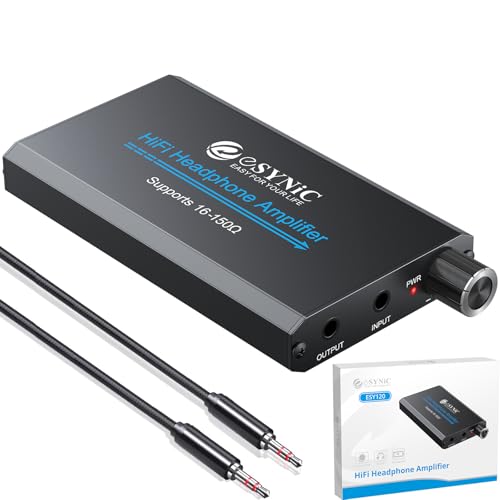
Best for: Users of wired headphones who want a portable amplifier with two-stage gain selection. eSynic lists a 16–150-ohm impedance range, a 3.5mm audio input and output, and low- and high-gain settings. Its guidance assigns low gain to 16–32-ohm earbuds and high gain to 50–150-ohm monitoring headphones.
The product has a metal case and a rechargeable 1,000mAh battery. Its listed playback time is more than eight hours at 30mW output into a 150-ohm load. The stated technical specifications include 0.0003% THD+N and a signal-to-noise ratio above 100dB.
Why it was selected: It offers a clearly described wired alternative for shoppers who need headphone amplification rather than wireless transmission. Its gain guidance can help buyers compare it with models that provide a broader stated impedance range.
Limitation: It does not list Bluetooth connectivity, so it will not make wired headphones wireless or send audio to Bluetooth headphones. Its stated impedance range tops out at 150 ohms.
Buying Guide: How To Choose A Headphone Amplifier
Do you want to amplify wireless headphones or make wired headphones wireless?
Start by identifying which device should make the wireless connection. Most Bluetooth headphones already contain their own amplifier and connect directly to a phone, computer, or other Bluetooth source. An external headphone amplifier generally connects to wired headphones. A Bluetooth receiver such as the FiiO BTR11 accepts wireless audio from a source and outputs it to wired headphones; it does not transmit sound to Bluetooth headphones.
If your goal is to use existing Bluetooth headphones with a television, stereo, or other wired audio source, look for a Bluetooth transmitter with the correct input. None of the listed general-purpose wired headphone amps is identified as a transmitter for Bluetooth headphones. For a guitar setup, the Spark NEO is a separate category: it is a wireless guitar headphone system with its own transmitter.
What will you connect: a phone, computer, or instrument?
For a phone or other Bluetooth audio source paired with wired headphones, consider a Bluetooth receiver with a headphone output. For a computer, laptop, or controller with a 3.5mm output, a wired amplifier may be more appropriate if your headphones need additional drive or you want gain and bass controls.
Musicians should prioritize the instrument connection. Spark NEO is designed for electric, acoustic, and bass guitars, with a 1/4-inch input and wireless transmitter. A standard headphone amplifier designed for phone or computer audio should not be assumed to support an instrument input.
How should you compare impedance and gain?
Check your headphone’s impedance in its specifications, then compare it with the amplifier’s stated range and gain options. The YGiTK Bluetooth model lists 16–600 ohms, while the eSynic model lists 16–150 ohms and describes low- and high-gain use. These figures are product specifications, not a guarantee that every headphone will perform identically. Source output, headphone sensitivity, and listening level also matter.
A gain switch changes the amplifier’s output setting; it is not a wireless feature. Use the setting recommended for your headphones when available, and begin at a low volume when connecting equipment.
Which features matter for daily use?
- Connection type: Confirm whether the device has Bluetooth input, Bluetooth transmission, a 3.5mm output, or an instrument input.
- Battery runtime: Compare the stated runtime with your typical listening or practice session. Listed figures can depend on operating conditions.
- Controls: Bass adjustment and gain selection can offer more control, but are not necessary for every listener.
- Portability: A lightweight receiver with a clip or lanyard may be convenient for mobile use. A larger dedicated guitar system serves a different purpose.
- Headphone compatibility: Check connector type, impedance, and whether your headphones are wired or Bluetooth.
Is a headphone amplifier necessary?
Not always. If your wired headphones reach a comfortable listening level from your device and sound appropriate for your use, an external amplifier may not be needed. An amplifier is more relevant when a compatible wired headphone setup requires a separate amplification stage or when you need features such as gain selection or bass control. It will not automatically improve every headphone or audio source.
Frequently Asked Questions
Can an amplifier connect directly to Bluetooth headphones?
Only if it specifically supports Bluetooth transmission to headphones. A Bluetooth receiver instead takes audio from a wireless source and sends it to wired headphones. Check the product’s direction of Bluetooth connectivity before buying.
Can the FiiO BTR11 make wired headphones wireless?
Yes, in the sense that it receives Bluetooth audio from a source and connects to wired headphones through its 3.5mm output. It does not make wired headphones themselves Bluetooth devices, and it is not described as a transmitter for Bluetooth headphones.
Is the Positive Grid Spark NEO a regular headphone amplifier?
It is a wireless headphone system intended for guitar practice. It includes headphones and a wireless transmitter, plus a built-in 1/4-inch input and app-based tools. It is not the same type of product as a general Bluetooth receiver for music listening.
What impedance range should I choose?
Compare the amplifier’s stated range and gain guidance with your headphone specifications. The products listed here cover different ranges, and performance can also depend on headphone sensitivity, source, and listening conditions.
Will a wired headphone amplifier work with Bluetooth headphones?
Not by itself in most cases. A conventional headphone amplifier uses a physical output connection for wired headphones. To use Bluetooth headphones with a wired source, look for a Bluetooth transmitter that supports the source’s output connection.