
A cheap MIDI pad controller can make beat programming and hands-on music production more accessible without requiring a large control surface. The Akai LPD8 is best for a compact setup with assignable knobs, while the Donner STARRYPAD MINI offers 16 pads and included learning resources. The JP-1 suits buyers seeking wireless connection, the EMP16 adds Bluetooth and MIDI In/Out, and the Akai APC Mini MK2 is better for Ableton Live workflows that benefit from a larger grid and faders.
| Controller | Best For | Standout Listed Features |
|---|---|---|
| Akai Professional LPD8 | Compact beat making | 8 RGB pads, 8 assignable knobs |
| Donner STARRYPAD MINI | Beginners and learning | 16 pads, Note Repeat, 40 courses |
| JP-1 | Wireless-focused setups | 16 RGB pads, wireless connection |
| EMP16 | More performance controls | 16 velocity-sensitive pads, MIDI In/Out |
| Akai APC Mini MK2 | Ableton Live and clip control | 64 RGB pads, 9 faders |
Akai Professional LPD8

The Akai Professional LPD8 is a compact USB MIDI pad controller with eight RGB MPC drum pads and eight assignable knobs. Its small control set makes it a straightforward choice for producers who want to trigger sounds and adjust mapped parameters without setting aside space for a large grid.
Best for: Beat makers who prioritize a portable, simple setup and want knobs as well as pads. The eight assignable knobs can provide hands-on control of parameters configured in a compatible production workflow. The product listing describes the controller as having universal DAW compatibility.
Why it stands out: It combines pads and knobs in a compact format. That may be a better fit than a larger controller when desk space and a focused set of controls matter more than having many trigger points.
Consideration: It has eight pads, fewer than the 16-pad models in this guide. Choose another option if a larger pad layout is a priority.
Donner STARRYPAD MINI

The Donner STARRYPAD MINI is a portable USB MIDI pad controller with 16 beat pads and a Note Repeat feature. Its product name also lists included music production software and 40 courses, making it a practical option for buyers who want a pad controller alongside beginner-oriented learning material.
Best for: New beat makers who want 16 pads and structured resources as part of the package. Note Repeat is a listed feature for creating repeated-note patterns, while the larger pad count offers more trigger positions than an eight-pad controller.
Why it stands out: The combination of a 16-pad layout, Note Repeat, included software, and 40 courses distinguishes it from models focused mainly on wireless operation or extensive performance controls. It can suit a buyer building a first beat-making setup.
Consideration: The listing identifies this as a mini controller. Buyers who want a large control surface or a specific set of knobs and faders should compare layouts before choosing.
JP-1 Wireless MIDI Pad Controller

The JP-1 is a portable MIDI pad controller listing 16 RGB beat pads and a wireless connection. Its product description presents it for music production, finger drumming, sampling, and looping on a laptop, tablet, or phone.
Best for: Buyers who want a 16-pad controller and value the listed wireless connection. It is also described for beginners, so it may be worth considering for someone exploring beat production or finger drumming across the devices named in the listing.
Why it stands out: The wireless feature separates it from the USB-focused Donner and LPD8 descriptions. The RGB pads provide a visual element, and the listed use cases cover several common beat-making activities.
Consideration: The product details provided do not specify wireless protocol, power requirements, or connection setup. Confirm those specifics in the full listing if they are essential to your intended device or workflow.
EMP16 MIDI Pad Controller
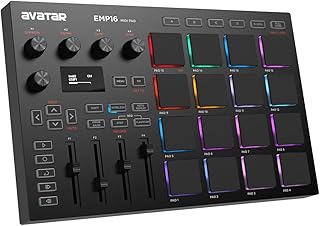
The EMP16 combines 16 RGB velocity-sensitive beat pads with Bluetooth, an OLED display, and MIDI In/Out. Its listed controls also include 16 Level and Full/Half Level modes, giving it a more feature-focused profile than a basic pad-only controller.
Best for: Producers who want velocity-sensitive pads and additional listed control modes. The OLED display and MIDI In/Out may also appeal to buyers who specifically need those features in their controller setup.
Why it stands out: Among these five options, the EMP16 explicitly lists Bluetooth alongside MIDI In/Out and performance functions such as 16 Level and Full/Half Level. That makes it a candidate for buyers comparing more than pad count alone.
Consideration: The available product details do not explain how Bluetooth works with particular devices or software. Verify connection requirements and compatibility details before relying on those functions.
Akai Professional APC Mini MK2

The Akai Professional APC Mini MK2 is a USB MIDI controller with 64 RGB pads, nine faders, Drum and Note modes, and 1:1 mapping for Ableton Live. Its larger grid and faders make it different from compact controllers designed primarily around a small set of drum pads.
Best for: Ableton Live users seeking a grid-based controller for live performance and music production. The listing specifically names 1:1 mapping for Ableton Live, while the 64 pads and nine faders provide a larger control layout.
Why it stands out: It has the most pads in this selection and includes faders, Drum mode, and Note mode. Choose it if those controls and its stated Ableton Live mapping match your workflow.
Consideration: Its large grid may be more than a buyer needs for basic drum triggering. The named 1:1 mapping is for Ableton Live, so buyers using other software should verify their desired control setup.
Buying Guide: How To Choose A Cheap MIDI Pad Controller
Compare the controller’s layout and connection features with the way you plan to make music. A low-cost controller is only useful if its pads, controls, and connection method suit your software and setup. Product descriptions do not always provide complete compatibility or setup details, so check the manufacturer or full product listing for specifics that matter to you.
How many pads do you need?
An eight-pad controller such as the LPD8 can be enough for a compact setup focused on triggering a limited selection of sounds. A 16-pad layout offers more physical trigger positions, which may be useful for assigning a broader set of samples or sounds. The APC Mini MK2’s 64-pad grid is a larger format intended for a broader control surface, rather than simply providing a few drum triggers.
More pads do not automatically make a controller the better choice. Consider whether you have a use for the extra layout and whether it fits your available desk or performance space. If you mainly want a small number of drum sounds and knobs, a compact model may be more practical.
Do velocity sensitivity and performance modes matter?
Velocity sensitivity is explicitly listed for the EMP16. This feature is relevant to buyers who want pad strikes to provide velocity information to their music software. The EMP16 also lists 16 Level and Full/Half Level modes. Check the product details and your software documentation to understand how these functions fit your setup.
The Donner STARRYPAD MINI lists Note Repeat, which may be useful for producing repeated-note patterns. For the Akai APC Mini MK2, the named Drum and Note modes and Ableton Live mapping are key points to compare. Do not assume that similarly named controls operate identically across different models.
Should you choose wireless, Bluetooth, or USB?
Connection type affects setup and convenience. The LPD8 and APC Mini MK2 are described as USB controllers, while the JP-1 lists a wireless connection and the EMP16 lists Bluetooth as well as MIDI In/Out. Donner’s product name identifies it as a mini USB MIDI controller.
Wireless and Bluetooth details are not fully explained in the supplied product information. Before buying, check which connection methods the controller supports in practice, whether your intended computer or mobile device supports them, and whether any additional setup is required. Do not assume that a wireless feature means a particular range, battery life, or connection protocol unless the listing states it.
Which controller suits a beginner?
A beginner may prefer a simple layout, clear setup instructions, and access to learning material. The Donner STARRYPAD MINI is the only product in this selection whose name explicitly mentions included music production software and 40 courses. That makes it a relevant option for buyers who want learning resources included with their controller.
The JP-1 is also described as suitable for beginners and lists use cases such as finger drumming, sampling, and looping. Compare the resources and connection details with your needs rather than choosing solely based on a beginner label.
What should Ableton Live users compare?
The Akai APC Mini MK2 explicitly lists 1:1 mapping for Ableton Live, along with 64 RGB pads and nine faders. Those details make it the clearest fit in this group for a buyer prioritizing the named Ableton Live mapping and a large grid.
If you use another DAW, confirm how the controller maps to that software before purchasing. The LPD8 is described as having universal DAW compatibility, but buyers should still verify the functions and setup supported by their specific software.
How important are knobs, faders, and displays?
Pad count is only one part of a controller’s layout. The LPD8 lists eight assignable knobs for controlling mapped parameters. The APC Mini MK2 lists nine faders. The EMP16 lists an OLED display. These features can be useful when your workflow calls for more than triggering notes, but they add little value if you do not plan to use them.
Make a short list of the actions you want to control directly, such as triggering sounds, adjusting parameters, or working with a larger grid. Then compare the listed controls against that list. This helps prevent paying attention to features that do not support your actual workflow.
Frequently Asked Questions
What is a MIDI pad controller used for?
A MIDI pad controller sends performance or control input to music software or compatible equipment. Producers commonly use pads to trigger drum sounds, samples, notes, or other assigned actions. The exact functions depend on the controller, software, and configuration.
Which controller in this selection has the most pads?
The Akai Professional APC Mini MK2 has 64 RGB pads. The Donner STARRYPAD MINI, JP-1, and EMP16 each list 16 pads, while the Akai Professional LPD8 lists eight.
Which option includes learning resources?
The Donner STARRYPAD MINI product name lists included music production software and 40 courses. Review the full product listing to confirm what the included resources contain.
Which controller lists Bluetooth?
The EMP16 lists Bluetooth and MIDI In/Out. The JP-1 lists a wireless connection, but its supplied product details do not identify the specific wireless technology.
Which option is specifically mapped for Ableton Live?
The Akai Professional APC Mini MK2 lists 1:1 mapping for Ableton Live. Buyers using a different DAW should confirm software support and mapping details for their intended workflow.