
The best wind-up emergency radio depends on whether you prioritize battery capacity, weather-band coverage, lighting, or a compact design. The FosPower A1 is a versatile pick with four power options and reading lights; the 12,000mAh solar crank radio is best for buyers who prioritize a larger stated battery capacity; and the Raynic adds shortwave reception and a headphone jack. The options below all combine hand-crank charging with emergency-radio functions, but their listed features differ.
| Radio | Best For | Listed Standout Features |
|---|---|---|
| FosPower A1 | Multiple power options and area lighting | 7,400mWh, four power options, SOS, reading lights |
| 12,000mAh Solar Radio | Higher stated battery capacity | AM/FM/NOAA, dual outputs, two-mode flashlight |
| Emgykit Hand Crank Radio | Basic emergency functions | 2,000mAh, solar and crank charging, three LED flashlights |
| Raynic Emergency Radio | Shortwave and headphone listening | 5,000mAh, AM/FM/SW/NOAA, headphone jack |
| Compact 2,000mAh Radio | Portable, straightforward use | USB-C charging, solar and crank power, LED flashlight |
FosPower A1 With Multiple Power Options

The FosPower A1 is best for households that want several ways to keep an emergency radio powered. Its listed options include solar power, hand cranking, and two additional power options; the product description identifies it as a four-power-option radio. It receives AM, FM, and weather-band broadcasts.
Its stated 7,400mWh capacity is paired with a power-bank function for charging a phone. Lighting includes an LED flashlight and four LED reading lights, while an SOS alarm adds another emergency feature. That combination makes this a practical choice for buyers who want radio, task lighting, and a phone-charging option in one device.
- Best for: Buyers who value multiple power methods and several light sources.
- Why it stands out: It combines weather-band reception, a power bank, an SOS alarm, and four reading lights.
- Limitation: The listed information does not specify operating time per charge or the output capacity available for phone charging.
Choose this if having more than one type of light and several power options matters more than choosing a model based on the largest stated battery capacity.
12,000mAh Solar Hand-Crank Radio
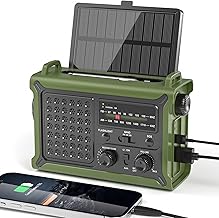
This radio is best for shoppers comparing products by stated battery capacity. Its description lists a 12,000mAh battery and AM, FM, and NOAA weather radio reception. It also includes a solar panel, hand-crank charging, and a battery-operated power option, though the product information provided does not explain the details of that battery option.
The radio has a two-mode LED flashlight and dual outputs for charging devices. Those outputs may be useful when more than one charging connection is needed, but the listing does not establish how quickly a phone can be charged or how many full charges the radio can provide. Its “clear signal” wording is part of the product name, not a measurable reception guarantee.
- Best for: Buyers who want a higher stated capacity and dual charging outputs.
- Why it stands out: The 12,000mAh specification is higher than the stated capacities of the other listed models.
- Limitation: The provided product details do not give battery runtime, charging speeds, or the specific meaning of its battery-operated option.
Choose this if the stated capacity and dual outputs are priorities. Compare the complete manufacturer details before relying on it to keep a particular phone charged during an outage.
Emgykit Radio With Three LED Flashlights

The Emgykit is best for buyers seeking a compact feature set centered on weather information, lighting, and emergency signaling. It receives AM, FM, and NOAA weather-band broadcasts and lists both solar and hand-crank power. Its stated battery capacity is 2,000mAh, or 7,400mWh.
For visibility, the product name specifies three LED flashlights. It also lists an SOS function and describes the radio as a charger for power outages. These features make it a straightforward option for someone who wants a radio with lighting and signaling without selecting a model primarily for a larger battery capacity or extra reception bands.
- Best for: Buyers who want AM/FM/NOAA reception, solar and crank power, and multiple flashlight LEDs.
- Why it stands out: Its listed emergency functions include three LED flashlights and SOS signaling.
- Limitation: The listed battery capacity is 2,000mAh; the provided details do not state runtime or phone-charging performance.
Choose this if its combination of basic radio, light, and SOS features matches your needs. If battery capacity is your main comparison point, review the higher-capacity options as well.
Raynic Radio With Shortwave And Headphone Jack

The Raynic is best for buyers who want shortwave reception in addition to AM, FM, and NOAA weather alerts. The product description lists a 5,000mAh battery and identifies the radio as solar-powered and hand-crank powered. It also includes a headphone jack, which provides a listed option for private listening.
For emergencies, the Raynic includes a cell-phone charger, flashlight, and SOS siren. Its broader range of named radio bands differentiates it from the models in this group that list only AM, FM, and NOAA reception. The headphone jack may also be useful when a listener wants to avoid playing audio through the radio speaker.
- Best for: Buyers who specifically want shortwave reception and a headphone jack.
- Why it stands out: It lists AM/FM/SW/NOAA, along with a flashlight, phone charger, and SOS siren.
- Limitation: Its stated 5,000mAh capacity is below the 12,000mAh figure listed for one alternative; runtime is not provided.
Choose this if shortwave and private listening matter. Avoid choosing it solely for the largest stated battery capacity in this selection.
Compact 2,000mAh Radio With USB-C

This model is best for buyers who want a lightweight, compact radio with a straightforward set of emergency features. Its product name lists a 2,000mAh battery, AM/FM/NOAA reception, an LED flashlight, solar power, and hand-crank power. It also identifies USB-C charging, which is a useful detail for buyers checking how the radio itself can be charged.
The listed features focus on essential functions rather than extras such as shortwave reception, a headphone jack, or multiple reading lights. The name describes it as a portable radio for power outages and emergencies. However, no measurements or weight are provided in the product information here, so shoppers should verify dimensions if packability is important.
- Best for: Buyers who prioritize a compact feature set and USB-C charging.
- Why it stands out: It combines AM/FM/NOAA reception with solar, hand-crank, and USB-C charging details.
- Limitation: Its stated capacity is 2,000mAh, and the listing details provided do not specify runtime or charging performance.
Choose this if a simpler emergency radio is more important than maximum listed capacity or extra listening features.
Buying Guide: How To Choose A Wind-Up Emergency Radio
Which radio bands do you need?
Start by checking the exact bands listed. Each of these five radios includes AM, FM, and NOAA weather-band reception in its product description. The Raynic additionally lists shortwave reception. If you are considering a radio for a particular information source, verify that the band and alert functions you need are explicitly listed rather than assuming all emergency radios offer the same coverage.
How should you compare battery capacity?
Battery figures are useful for comparing the stated specifications, but they do not by themselves establish how long a radio will run or how many times it can charge a phone. The products here list capacity in different units: several use mAh, while the FosPower and Emgykit descriptions also give 7,400mWh. Compare like units carefully, and consult the full product details for runtime and charging information when available.
Is hand-crank power enough?
A hand crank can provide a way to generate power without relying on a wall outlet, but the product details supplied here do not state how much listening or light time a particular cranking period provides. Consider hand cranking as one part of a broader power plan. Look for a model that also lists other methods, such as solar power or USB charging, if you want alternatives.
Before an emergency, learn how the radio is operated and check its charging process. Keep any required charging cables or batteries with your emergency supplies. Do not assume that a brief crank will fully recharge the radio or a connected phone unless the manufacturer provides that information.
Which lighting and alert features matter?
Lighting varies across these models. The FosPower lists an LED flashlight and four LED reading lights; the Emgykit lists three LED flashlights; the Raynic lists a flashlight and SOS siren. Other products list an LED flashlight, with the 12,000mAh model specifying two flashlight modes. Match the lighting setup to how you expect to use it, such as finding items or illuminating a small area.
An SOS alarm or siren can be a useful listed feature, but it is not a substitute for a broader emergency communication plan. Check the product’s controls and instructions so you know how to activate its alert function.
Do you need the radio to charge a phone?
Several models list a phone-charging or power-bank function, and the 12,000mAh radio lists dual outputs. These descriptions do not provide consistent charging-speed or phone-compatibility details. If phone charging is important, confirm the output specifications and charging method in the full listing, and consider whether preserving the radio’s charge for listening is more important during a prolonged outage.
What size and controls should you check?
Product names may describe a radio as compact or lightweight, but the details supplied for these products do not include dimensions or measured weight. Check those specifications if you plan to keep the radio in a go-bag, drawer, or vehicle kit. Also review controls, display information, and instructions when available. A feature is most useful when household members can identify and operate it quickly.
Frequently Asked Questions
What is a wind-up emergency radio?
A wind-up emergency radio uses a hand crank as one way to generate power for radio operation or other listed functions. Many models also include additional power methods, such as solar charging or USB charging.
Do these radios receive NOAA weather broadcasts?
All five products in this guide list NOAA or weather-band reception. Check each product’s full specifications for details about alert functions, reception, and operation.
Which listed radio has the largest stated battery capacity?
The solar hand-crank radio described as 12,000mAh has the largest stated capacity among these five products. Its listing details here do not specify runtime or the number of phone charges it can provide.
Which option lists shortwave reception?
The Raynic Emergency Radio lists AM, FM, shortwave, and NOAA alert reception. The other products in this selection do not list shortwave in their provided product names.
Can a hand-crank radio fully charge a phone?
The product details provided do not establish that any model can fully charge a specific phone. Check the radio’s output specifications and the manufacturer’s charging guidance before relying on it as a phone-charging source.
Is a solar panel a replacement for hand cranking?
Solar power provides another listed charging method on several models, but the provided descriptions do not state how quickly solar charging works or what conditions it requires. Compare the manufacturer’s instructions and treat solar and hand-crank power as separate options rather than assuming either will meet every power need.