
The best TRS-to-stereo cable depends on the connectors at both ends and whether you need to carry stereo audio or split it into two mono signals. For a 3.5mm stereo source feeding two 1/4-inch inputs, choose a breakout cable such as the Cable Matters or Tisino 3.5mm model. For a 1/4-inch stereo output feeding two 1/4-inch mono inputs, consider the Tisino 10-foot or Hosa insert cable. The Elebase cable is a single TRS-to-TRS lead, not a stereo breakout.
| Product | Best For | Connection Type |
|---|---|---|
| Tisino 1/8-inch to Dual 1/4-inch | Short phone or other 3.5mm source connections | 3.5mm TRS to two 1/4-inch TS |
| Cable Matters 3.5mm TRS to Dual 6.35mm | Longer 3.5mm-to-mixer runs | 3.5mm TRS to two 1/4-inch TS |
| Hosa STP-201RR | Compact 1/4-inch insert connections | 1/4-inch TRS to two 1/4-inch TS |
| Tisino 1/4-inch TRS to Dual 1/4-inch | Longer stereo breakouts | 1/4-inch TRS to two 1/4-inch TS |
| Elebase 1/4-inch TRS cable | Single TRS-to-TRS connections | 1/4-inch TRS to 1/4-inch TRS |
Tisino 3.5mm To Dual 1/4-Inch Cable

This 3.3-foot cable connects a 3.5mm TRS stereo output to two 1/4-inch TS mono plugs. Its split design is intended to route the left and right channels separately to equipment with two mono inputs. The listed construction details include gold-plated connectors and 20 AWG oxygen-free copper.
Best for: Someone connecting a phone or another device with a 3.5mm stereo output to a mixer, speaker, or amplifier that accepts separate 1/4-inch inputs. Choose this if you need a short breakout and the source and destination match those connector types. The short length may be limiting when the equipment is far apart.
Cable Matters 3.5mm To Dual 1/4-Inch Breakout
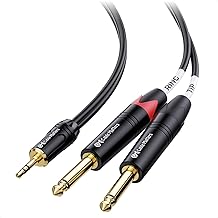
This six-foot breakout cable converts a 3.5mm TRS connection to two 6.35mm, or 1/4-inch, TS connectors. It is designed for splitting a stereo connection into two mono paths, such as left and right channels routed to separate inputs. The listed product name identifies the connector sizes and cable length; it does not specify additional construction features.
Best for: Buyers who need more reach than a short 3.3-foot cable provides and have a 3.5mm stereo output plus two 1/4-inch mono inputs. It is a better fit for a desktop or equipment setup where the source and mixer are farther apart. Avoid it if the destination requires one combined stereo 1/4-inch input rather than two separate mono inputs.
Hosa STP-201RR Right-Angle Insert Cable

The Hosa STP-201RR has a 1/4-inch TRS plug at one end and two right-angle 1/4-inch TS plugs at the other. Its listed length is 3.3 feet. This connector arrangement is commonly used as an insert cable, with the TRS end connecting to an insert jack and the two mono plugs carrying separate send and return paths.
Best for: Buyers whose equipment uses a 1/4-inch insert connection and who want a short cable with right-angle plugs on the split end. The right-angle design may suit a close, compact setup. It is not the right choice for a 3.5mm source, and the short cable may not suit equipment placed farther apart. Check the equipment’s insert wiring requirements before connecting.
Tisino 1/4-Inch TRS To Dual 1/4-Inch Cable

This 10-foot cable has one 1/4-inch TRS connector and two 1/4-inch TS connectors. The Y-splitter arrangement can separate a stereo signal from a 1/4-inch TRS output into two mono connections. Connector layout is the main deciding factor: this model starts with a 1/4-inch plug, unlike the 3.5mm breakout cables above.
Best for: Buyers who need to route a 1/4-inch stereo output to two 1/4-inch mono inputs and want a longer lead. Choose it over a 3.5mm splitter when the source has a quarter-inch output. The product information provided does not specify additional connector materials or shielding, so confirm that any special construction requirement is met before purchase.
Elebase 1/4-Inch TRS Instrument Cable

The Elebase listing describes two 10-foot cables with 1/4-inch TRS male connectors. It identifies uses with electric guitar, bass, keyboard, mixer, amplifier, speaker, and equalizer equipment. This is a single-cable TRS-to-TRS design rather than a Y-splitter, so it does not divide one stereo TRS plug into two separate TS plugs.
Best for: Buyers who need a pair of quarter-inch TRS-to-TRS leads for equipment with matching TRS connections. Its two-cable pack and 10-foot length distinguish it from the breakout options. Do not choose it if your goal is to separate left and right channels into two mono inputs.
Buying Guide: How To Choose A TRS To Stereo Cable
Do you need a stereo cable or a breakout cable?
A TRS connector has three contact points: tip, ring, and sleeve. Depending on how the equipment is designed, those contacts can carry left and right stereo audio or a balanced mono signal. The connector shape alone does not tell you how a particular device uses it. Check the source and destination labels or manuals before choosing a cable.
A TRS-to-dual-TS breakout cable has one TRS plug on one end and two TS plugs on the other. It is commonly used to separate stereo left and right channels into two mono connections. An insert cable can have the same broad connector pattern but serve a different purpose: connecting an equipment insert’s send and return paths. These uses are not automatically interchangeable.
Which connector sizes do your devices use?
Match the cable ends to the actual jacks. A 3.5mm plug is commonly called 1/8 inch, while 6.35mm is commonly called 1/4 inch. A 3.5mm-to-dual-1/4-inch cable is suitable only when the source has a 3.5mm output and the receiving equipment has two 1/4-inch inputs. A 1/4-inch TRS-to-dual-1/4-inch cable requires a quarter-inch source connection.
Also check whether the destination uses one stereo input or two separate mono inputs. A breakout cable gives you two plugs to connect independently. It does not turn two mono inputs into a single stereo input, and a straight TRS-to-TRS cable does not split the signal into separate plugs.
How much cable length is practical?
Choose a length that reaches between connected devices without leaving a large excess loop. The listed options include short 3.3-foot cables, a six-foot breakout, and 10-foot cables. A longer cable can make equipment placement easier, while a shorter cable can reduce slack in a compact setup. The cable length should be measured against the actual route, not just the straight-line distance.
What should you verify before ordering?
- Confirm whether the source output carries stereo audio, balanced mono, or an insert signal.
- Match the connector size at each end: 3.5mm or 1/4 inch.
- Check whether you need one TRS-to-TRS lead or one TRS-to-two-TS breakout.
- For a stereo breakout, identify which two inputs will receive the left and right channels.
- For an insert cable, verify the equipment’s send-and-return configuration and wiring needs.
- Consider the listed cable length and whether straight or right-angle plugs suit the space.
For a typical 3.5mm stereo output feeding two quarter-inch mono inputs, compare the Tisino short cable with the six-foot Cable Matters option based on reach. For a quarter-inch stereo output feeding two mono inputs, compare the 10-foot Tisino breakout with the short Hosa insert cable, while confirming the intended signal use. For a straight quarter-inch TRS connection, the Elebase cable is the relevant type, but it is not a stereo splitter.
Frequently Asked Questions
Does a TRS cable always carry stereo sound?
No. A TRS connector can carry stereo unbalanced audio, balanced mono audio, or another signal arrangement such as an insert send and return. Check the equipment documentation to confirm the signal type.
Can I use a TRS-to-dual-TS cable to split stereo?
Often, yes, when the source’s TRS output carries left and right stereo channels and the two TS plugs connect to separate mono inputs. Confirm the source’s output design and input requirements first.
Is a balanced TRS cable the same as a stereo cable?
No. Both can use TRS connectors, but a balanced connection uses the tip and ring for one audio signal’s two opposite-polarity legs. A stereo connection uses the tip and ring for left and right channels. The cable’s connector does not determine the device’s wiring.
What is the difference between 3.5mm and 1/4-inch TRS?
The primary difference is plug size: 3.5mm is smaller than 1/4 inch, or 6.35mm. They are not physically interchangeable without an adapter or a cable with the correct connectors.
Is the Elebase cable a stereo splitter?
No. The listed Elebase product is a 1/4-inch TRS-to-TRS cable. It has one plug at each end and is not described as a TRS-to-dual-TS breakout cable.