
The Gemini CDM-4000BT is the closest match for buyers seeking a twin CD player with a built-in mixer: it combines dual CD/USB decks, Bluetooth playback, and onboard mixing controls. The Gemini CDX-2250i is a better fit for people who want two CD/USB decks but already have a separate mixer. The other three products are individual media players, not complete twin-deck mixer systems, so they suit buyers building a modular setup.
| Product | Best suited for | Built-in mixer? |
|---|---|---|
| Gemini CDM-4000BT Bundle | All-in-one CD/USB DJ setup | Yes |
| Gemini CDX-2250i | Two CD/USB decks for a rack setup | No mixer stated |
| Gemini MDJ-600 | Single-deck CD/USB or MIDI use | No |
| Gemini MDJ-500 | Single USB deck or MIDI control | No |
| Gemini MDJ-900 | Advanced standalone USB playback | No |
Gemini CDM-4000BT Dual CD/USB Mixer Bundle

Best for: DJs who want a standalone twin-deck player and mixer in one rack-mountable unit. The CDM-4000BT is the most direct match here because its listed features include dual CD/USB decks and a central mixer section. It also supports Bluetooth streaming, so it offers another playback source in addition to discs and USB storage.
The mixer section includes two-band EQ, gain control, flexible connections, and a crossfader. Touch-sensitive jog wheels support searching, scratching, and pitch bending. Manual looping and variable pitch control are also listed. The bundle includes a wired handheld microphone and two cables, which may be useful for announcements or events where a microphone is needed.
Why it was selected: Unlike the standalone MDJ players, this is described as a complete, laptop-free DJ workstation with two decks and an onboard mixer. It is suited to mobile rigs, home DJ setups, and installations where an integrated layout is preferred.
Limitation: The bundle includes a microphone and cables, but buyers who only need a player may prefer a simpler package. Check the included connections and setup requirements against the rest of your equipment before purchasing.
Gemini CDX-2250i Dual CD And USB Player

Best for: DJs who need two playback decks in a rackmount format and already have a separate mixer. The listed product name describes a dual-deck CD and USB player in a two-by-two-rack-unit design. It also names jog wheels, looping, pitch bend, and an anti-shock RAM buffer.
This model is a better fit than a single-deck player when the goal is to control two playback sources from one unit. CD and USB support gives buyers format options for their music library. The jog wheels and pitch-bend functions are relevant for hands-on track adjustment, while looping can support repeated sections during a set.
Why it was selected: It is one of the few products in this group explicitly described as a dual-deck CD/USB player. That makes it relevant to a twin-player search, even though the listing does not describe a built-in mixer.
Limitation: Do not assume this is an all-in-one mixer system. The provided product information describes a player, so plan for a separate mixer if your setup requires one.
Gemini MDJ-600 CD/USB Standalone Player

Best for: DJs who want one CD/USB player with performance features, or who are assembling a modular system with multiple players and a separate mixer. This standalone model supports CD, CD-R, USB, and MIDI according to the product details. Its four hot cues, auto and manual looping, and Quantize mode provide direct access to playback tools.
Additional listed features include Vinyl, Slip, and Reverse modes, along with a selectable pitch range from plus or minus 4% to 100%. The listing identifies compatibility with VirtualDJ and Serato and mentions V-Case software. For mobile DJs, the option to play from discs or USB drives may provide useful format flexibility.
Why it was selected: The MDJ-600 offers more performance and format details than a basic single player, making it a useful comparison for buyers who may accept a modular setup rather than an integrated twin-deck mixer.
Limitation: It is a single standalone player, not a twin-deck unit or mixer. A second deck and a separate mixer may be needed for a conventional two-deck arrangement.
Gemini MDJ-500 USB And MIDI Player

Best for: Buyers who need a standalone USB media player or MIDI controller as one part of a larger DJ system. The product name identifies it as a USB and MIDI player and lists four hot cues, auto loops, a full-color display, and V-Case software.
Those features make the MDJ-500 relevant to DJs who want a dedicated hardware control surface and do not require disc playback from this unit. It can be considered alongside other modular players when building a setup around a separate mixer. Its role is different from the CDM-4000BT, which combines dual decks and a mixer in one system.
Why it was selected: It provides a lower-complexity comparison for shoppers considering whether they need a complete twin CD system or would rather add individual USB/MIDI players to an existing setup.
Limitation: The available product information does not list CD playback or a built-in mixer. It is not a direct substitute for a twin CD player mixer.
Gemini MDJ-900 Standalone USB Player
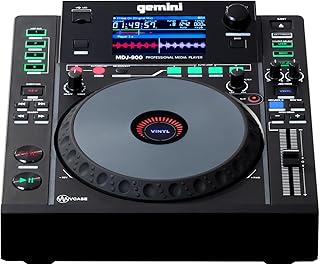
Best for: DJs seeking a standalone USB deck with a larger jog wheel and advanced controls, especially when developing a multi-player setup. The listed features include an eight-inch touch-sensitive jog wheel with adjustable tension, master and sync modes, and link capability for connecting up to four MDJ-900 units.
The MDJ-900 also lists four hot-cue pads, four auto-loop pads, manual looping, Quantize, Vinyl, Slip, and Reverse modes. Its full-color 4.3-inch display shows waveforms, BPM, pitch, and track information. These controls make it the most feature-rich individual player in this selection based on the supplied details.
Why it was selected: It is a useful option for buyers who prioritize jog-wheel control and multi-deck practice over an integrated CD player and mixer.
Limitation: It is a USB player rather than a twin CD system, and the listing does not describe a built-in mixer. Choose it only if that modular format fits your equipment plan.
Buying Guide: How To Choose A Twin CD Player Mixer
Do you need an integrated mixer?
Start by deciding whether you want one unit to handle playback and mixing. The CDM-4000BT is the clearest all-in-one option in this selection because its listed components include dual CD/USB decks and a central mixer. The CDX-2250i is a dual-deck player, but the supplied product information does not identify an onboard mixer. The MDJ models are individual players, so they are better suited to modular systems.
If you already own a mixer, a standalone player may be appropriate. If you are buying a first DJ setup, confirm that your chosen equipment includes the mixer functions you need, such as channel controls and a crossfader. Do not treat “dual player” and “player mixer” as interchangeable descriptions.
Should you choose CD, USB, or both?
Choose based on the media you actually use. The CDM-4000BT and CDX-2250i are described as supporting both CD and USB playback. The MDJ-600 also lists CD and USB support, while the MDJ-500 and MDJ-900 are described as USB players. CD support matters if your music collection or backup workflow relies on discs; USB-only models may suit buyers who organize their libraries on storage drives.
Check the exact media formats and file requirements in the product documentation before buying. The supplied descriptions do not provide a complete list of supported audio formats or USB-drive specifications.
What controls matter for your mixing style?
Jog wheels, pitch adjustment, looping, and cue controls can affect how much hands-on control a player provides. The CDX-2250i lists jog wheels, loops, and pitch bend. The MDJ-600 lists hot cues, looping, Quantize, and additional performance modes. The MDJ-900 emphasizes its eight-inch jog wheel, adjustable tension, display information, and multi-player link features.
For a simpler setup, prioritize the playback formats and mixer layout before advanced performance controls. For practice or performance that relies on cue points and loops, compare the specific controls listed for each unit.
How important is portability and rack fit?
The CDX-2250i is identified as a two-by-two-rack-unit player, and the CDM-4000BT is described as rack-mountable. These details may matter for a mobile rig or a fixed rack installation. The MDJ-600 is described as compact, but the available information does not give measurements. Confirm dimensions, mounting needs, and transport-case fit before ordering.
What connections and accessories should you verify?
Review the product’s inputs, outputs, power requirements, and included cables against your mixer, speakers, and other equipment. The CDM-4000BT bundle lists two RCA cables, a power cable, a wired microphone, and two microphone cables. Do not assume the other products include cables or accessories unless their listing states so. Also verify whether your planned system needs a separate mixer, headphones, or additional audio cables.
Frequently Asked Questions
Which product here has a built-in mixer?
The Gemini CDM-4000BT is the product described with a central mixer section and dual CD/USB decks. The CDX-2250i is listed as a dual-deck player, but the supplied details do not state that it includes a mixer.
Is the Gemini CDX-2250i a complete twin CD player mixer?
It is described as a dual-deck CD/USB player with jog wheels, looping, and pitch bend. The supplied product information does not identify a built-in mixer, so buyers should plan for a separate mixer unless the full listing confirms otherwise.
Can the MDJ-600 play CDs?
Yes. Its listed features describe CD and CD-R playback as well as USB playback. It is a single player, not a twin-deck mixer.
Which option is best for a USB-only setup?
The MDJ-500 and MDJ-900 are described as USB players. The MDJ-900 lists an eight-inch jog wheel and multi-player link features, while the MDJ-500 lists MIDI use, hot cues, auto loops, and a full-color display.
What should I buy if I already own a mixer?
Consider a standalone player or dual-deck player based on your media needs. The CDX-2250i provides two CD/USB decks, while the MDJ models are individual players with different USB, MIDI, and performance features.