
The best 5-pin DIN to 1/4-inch jack option depends on connector gender, plug angle, and the audio equipment’s wiring—not just the connector size. The Seadream female-to-male cables suit setups needing a DIN socket, while the Seadream male-to-male and Sanpyl cable suit equipment with a DIN socket input. Check your devices’ manuals before buying: a 5-pin DIN plug can carry different signals, and a connector that physically fits may not provide the connection you need.
| Product | Connector configuration | Best for |
|---|---|---|
| Seadream 30cm adapter | DIN female to 1/4-inch male | Short connection with a straight plug |
| Seadream 8-inch angled cable | DIN male to 1/4-inch male | Male DIN connection and tight spaces |
| Seadream angled adapter | DIN female to angled 1/4-inch male | Female DIN connection with reduced plug protrusion |
| Sanpyl angled cable | DIN male to 1/4-inch male | Connecting listed audio equipment with a right-angle plug |
| SinLoon 0.5m cable | DIN male to 3.5mm male | An alternative only when the device has a 3.5mm jack |
Seadream 30cm DIN Female Adapter Cable
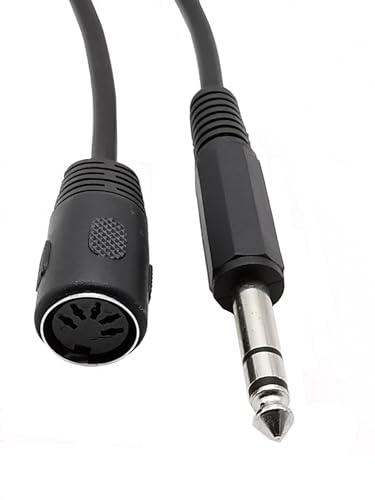
This Seadream cable has a 5-pin DIN female socket on one end and a 6.35mm (1/4-inch) male plug on the other. At 30cm, it is a short adapter-style cable for a setup where the existing cable or device has a male DIN plug and the destination accepts a 1/4-inch jack.
Best for: Buyers who need a DIN socket rather than a DIN plug, and prefer a straight 1/4-inch connector. The listed features include double shielding, a pure copper core, and a tight-fitting connection intended to support signal transmission.
Consider: The short length limits how far apart the connected devices can be. Confirm that your equipment’s required DIN wiring and signal type match; connector shape alone does not confirm compatibility.
Seadream 8-Inch Angled DIN Cable

This cable pairs a 5-pin DIN male connector with a 6.35mm (1/4-inch) male plug. Its 1/4-inch end has a 90-degree angle, and the listed length is 8 inches. The manufacturer describes it for connecting professional audio equipment with a 1/4-inch interface to MIDI-interface equipment and instruments.
Best for: A setup requiring male connectors at both ends, especially when a straight 1/4-inch plug would stick out too far. The angled design can help keep the cable close to the device and reduce strain from an extended plug.
The product listing also identifies a nickel-plated plug and states compatibility with MIDI standards. Those details do not establish that every device using a 5-pin DIN connector shares the same audio wiring.
Consider: The 8-inch length is best suited to nearby equipment. Avoid choosing it if you need a DIN female socket or a longer cable run.
Seadream Angled DIN Female Adapter

This Seadream adapter has a 5-pin DIN female socket and a right-angle 6.35mm (1/4-inch) male plug. It is a useful configuration to compare with the straight-plug Seadream adapter: both provide a DIN female end, but this model turns the 1/4-inch connector to the side.
Best for: Buyers who need a DIN female connection and want the 1/4-inch plug to sit closer to the equipment. Its listed features include double shielding, a pure copper core, and a snug connection.
Consider: The angled connector changes the direction the cable exits, so check the available space and jack orientation before ordering. The provided information does not state a cable length; confirm the listing details if reach is important.
Sanpyl Right-Angle DIN Cable

The Sanpyl cable has a 6.35mm (1/4-inch) male connector and a 5-pin DIN male connector. The listing describes a 90-degree right-angle design and names speakers, amplifiers, mixers, recorders, MIDI keyboards, synthesizers, organs, electric pianos, and guitars among the equipment it is intended to connect.
Best for: Buyers whose devices require male connectors at both ends and who want a right-angle 1/4-inch plug. It is a direct configuration match for setups with a 1/4-inch jack on one device and a 5-pin DIN socket on the other, provided the signal wiring is suitable.
Consider: The product information does not specify the cable length or shielding. Check those details in the listing if your installation has a particular reach or noise-control requirement.
SinLoon Short DIN-to-3.5mm Cable

This SinLoon cable is not a 1/4-inch jack cable. It has a 5-pin DIN male connector and a 3.5mm (1/8-inch) TRS stereo male connector, with a listed length of 0.5m. It is included as a useful alternative for readers whose device has a small 3.5mm stereo output rather than a 6.35mm jack.
Best for: Connecting a device with a standard 3.5mm stereo output to compatible 5-pin DIN audio equipment. The listing mentions older European DIN audio equipment and B&O systems, as well as a flexible PVC jacket and nickel-plated shielding.
Consider: Do not choose this cable if your equipment has a 1/4-inch jack. A 3.5mm connector is smaller, and this product is not a substitute for the other cables in this guide without an appropriate connection solution.
Buying Guide: How to Choose a 5-Pin DIN to 1/4-Inch Cable
Which connector genders do your devices require?
Check both device ports before selecting a cable. A male connector plugs into a socket; a female connector receives a plug. The products here include DIN male-to-1/4-inch male cables and DIN female-to-1/4-inch male adapters. A mismatch at either end means the cable will not connect directly.
Write down the port type on each device, rather than relying on a cable description such as “DIN to jack.” That shorthand does not specify whether the DIN end is male or female. Also verify whether a device has a 6.35mm (1/4-inch) or 3.5mm (1/8-inch) jack; they are different sizes.
Does 5-pin DIN mean the cable carries MIDI or stereo audio?
No. A 5-pin DIN connector describes the physical connector, not necessarily the signal or pin assignment. DIN connectors appear in different applications, including MIDI and older audio equipment. A cable described as compatible with MIDI standards should not automatically be treated as an audio cable for any DIN-equipped device.
Consult the equipment manuals or manufacturer documentation for the intended signal and wiring. Confirm that the cable is designed for that use before connecting audio sources, instruments, or recording equipment. Correct connector gender and size are necessary, but they do not guarantee electrical compatibility.
Should you choose a straight or right-angle 1/4-inch plug?
A straight plug may be appropriate when the jack has clear space and the cable needs to extend outward. A right-angle plug turns the cable along the side of the device. That can reduce how far the connector protrudes, which is useful around closely placed equipment or rear panels with limited clearance.
Check the jack’s direction and nearby obstructions. A right-angle connector can be less convenient if the cable needs to exit in the opposite direction or if the device’s layout blocks the cable path.
How much cable length do you need?
Choose a length that reaches between the devices without pulling at the connectors. The Seadream adapter listed at 30cm and the angled cable listed at 8 inches are intended for short connections. The SinLoon 3.5mm alternative is listed at 0.5m, but it does not have a 1/4-inch plug.
Two of the listed products do not specify length in the supplied product features. Check the current product listing for dimensions before buying if distance matters. Avoid assuming that a short adapter will provide the reach of a full-length cable.
What construction details matter?
Look for features that match your needs, such as shielding, connector plating, and a stated cable length. The Seadream female-to-1/4-inch products list double shielding and a pure copper core. The Seadream male-to-male cable lists a nickel-plated plug. The SinLoon alternative lists nickel-plated shielding and a flexible PVC jacket.
These descriptions help compare the listed construction, but they do not replace checking signal compatibility or installation requirements. If the cable will be routed near power supplies or other audio cables, confirm that its construction and intended use suit your setup.
Frequently Asked Questions
Can I connect a 5-pin DIN device directly to a 1/4-inch jack?
Yes, if the cable has the correct connector genders and its wiring supports the signal used by both devices. Check the manuals or documentation for the equipment; physical fit alone does not confirm compatibility.
Are 5-pin DIN and MIDI cables interchangeable with audio cables?
Not necessarily. Both may use a 5-pin DIN connector, but the intended signals and wiring can differ. Confirm the cable’s specific application and the devices’ pin assignments before use.
Is a 6.35mm jack the same as a 1/4-inch jack?
Yes. In common product descriptions, 6.35mm is the metric size for a 1/4-inch audio jack. A 3.5mm (1/8-inch) jack is smaller and is not the same connector.
Which option has a DIN female connector?
The two Seadream female-to-1/4-inch adapter cables listed above have a 5-pin DIN female socket. One has a straight 1/4-inch plug and the other has a right-angle 1/4-inch plug.
What if my device has a 3.5mm output instead of a 1/4-inch output?
The SinLoon product listed here has a 3.5mm TRS male connector, but it is not a 1/4-inch cable. Confirm the DIN-side connection and signal wiring are also suitable for your equipment.