
The best headset for a fitness instructor depends on the audio setup and workout environment. The Shure BLX14/SM31 is a complete wireless system for instructors seeking a dedicated headset and receiver; the KIMAFUN GWP91 is designed for sweat and water exposure; and the Samson Airline XDm offers a bodypack-free design. The other picks suit instructors who need a headset mic with adapters or a two-person wireless setup.
| Product | Best For | Key Difference |
|---|---|---|
| Shure BLX14/SM31 | Complete wireless setup | Includes headset, transmitter, and receiver |
| KIMAFUN GWP91 | Water-based and sweaty classes | IP67 waterproof rating listed |
| KIMAFUN G100-1 | Multiple audio connections | Includes phone and 1/4-inch adapters |
| Samson Airline XDm | Movement without a bodypack | Transmitter integrated into headset |
| MICVISTA Dual Wireless System | Two instructors or presenters | Supports two microphones at once |
Shure BLX14/SM31 Wireless Fitness System

Best for: Fitness instructors who want a bundled wireless headset system rather than sourcing a microphone, transmitter, and receiver separately. This Shure package includes the SM31FH fitness headset microphone, BLX1 bodypack transmitter, and BLX4 single-channel receiver.
The listed system operates in the H9 UHF band, from 512 to 542 MHz. Its stated transmission range is up to approximately 300 feet line-of-sight. The bodypack transmitter can run for up to 14 hours on two AA batteries under typical conditions. The package also lists a power supply, batteries, clothing clip, windscreen, and user guide.
Choose this system if your class space needs wireless movement and you want the core components together. The SM31FH is designed for fitness use, with a weather-resistant construction and a lightweight wireframe fit. The stated range is line-of-sight, not a guarantee for every gym layout.
Limitation: Check that the H9 frequency band is authorized for use in your location before ordering. The system also requires a receiver connection to your sound equipment.
KIMAFUN GWP91 IP67 Wireless Headset

Best for: Water aerobics instructors, swimming coaches, and fitness teachers who expect regular exposure to sweat or moisture. KIMAFUN lists an IP67 waterproof rating and describes the microphone shell as resistant to sweat, moisture, and dust.
The 2.4 GHz wireless headset has a secure-fit design intended to stay in place during high-impact activity. Its listed weight is 0.1 pounds, and detachable waterproof microphone heads are included for replacement. The product is presented for fitness, yoga, spinning, swimming instruction, teaching, and other active use.
Choose this model if moisture resistance and freedom from a headset cable are higher priorities than a wired connection. Its lightweight design may also suit instructors who move around the room while giving cues.
Limitation: The product information does not specify the receiver’s connection types or operating range. Confirm that the included system connects to your speaker or audio equipment before buying, especially for a pool or studio installation.
KIMAFUN G100-1 Wireless Headset Microphone
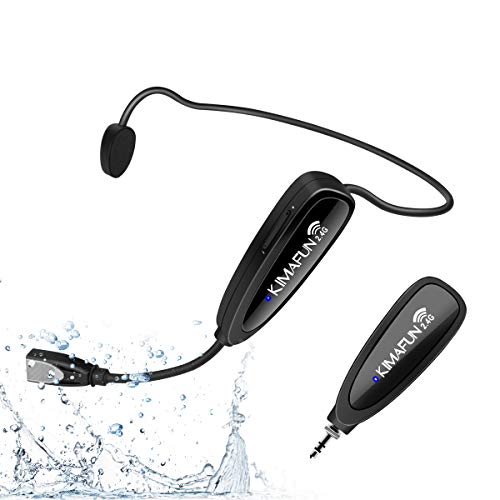
Best for: Instructors who need a wireless headset with several listed connection options. The G100-1 includes a phone adapter for Android phones and iPhones and a 6.35 mm, or 1/4-inch, adapter for a voice amplifier, audio mixer, or outdoor speaker.
KIMAFUN describes the headset as sweatproof and waterproof, with a dust-proof, corrosion-resistant microphone shell and a waterproof condenser. Its ergonomic design is intended to fit securely during movement, dancing, and high-impact activity. The 2.4 GHz wireless connection is described as automatically connecting within about two seconds.
Choose this option if you want the listed adapters for connecting with a phone or compatible audio equipment. It is also a practical choice for instructors who record audio or video using a phone, provided the appropriate adapter and device connection are used.
Limitation: A USB sound card is required for use with a laptop or desktop computer, according to the product details. Check the supplied adapter and your device’s input requirements before relying on it for class.
Samson Airline XDm Fitness Headset System

Best for: Instructors who want to avoid wearing a separate bodypack transmitter. Samson integrates its AHD wireless transmitter into the headset, giving the user a bodypack-free setup and access to gain and mute controls on the headset.
The system includes a compact RXD1M desktop receiver with XLR, 1/4-inch, and 1/8-inch outputs. One-touch pairing is listed as a setup feature. The rechargeable lithium-ion battery is stated to provide up to six hours of use on a full charge.
Choose this headset if a bodypack and cable could get in the way during demonstrations or movement. Its receiver’s multiple output formats may help when connecting to different audio rigs, as long as the destination equipment accepts one of the listed connections.
Limitation: The stated maximum battery life is six hours, so instructors with longer teaching days may need to plan charging between sessions. The available product details do not list a wireless range.
MICVISTA Dual Wireless Headset Microphones

Best for: Classes or demonstrations where two people need to speak through the same audio setup. The system pairs two transmitters with one receiver, and the product details say both microphones can be used at the same time or just one can be used.
This 2.4 GHz system includes 3.5 mm and 6.35 mm audio jack support, with the corresponding adapters listed for use with portable PA systems, voice amplifiers, mixers, speakers, and other compatible equipment. The stated transmission distance is up to 160 feet in an open area. The setup process is described as pairing the transmitter and receiver using their power switches.
Choose MICVISTA if a co-instructor, guest speaker, or partner needs a microphone as well. It can also be used with one headset when only one speaker is needed.
Limitation: The stated 160-foot distance applies to an open area and may not reflect performance in a crowded or obstructed gym. Confirm that your speaker has a compatible microphone input.
Buying Guide: How To Choose A Fitness Instructor Headset
Do you need a complete wireless system or just a headset mic?
A headset microphone may be only one part of an audio setup. A wireless system typically requires a microphone, a transmitter, and a receiver that can connect to the speaker or amplifier. The Shure BLX14/SM31 lists all three core components. By contrast, a microphone designed to plug into a bodypack transmitter needs a compatible wireless system that you may already own.
Before choosing, identify the equipment already in your studio. Check whether it accepts a microphone input and whether that input is 3.5 mm, 1/4-inch, XLR, or another format. An adapter can help only when it matches the connection and signal requirements of the devices.
Will the headset handle sweat or water exposure?
For ordinary indoor classes, sweat resistance may be a useful feature because the microphone sits close to the instructor’s face. For water aerobics or poolside coaching, prioritize products that specifically describe waterproofing and confirm how the rating applies to the full system. The KIMAFUN GWP91 lists IP67 protection; do not assume that other products have the same rating simply because they are described as sweatproof.
Also consider how the microphone will be cleaned and maintained. Follow the product’s own care instructions, particularly for removable microphone heads or components exposed to moisture.
How much movement and wireless freedom do you need?
A secure, lightweight headset can be helpful when demonstrating exercises, walking around a studio, or moving at a fast pace. Wireless systems avoid a cable running from the microphone to the audio equipment. A bodypack system still requires the transmitter to be worn, while the Samson Airline XDm integrates the transmitter into its headset.
For a large room, compare the listed transmission range with your teaching area, but treat range figures as conditions-dependent. The Shure system lists a line-of-sight range, and MICVISTA specifies an open-area range. Walls, equipment, and other obstructions can affect real-world use.
Do you teach alone or with another speaker?
A single-channel system is suitable when one instructor speaks at a time. If a second instructor or presenter needs to speak through the same sound system, a dual-transmitter product such as MICVISTA may be more appropriate. Check whether both transmitters can be used simultaneously and whether the receiver has a compatible output for the room’s audio equipment.
What should you check before ordering?
- Connections: Match the receiver or microphone output to your amplifier, PA system, mixer, phone, or recording device.
- Frequency band: For UHF systems, verify that the listed band is authorized for your location.
- Battery plan: Compare stated operating time with your class schedule and consider how the system is powered or recharged.
- Fit: Look for a headset designed to remain stable during movement, and check whether its microphone position can suit your speaking style.
- Moisture exposure: Choose based on the actual environment, especially for water-based classes, rather than relying on general fitness-use wording.
- Room size: Compare the stated wireless range with your space while allowing for obstructions and other conditions.
Frequently Asked Questions
What type of microphone is best for a fitness instructor?
A lightweight headset microphone is a common choice because it keeps the microphone near the instructor’s mouth while leaving the hands free. The right option depends on sweat exposure, wireless needs, fit, and compatibility with the room’s sound system.
Can I connect any fitness headset microphone to a speaker?
No. Some headset microphones require a compatible wireless bodypack and receiver, while other systems include their own transmitter and receiver. Check the connection type and required components before buying.
Is a waterproof headset necessary for indoor fitness classes?
Not necessarily. Sweat resistance may be sufficient for many indoor classes, while water aerobics or poolside instruction calls for closer attention to stated waterproof protection. Confirm which components the protection applies to.
How long should a wireless fitness headset battery last?
Battery needs depend on how many classes you teach between charging or battery changes. Compare the manufacturer’s stated operating time with your schedule; the listed systems range from up to six hours for the Samson Airline XDm to up to 14 hours for the Shure BLX1 under typical conditions.
Can two instructors use one wireless microphone receiver?
Some systems support two transmitters with one receiver. The MICVISTA system is listed for two people using its receiver, but confirm that your audio equipment supports its output connection.