Best 1/4-Inch Audio Cables for Musicians and Home Studios
When shopping for 1/4-inch audio cables, the right choice depends on your setup and noise sensitivity. This guide highlights five reliable options, with notes on who benefits most from each design. Use these selections to connect guitars, keyboards, mixers, and amps with confidence. The top picks emphasize sturdy construction, shielding, and compatibility for common studio and live-sound environments.
| Product | Best For | Key Benefit |
|---|---|---|
| Cable Matters 2-Pack 1/4 Inch TS to TS | Guitarists and keyboard players needing mono cables | Durable, anti-kink design with gold-plated connectors |
| Birvemce 2 Pack Premium TRS 10FT | Studio and stage users requiring stereo signaling | 128-core OFC, braided shield, low noise |
| Elebase 1/4 Inch TRS 10ft 2Pack | Balanced connections for multi-instrument rigs | Two-layer shielding with gold-plated TRS jacks |
| AkoDa 1/4 Inch TRS 10ft 2Pack | Home studios and live rigs needing durable build | Strong shielding, nylon braided sheath, durable connectors |
| Amazon Basics TS 1/4 Inch Straight | Budget-conscious players and beginners | OFC shield and conductor with anti-noise features |
Cable Matters 2-Pack 1/4 Inch TS to TS Guitar Cable

Best for: Electric guitarists and keyboard players who prefer mono signaling. This 6-foot straight cord uses a flexible PVC jacket and gold-plated connectors for reliable transmission. It features braid shielding to reduce EMI noise and heavy-gauge copper conductors for clear sound. A caution: mono cables cannot carry stereo signals; choose this if your equipment only requires TS connections.
Birvemce 2 Pack Premium TRS Cable 10FT

Best for: Pro audio setups and DJ equipment that benefit from balanced stereo signaling. This 10-foot TRS cable provides dual-channel transmission with 128 OFC cores, braided shielding, and gold-plated connectors to minimize hum and buzz. Use this when precise stereo detail matters. Caution: longer runs can introduce capacitance; test with your specific gear if you’re plugging into high-impedance inputs.
Elebase 1/4 Inch TRS Instrument Cable 10ft 2Pack
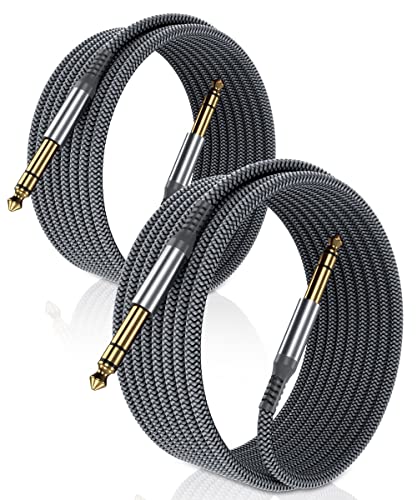
Best for: Balanced connections across guitars, keyboards, and amps in home studios. The Elebase cables feature a solid aluminum shell, nylon-braided jacket, and two-layer shielding with gold-plated TRS connectors to cut interference. Limitation: color options are limited, so match aesthetics to your rig if that matters.
Akoada 1/4 Inch TRS Instrument Cable 10ft 2Pack

Best for: Musicians seeking sturdy construction with strong shielding and nylon braided exterior. This 10-foot pair uses gold-plated connectors and a three-core copper center with anti-oxidation properties. Choose this if you need reliable performance under tension during live use. Caution: some users report limited compatibility with certain devices if a 6.35mm jack is not standard on the gear.
Amazon Basics TS 1/4 Inch Straight Instrument Cable

Best for: Budget-conscious players needing a simple, reliable mono cable. It uses an OFC center conductor and shield to reduce interference and maintain signal clarity. Limitation: being a budget option, it may not have the same ruggedness as higher-end cables for heavy stage use.
New Bee Guitar Cable 10ft

Best for: Electric guitarists and bass players needing a reliable straight/angle combo. The 10-foot option uses low-noise conductors and a PVC-insulated jacket to minimize interference. Caution: the right-angle variant may be preferable if your setup requires a more compact space; verify connector orientation before purchase.
Buying Guide
- Cable type matters: TS cables carry mono signals (single channel), while TRS cables carry stereo or balanced signals. Choose TS for guitar-to-amp and TRS for stereo or balanced connections.
- Shielding and conductor quality: Look for braided or multi-layer shielding and oxygen-free copper conductors to reduce hum, buzz, and signal loss.
- connectors and durability: Gold-plated connectors resist corrosion and improve long-term reliability. Consider nylon-braided jackets for added durability in live settings.
- Length considerations: Longer cables introduce more capacitance and potential signal loss. Match length to the application; 6–10 feet is common for stage setups, 10–20 feet for studio rigs.
- Compatibility: Ensure the 1/4-inch connector type (TS vs TRS) matches your gear’s inputs and outputs, including mixers, amps, and pedals.
- Budget vs. build: Higher-quality cables reduce noise and failure risk but cost more. For on-the-go gigging, invest in better shielding and connectors; for casual home use, a budget option can suffice.
Frequently Asked Questions
- What is the difference between TS and TRS cables?
- Are longer 1/4-inch cables more prone to noise?
- Should I choose balanced TRS cables for instruments?
- What features indicate a durable instrument cable?
- Can I use a 1/4-inch cable with different devices like mixers and keyboards?
- Do I need shielded cables for studio use?
Notes: Product descriptions reference standard features such as shielding, connector quality, and construction materials. The list presents five relevant options chosen for a typical American home studio and live-performance environment. No price data is included to maintain objectivity.