Best 1/4 Inch to 3.5mm Audio Cables and Adapters for Pro and Home Use
The right 1/4 inch to 3.5mm cable or adapter can simplify connecting headphones, instruments, DJs, and studio gear to a variety of devices. This guide highlights five top options, helping readers choose based on durability, signal integrity, and setup needs. Best for home studios, live rigs, or portable setups, these picks balance value and performance for both beginners and professionals.
Buyer summary table:
| Product | Ideal For |
|---|---|
| Cable Matters 3.5mm TRS to Dual 6.35mm TS Breakout Cable | Studio monitors, mixers, DJ setups |
| UGREEN 1/8 to 1/4 Stereo Cable | Guitar, laptop, home theater, versatile general use |
| VCE 6.35mm to 3.5mm Adapter (2 Pack) | Quick 1/4″ to 3.5″ conversions on the go |
| JSAUX 4ft 3.5mm to 6.35mm Cable | Guitars, amps, and keyboards with high fidelity goals |
| Amazon Basics Gold-Plated 6.35mm to 3.5mm Adapter (2-Pack) | Budget-friendly, reliable adapters |
Cable Matters 3.5mm TRS to Dual 6.35mm TS Breakout Cable

This 1/8″ TRS to dual 1/4″ TS cable splits stereo from a 3.5mm TRS source into left and right channels for a mixer, speakers, or studio monitors. It’s best for home studios, live performances, and DJ rigs requiring a clean stereo split to two mono inputs. The OFC conductors and braided shielding reduce signal loss and noise for clearer audio.
Who this is best for: musicians, podcasters, and small studios needing a compact breakout to run separate left/right lines. Caution: the two 1/4″ ends are joined; ensure you have enough slack to separate them for your setup.
UGREEN 1/8 to 1/4 Stereo Cable

This 3.5mm TRS to 6.35mm cable uses 24K gold-plated connectors and double shielding for minimal signal loss and crisp audio. It’s best for guitarists, laptop users, and home theater devices needing reliable stereo transfer with enhanced durability thanks to a zinc alloy housing and nylon braid.
Who this is best for: players and on-the-go users who want a sturdy, long cable for multiple devices. Caution: ensure stereo processing is supported on the source for true stereo output.
VCE 6.35mm to 3.5mm Adapter (2 Pack)

This pair converts a 1/4″ stereo port to a 3.5mm plug with 24K gold-plated connectors for maximum conductivity. It minimizes signal loss and noise, delivering clear stereo sound from pro audio gear to personal devices. It has a solid brass build and knurled grip for easy handling in tight spaces.
Who this is best for: users who need quick, reliable adapters on hand for instrument and studio gear. Caution: adapters are male to female; check orientation before plugging to avoid misalignment.
JSAUX 3.5mm to 6.35mm Cable

JSAUX offers a bidirectional 4FT TRS cable with 24K gold-plated connectors, pure copper shell, and a double-braided nylon jacket. It’s designed for hi-fi performance with minimal signal loss. Best for connecting devices like iPods, laptops, or phones to amplifiers, keyboards, or speakers with a 6.35mm input.
Who this is best for: users seeking robust construction and solid fidelity for mid-length runs. Caution: shorter or longer lengths may better suit particular setups; verify space before purchase.
Amazon Basics Gold-Plated 6.35mm to 3.5mm Adapter (2-Pack)
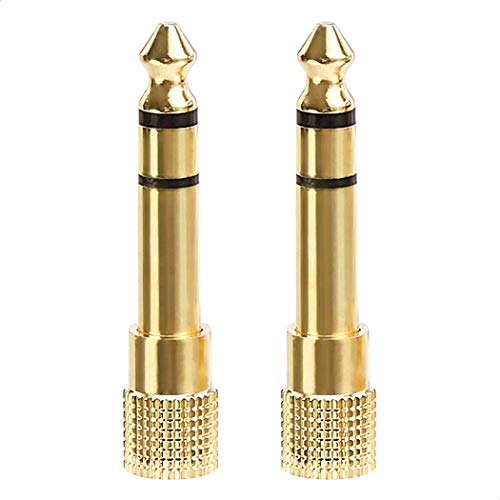
Amazon Basics provides a budget-friendly 2-pack of adapters that convert 6.35mm plugs to 3.5mm female jacks. This is suitable for connecting headphones or small speakers to larger pro audio devices. The gold-plated connectors help ensure corrosion resistance and a reliable connection.
Who this is best for: budget-conscious buyers needing dependable adapters for occasional or mixed-use setups. Caution: as a general-use adapter, it may not offer premium shielding or build features found in higher-end cables.
Buying Guide
What to consider when choosing a 1/4″ to 3.5mm audio cable or adapter
- Connector quality: Look for gold-plated contacts and solid brass or copper conductors to minimize signal loss and corrosion.
- Shielding and construction: Double shielding and braided jackets improve durability and reduce noise, especially in live or high-interference environments.
- Length and flexibility: Choose a length that fits your setup without excess slack; longer runs risk signal degradation in poor-cabled paths.
- Directionality: Some adapters are unidirectional; verify compatibility with your source and destination devices to avoid connectivity issues.
- Duplex needs: If you need a stereo signal split into two mono lines, a breakout cable (TRS to dual TS) is ideal; ensure you have matching inputs on your gear.
- Durability vs. cost: Higher-end materials offer longevity in demanding setups, but budget options can suffice for light-use scenarios.
Practical setup tips
- Test cables with a known-good source and destination to verify channels are correctly mapped.
- Avoid wrapping cables tightly around sharp edges; use protective routing to extend life.
- When using adapters, ensure the connected device supports the expected impedance and stereo configuration.
Quick comparison at a glance
- Best for studio splits: Cable Matters 3.5mm TRS to Dual 6.35mm TS Breakout Cable
- Best all-around value: Amazon Basics Gold-Plated 6.35mm to 3.5mm Adapter
- Best for durability: UGREEN 1/8 to 1/4 Stereo Cable
- Best for adapters on the go: VCE 6.35mm to 3.5mm Adapter (2 Pack)
- Best for hi-fi fidelity: JSAUX 3.5mm to 6.35mm Cable
FAQ
- What is the main difference between a TRS and TS connection?
– TRS carries stereo signals (tip-ring-sleeve), while TS carries a single channel (tip-sleeve); breakout cables convert a stereo signal to two mono lines for independent left and right channels. - Do adapters affect sound quality?
– Quality adapters with good conductors and shielding minimize signal loss and noise, but cheaper adapters may introduce audible degradation in some setups. - When should I use a breakout cable versus individual adapters?
– Use a breakout cable when you need separate left and right feeds; use adapters to convert plug sizes for direct device compatibility. - Are gold-plated connectors necessary?
– They help resist corrosion and can improve long-term reliability, especially with frequent plug/unplug cycles. - Is longer always better for cables?
– Not necessarily. Longer cables can introduce more resistance and potential signal loss; choose the shortest practical length for your layout.