
Best 1.5 Mm Speaker Cable Options for Clear Audio and Easy Setup
Looking for 1.5 mm² speaker cable to support clear audio and solid connections? This guide highlights five practical options, including copper-clad alternatives, that are well-suited for home theaters, stereo setups, and DIY projects. Each pick is explained with who it’s best for, plus a simple buying checklist to help you compare features like conductor material, length, and polarity. The top picks are chosen for compatibility with standard speakers and receivers, straightforward installation, and budget-friendly performance. A quick summary table of the chosen products follows to help you compare at a glance.
| Product | Conductor Type | Approx. Length | Best For |
|---|---|---|---|
| SeKi Speaker Cable 2 x 1.50 mm² | CCA | 100 m | Long runs, cost-conscious installs |
| Install Link 16 AWG Speaker Wire | CCA | 100 ft | Home theater and car audio |
| Amazon Basics 16-Gauge Speaker Wire (100 ft) | Brass-plated copper shielding | 100 ft | General high-value use |
| Kinter 16-Gauge Speaker Wire (100 ft) | CCA | 100 ft | Budget-friendly DIY runs |
| Amazon Basics 16-Gauge Speaker Wire (50 ft) | Brass-plated copper shielding | 50 ft | Smaller setups |
SeKi Speaker Cable 2 x 1.50 mm² – 100 m
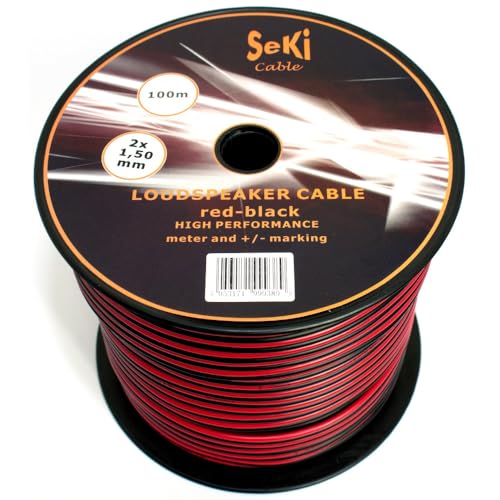
Best for long runs in budget-conscious installations. This 2 x 1.5 mm² cable uses copper-clad aluminium (CCA) conductors, offering a cost-effective solution for venues where long cable length is needed without premium copper pricing. The 100 m length is ideal for fixed installations such as home theaters and multi-room audio. Best for: users who need lengthy runs and economical options. Caution: CCA may have higher resistance than pure copper, potentially affecting high-frequency performance over very long distances.
Install Link 16 AWG Gauge Speaker Wire (100 Feet) – CCA

Better for mid-range home theaters and car audio setups. This 16 AWG double conductor wire uses copper-clad aluminum for a balance of cost and conductivity. It provides good flexibility, easy stripping, and distinct polarity identification. Best for: DIY enthusiasts and professionals seeking straightforward installation with reliable performance. Caution: While suitable for most home theater environments, very long runs or high-end audio systems may benefit from heavier gauges or pure copper conductors.
Amazon Basics 16-Gauge Speaker Wire Cable, 100 ft

Best value for standard setups. This 16-gauge wire with a clearly marked polarity is suitable for connecting speakers to A/V receivers or amplifiers across moderate distances. It offers straightforward installation and consistent performance for typical living rooms or small home theaters. Caution: For very long runs or high-demand audiophile systems, consider thicker gauges for reduced signal loss.
Kinter Cable 100ft 16-Gauge Speaker Wire

Best for affordable DIY installs with clear polarity marking. The 100-foot length includes red polarity stripe for easy identification, and the soft, flexible PVC jacket aids handling. Best for: budget-conscious builders and hobbyists working with standard 16-gauge runs. Caution: The use of CCA reduces potential conductivity compared to pure copper in high-frequency or long-distance scenarios.
Amazon Basics 16-Gauge Speaker Wire, 50 Feet

Best for small to medium rooms where a 50-foot run suffices. Straightforward polarity marking and a plastic jacket help maintain signal quality and ease of installation between speakers and amplifiers. Best for: compact setups or secondary zones where shorter runs are common. Caution: If you anticipate future expansion to longer runs, consider stepping up to 100 ft options to avoid splices.
Buying Guide: 1.5 mm² Speaker Cable Essentials
Conductor material: Copper offers the best conductivity; copper-clad aluminum (CCA) provides savings with slightly higher resistance. For long runs or critical listening, copper or higher-purity options are preferable.
Length and gauge: Choose a length that minimizes splices. A 100 ft run is common for larger rooms; for smaller spaces, 50 ft or less may suffice. 16 AWG is close to 1.31 mm² and a common alternative when 1.5 mm² is not strictly required.
Jacket and insulation: Look for flexible jackets that resist kinking and provide clear polarity markings. For in-wall or exposed installs, ensure jackets meet local safety guidelines.
Polarity identification: Clear red/black markings help maintain correct speaker phase, which is essential for accurate stereo imaging.
Use case alignment: Long cable runs in rooms with furniture can benefit from better shielding and low resistance; car audio setups may prioritize compact wiring with robust flexibility.
Frequently Asked Questions
- What does 1.5 mm² mean in speaker wire? – It refers to the cross-sectional area of the conductor. Larger areas typically reduce resistance and allow longer runs with less signal loss.
- Is copper-clad aluminum (CCA) acceptable for high-fidelity audio? – CCA is cost-effective and suitable for many setups, but pure copper may offer lower resistance for premium or long-distance runs.
- Which is better for a home theater: 16 AWG or 1.5 mm² wire? – Both are common; 1.5 mm² is roughly similar to 16 AWG. For longer runs or high-powered systems, thicker or higher-purity conductors may help.
- How important is polarity marking? – Very important. Correct polarity ensures proper speaker phase and accurate stereo imaging.
- Can I use speaker wire for outdoor installations? – Only if the jacket is rated for outdoor use and the run is protected from moisture and physical damage.
- Should I buy multiple shorter cables or one long run? – One long run minimizes joins and potential signal loss; however, multiple shorter cables can reduce voltage drop in some layouts.