
Best 120 Volt Car Power Inverters for Travel and On‑the‑Go Power Needs
Answering the common question “what’s the best 120V converter for car use?” these portable inverters convert 12V vehicle power to household 110–120V AC. They’re ideal for road trips, camping, and mobile offices. The top picks below target different needs: compact charging on long drives, higher continuous power for laptops and small appliances, and fast USB charging for mobile devices. Each pick is best for a distinct use case, from solo commuters to families traveling with multiple devices.
| Product | Continuous Power | Best For | Key Pros |
|---|---|---|---|
| Pro Chaser 400W (B0CPDGXT5H) | 400W | Road trips with multiple USB devices | Dual AC, USB-C PD, USB-A QC |
| OLTEANP 500W | 500W | Mobile office on wheels | Built‑in safety protections |
| Ampeak 150W | 150W | Casual charging on short trips | Compact and simple |
| OLTEANP 1000W | 1000W | Heavy-duty power needs | High surge, multiple protections |
| FSATBTNE 400W | 400W | Versatile road‑trip charging | Fast USB-C PD, dual USB, heat protection |
Pro Chaser 400W Power Inverter For Vehicles
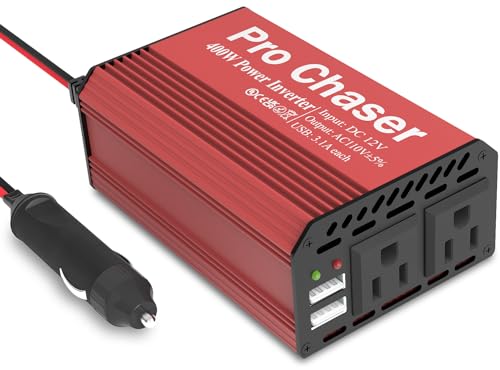
The Pro Chaser model delivers 400W continuous DC-to-AC power with an 800W peak. It features dual 110V AC outlets and two USB ports (high-speed 3.1A). This setup targets travelers who need reliable laptop or small appliance power on the go, plus quick device charging. Best for families on road trips or mobile workers who rely on both AC devices and USB-powered gear. Caution: avoid running high‑watt appliances near the 400W continuous limit to prevent overload.
Pro Chaser 400W Power Inverters (Second Model)

This version expands charging versatility with dual 110V outlets plus USB‑A QC 18W and USB‑C PD 65W ports. It suits road travelers who need quick USB charging for modern devices (iPhone, Android, tablets) alongside AC-powered gear like laptops or small appliances. Choose this if you want faster USB-C charging and flexible device support. Limitation: USB-C PD 65W may not power larger laptops at full speed compared to higher-watt options.
OLTEANP 500W Power Inverter

OLTEANP’s 500W inverter targets mobile offices and longer trips. It converts 12V DC to 110V/120V AC, supporting laptops, small TVs, and game consoles under 500W. It includes protection against undervoltage, overvoltage, overload, short circuits, and overheating with an intelligent cooling fan. Best for travelers who need steadier power for work devices compared with compact 150W units. Caution: keep peak loads in mind to avoid tripping protections during quick device spikes.
OLTEANP 1000W Power Inverter

The 1000W OLTEANP model is designed for heavy-use scenarios. It delivers 1000W continuous power with a 2000W peak surge. It’s ideal for running laptops with larger power needs, small appliances, and multimedia gear on longer trips. It includes multiple safety protections and a temperature-controlled cooling fan for extended operation. Choose this if you need sustained high-wattage performance. Limitation: higher size and weight reduce portability compared with smaller units.
FSATBTNE 400W Inverter With PD USB-C

FSATBTNE’s 400W model includes two AC outlets, a USB-C PD port (65W), and a USB-A (18W). It can deliver 400W continuous power and up to 800W peak, making it versatile for road trips, camping, and backseat charging. It emphasizes fast USB-C charging and robust cooling to support longer sessions. Choose this if you want a compact unit with strong USB-C performance. Limitation: PD 65W may not fully power some larger laptops at peak speed.
Buying Guide
- What power level do you actually need? If most devices are under 200W, a 150–400W inverter may suffice; for laptops and small appliances choose 500–1000W.
- USB charging needs matter. Look for USB-C PD ports for fast charging and USB-A QC ports for legacy devices.
- How will you connect? A 30-inch cord provides flexibility for back-seat use; a cigarette-lighter plug is common but wires may limit placement.
- Safety protections are essential. Prioritize undervoltage/overvoltage, overload, short-circuit, and overheat protections with automatic cooling.
- Portability vs. capacity. Higher-watt units offer more power but are bulkier; pick based on travel style and storage space.
- Heat management matters. Inverters generate heat; look for built-in cooling fans or heat-dissipation designs for extended use.
FAQ
- Do car inverters require installation? Most are plug-and-play via the cigarette lighter socket; some high-watt models may require direct battery connections.
- Can I power a refrigerator or other large appliance in a car? Yes, if the inverter’s continuous wattage rating exceeds the device’s draw; check surge needs for startups.
- Will inverters drain my car battery? Prolonged use of high-watt devices can deplete the battery; avoid leaving the engine off for extended periods while using high-watt loads.
- Is USB-C PD necessary? PD speeds power delivery to laptops and devices faster than standard USB ports; a PD port adds versatility for modern devices.
- What safety features should I expect? Look for overload, short-circuit, and over/under voltage protections, plus temperature management to prevent overheating.
- Can I run multiple devices at once? Many units support multiple outlets and USB ports; verify total wattage to avoid tripping the inverter’s limits.