
Best 16-Input XLR Audio Interfaces for Studio-Quality Home Recording
If you need a reliable 16-input USB audio interface for multi-mic recording, hybrid studios, or live tracking, these options cover a range of budgets and feature sets. This guide highlights five strong choices, who they’re best for, and why they stand out. The top picks include interfaces with eight or more mic preamps, expanded line inputs, and versatile I/O configurations to grow with your studio. Use this overview to compare compatibility with your setup, whether you’re a guitarist, podcaster, or producer layering drums and ensembles.
Summary of chosen products:
- Fender Quantum LT 16 — 16-in, 8-out USB-C with eight MAX-HD mic preamps and 14 line inputs.
- Tascam US-16×08 — 16 mic/line inputs and 8 outputs with Ultra-HDDA preamps.
- Focusrite Scarlett 18i16 4th Gen — 18 inputs, 16 outputs, including multiple mic preamps and ADAT I/O.
- Focusrite Scarlett 16i16 4th Gen — 16 inputs, 16 outputs, with flexible I/O and 24-bit/192kHz conversion.
- XTUGA USB Audio Interface Q-12 — compact 2-in, ultra-low latency option for mobile or on-the-go setups (included for comparison).
Fender Quantum LT 16 — 16-in USB-C Audio Interface

Best for hybrid studios needing robust I/O. The Fender Quantum LT 16 delivers 16 inputs and 8 outputs via USB-C, plus fourteen line inputs for integrating outboard gear, synths, and drum mics. Eight MAX-HD mic preamps provide clear, low-noise gain up to +75 dB, which helps capture drums, ensembles, and loud sources with minimal coloration. The unit’s full I/O expansion supports complex recording setups, making it ideal for producers building larger, multi-mic projects. Caution: The Fender Amp & FX Pack integration requires the Fender Studio app, which some users may not need for basic recording.
Who it’s best for: projects requiring many mic preamps and extensive outboard integration in a single chassis, such as drum kits or live ensembles. Why chosen: it’s the most expansive package among the five, offering the highest I/O count and the most flexible routing. Limitation: dependent on software setup for guitar tones if you don’t plan to use the Fender studio features.
Tascam US-16×08 — Rackmount USB Audio Interface
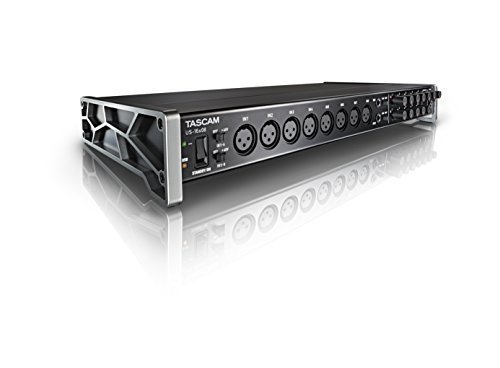
Best for professional-sounding multi-mic sessions. The US-16×08 provides sixteen mic/line inputs and eight outputs, with eight Ultra-HDDA preamps delivering clean gain up to 56 dB. This interface emphasizes quiet operation and broad input capacity, making it suitable for drum kits, choirs, or small ensembles where each mic needs ample headroom. The additional eight line inputs support direct instrument or synth connections, enabling versatile routing for complex mixes. Caution: The rack-mount design is ideal for studio desks but may be less portable for on-the-go recording.
Who it’s best for: studios that require many simultaneous mic channels with stable, clean preamps. Why chosen: it balances a robust mic count with practical I/O options. Limitation: no dedicated onboard talkback or advanced DSP beyond routing controls, which may matter for podcast workflows.
Focusrite Scarlett 18i16 4th Gen USB-C

Best for expanding a recording rig with abundant I/O. The Scarlett 18i16 (4th Gen) adds 18 inputs and 16 outputs, featuring four mic preamps, Hi-Z instrument inputs, ADAT, S/PDIF, and MIDI I/O. It leverages Focusrite’s 4th generation preamps for up to 69 dB of gain and a dynamic range designed for detailed, studio-grade recordings. This model is a fit for producers needing flexible routing for large projects, including orchestral or band setups. Caution: A larger footprint may be overkill for solo artists who primarily need a few inputs.
Who it’s best for: multi-instrument recording environments and small studios that require extensive I/O and scalable expansion. Why chosen: top-tier preamps, wide I/O, and reliable performance across a range of monitoring and routing tasks. Limitation: higher cost relative to smaller two-channel interfaces.
Focusrite Scarlett 16i16 4th Gen USB-C

Best for mid-sized studios seeking balanced I/O with strong preamps. The Scarlett 16i16 offers 16 inputs and 16 outputs, including two mic preamps and Hi-Z, plus ADAT, S/PDIF, and MIDI I/O. It uses 24-bit/192kHz converters, delivering clear, detailed recordings with substantial headroom for vocals and instruments. This model is a practical step up for producers needing more input channels without stepping into larger, rack-mount systems. Caution: The 16-in capacity can still be limiting for very large ensembles or drum-recording setups that exceed 16 simultaneous sources.
Who it’s best for: home and project studios needing reliable, scalable I/O for multi-track sessions. Why chosen: strong preamps with high-resolution conversion, plus compatibility with future expansion via ADAT. Limitation: not as expansive as higher-end dedicated multi-rack interfaces.
Buying Guide: 16-Input Interface Essentials
- What matters most: number of mic preamps vs. line inputs? If you plan to record many vocalists or drum channels simultaneously, prioritize mic preamps and low-noise performance. If you expect to integrate several synthesizers and outboard gear, ensure there are enough line inputs and ADAT options for expansion.
- Connectivity and expansion Look for USB-C compatibility, ADAT/BDAT, S/PDIF, MIDI I/O, and Hi-Z instrument inputs. ADAT is especially valuable when adding more preamps later.
- Latency and drivers Choose interfaces with reliable drivers and low-latency performance for real-time monitoring without noticeable delay.
- Portability vs. rack-mount design For mobile setups, compact or portable units help; for fixed studios, rackmount options keep cables organized and accessible.
- Preamplifier quality and headroom Preamps affect noise floor and gain. Consider models advertising high headroom and low noise for drums and loud sources.
- Software and workflow Many interfaces pair with companion software (routing, monitoring, plugins). Consider whether software integration aligns with your creative process.
FAQ
What is a good 16-input audio interface for drums?
Interfaces with at least eight mic preamps and high headroom, plus several line inputs for cymbals and toms, are ideal. Fender Quantum LT 16 or Tascam US-16×08 are solid multi-mic options.
Do I need ADAT if I already have many inputs?
ADAT allows adding more preamps via external mic preamps or converters. It’s useful if you anticipate expanding beyond your built-in inputs.
Is USB-C essential for a new interface?
USB-C offers modern connectivity and power efficiency; many newer interfaces use USB-C for better compatibility with laptops and desktops.
Can I use these interfaces for podcasting?
Yes. Select models with multiple mic preamps and good A-D converters. The more inputs you have, the more guests or vocal tracks you can record simultaneously.
Which is best for portability?
XTUGA Q-12 provides compact, plug-and-play usage, suitable for mobile recordings. For more serious multi-track work, choose a larger, stationary unit.
Are these interfaces compatible with both Mac and Windows?
All listed models are designed for cross-platform use, commonly with class-compliant USB drivers, though some features may be OS-specific.