
Compare Two Amps Or Two Speaker Pairs Easily — This guide reviews top 2(1)-in-1(2)-out amplifier/speaker switchers that let you route two amplifiers to one speaker pair or one amplifier to two speaker pairs (A/B switching). Below is a quick summary table of the selected products to help you scan features at a glance.
| Product | Brand | Key Feature |
|---|---|---|
| SOLUPEAK P2 2(1)-in-1(2)-Out | SOLUPEAK | Gold-plated banana jacks; passive; A/B push button |
| PROZOR 2(1)-in-1(2)-Out | PROZOR | Simple A/B selector; no external power; plug-and-play |
| Dingsun 2-Way Audio Switcher | Dingsun | Passive, switch-based; compact combiner box |
| Y.D.F 2 Port Amplifier Speaker Selector | Y.D.F | Gold-plated connectors; claims minimal signal loss |
| TENEALAY A21 2-Way Stereo Selector | TENEALAY | Designed for 80W per channel; 8–16 ohm compatibility |
SOLUPEAK P2 2(1)-in-1(2)-Out Amp Amplifier Speaker Switcher
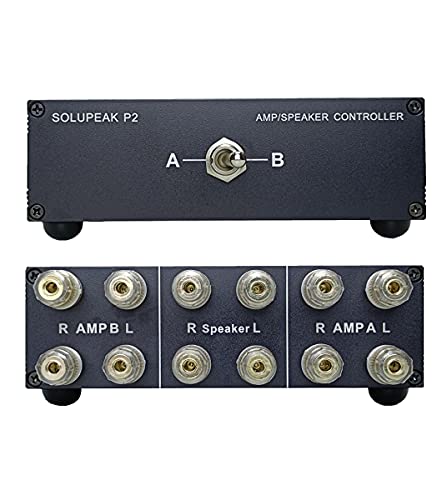
Overview: The SOLUPEAK P2 is a passive A/B switcher that supports either two amplifiers to one speaker pair or one amplifier to two speaker pairs. It uses a front A/B push button for switching and gold-plated banana jacks for connections.
Key Features:
- 2-IN-1-OUT and reversible 1-IN-2-OUT operation for flexible routing
- Passive, non-powered design — plug and play
- High-quality gold-plated banana jacks; accepts up to 12 gauge wire
- Quick A/B comparison between amps or speaker pairs
Notes: When used in 1-IN-2-OUT mode, only one speaker pair (A or B) can be active at a time. Suitable for quick comparisons and simple zone switching without extra wiring complexity.
PROZOR 2(1)-in-1(2)-Out Amplifier / Speakers Selector

Overview: PROZOR’s selector box provides straightforward A/B switching between amplifiers or speaker pairs. It’s an unpowered unit that is designed for easy installation and switching without tools or configuration.
Key Features:
- 2(1)-in-1(2)-OUT configuration with single-position selection at a time
- Connect two audio sources to AMP 1/2 and one speaker pair to speaker port
- Or connect one AMP to speaker port and two speaker pairs to AMP 1/2 ports
- No external power required; simple A/B toggle
Notes: The device emphasizes simplicity and reliability for home audio setups where only one source or zone is required at a time.
2-Way Audio Switcher (Dingsun) 2(1)-in-1(2)-Out

Overview: Dingsun offers a compact passive switcher intended for quick amplifier or speaker selection. The unit relies on mechanical switching and is meant for plug-and-play convenience.
Key Features:
- Supports two amplifiers to one speaker or one amplifier to two speakers
- Passive, non-powered design with manual switches
- Compact combiner box for space-saving installations
Notes: The Dingsun model is a straightforward and low-complexity option for users who want basic A/B switching without electronic circuitry or remote control functions.
Y.D.F 2 Port Amplifier Speaker Selector

Overview: The Y.D.F selector emphasizes low signal loss and gold-plated connectors for enhanced conductivity. It supports bidirectional switching between amps and speakers and claims to preserve audio quality.
Key Features:
- Bidirectional 2-IN-1-OUT / 1-IN-2-OUT operation
- Gold-plated banana jacks for up to 12 gauge wire
- Designed to minimize signal loss and distortion
Notes: Ideal for setups where maintaining signal integrity is important during A/B comparisons between amplifiers or speaker pairs.
TENEALAY 2-Way Stereo Amplifier Speaker Selector A21

Overview: The TENEALAY A21 is marketed as a zone-capable A/B selector with specific power and impedance guidance, making it suited for basic multi-zone home theater or distributed audio use.
Key Features:
- 2-IN-1-OUT and reversible 1-IN-2-OUT operation
- Rated for up to 80W max per channel and for 8–16 ohm speakers
- Designed to simplify unplugging/replugging for A/B comparisons or zone switching
Notes: The A21 provides clear spec guidance for power and impedance, which is useful when matching with amplifiers and speaker loads.
Additional Compatible Options Mentioned
There are more feature-rich and alternative models in the market such as metal-box screw terminal selectors (XtremPro), remote-enabled units with speakON sockets (MIZISNR), and other passive A/B switchers (LiNKFOR). These may offer different mounting styles, remote control, or connector types depending on installation needs.
Buying Guide: How To Choose A 2(1)-In-1(2)-Out Amplifier/Speaker Switch
This guide highlights the core factors to compare before buying a 2-in-1/1-in-2-out switcher for home audio.
Configuration And Use Case
- Bidirectional Needs: Confirm whether you need 2 amps → 1 speaker pair, 1 amp → 2 speaker pairs, or both. Most listed units support reversible A/B switching but only one channel plays at a time.
- Comparison Vs. Distribution: For quick A/B comparisons between amplifiers or speakers, a passive A/B push-button unit is sufficient. For multi-zone distribution where simultaneous playback is needed, consider a dedicated speaker selector with impedance protection (not covered by basic A/B boxes).
Power, Impedance, And Load Handling
- Amplifier Power Rating: Check the amplifier’s output and the selector’s specified per-channel wattage if provided. Some units (like TENEALAY A21) specify wattage and impedance support.
- Speaker Impedance: Ensure the selector supports your speaker impedance (commonly 8–16 ohms). Mismatched impedance can stress the amp or degrade performance.
Connector Types And Wire Gauge
- Banana Jacks Vs. Screw Terminals: Banana jacks allow quick connections and often accept up to 12 AWG wire. Screw-terminal boxes can be more secure for permanent installs.
- Gold-Plated Contacts: Gold plating reduces corrosion and can preserve signal quality over time. Consider models with gold-plated banana jacks if long-term reliability is important.
Signal Integrity And Design
- Passive Vs. Active: Passive switchers have no power requirement and introduce minimal circuitry; they rely on mechanical connections. Active switchers or those with isolation circuitry can reduce crosstalk or loss but may require power.
- Loss And Distortion: Manufacturers sometimes state “minimal signal loss.” For critical listening, focus on units with higher-quality connectors and solid mechanical switching.
Physical Build And Installation
- Size And Mounting: Smaller combiner boxes are easy to tuck behind equipment; metal-cased units offer more durability.
- Remote Control Or Manual: If remote switching is desirable, seek models that include remote control or electronic switching. Most simple A/B boxes reviewed here are manual.
Safety And Compatibility
- Avoid Simultaneous Parallel Loads: Basic selectors usually do not allow both speaker pairs to be active simultaneously without risking impedance issues. Use impedance-matching or protection when running multiple pairs at once.
- Check Manufacturer Notes: Follow guidance on maximum wattage, impedances, and wiring practices to avoid damaging amplifiers or speakers.
Comparison Perspectives
- Value-Focused: Passive, no-frills switchers (PROZOR, Dingsun) are cost-effective for simple A/B tasks.
- Audio Integrity: Models with gold connectors and claims of minimal signal loss (Y.D.F, SOLUPEAK) aim to preserve audio quality during switching.
- Power/Impedance Aware: If you need explicit power and impedance ratings, units like TENEALAY A21 provide clearer spec guidance.
- Advanced Features: For remote control, speakON connectors, or metal/glass styling, look toward models with extra features or higher build complexity (MIZISNR, XtremPro variants).
Use the product details and the buying guide above to match a selector box to your exact application—whether you’re comparing amplifiers, switching speaker zones, or testing speaker pairs. Always verify wiring and impedance compatibility before connecting multiple amplifiers or speaker pairs.