
Best 2 Channel 100 Watt Amps for Car and Home Audio Enthusiasts
Answering the common question: which 2-channel 100-watt amplifier fits your needs? This guide highlights five solid options, detailing who each is best for and why. Whether you’re upgrading a car stereo or powering a small home system, these picks balance power, versatility, and value. The top picks suit car audio lovers, DIY electronics hobbyists, and small-room audio setups who want clear, reliable amplification without overspending.
The following quick table compares key aspects to help you decide at a glance. All products are 2-channel amplifiers with around 100 watts per channel or dual 100-watt channels, designed for straightforward integration with standard car or home audio gear.
| Product | Best For | Power (per channel) | Notes |
|---|---|---|---|
| BOSS Audio CE102 | Car audio beginners | 100W x 2 | Compact, straightforward install |
| ARRAROWN ZK-1002T | DIY projects | 100W x 2 | Bluetooth-enabled board |
| ZK-1002T Bluetooth Amplifier Board (Wuzhi Audio) | Custom setups | 100W x 2 | Wide voltage, versatile inputs |
| Pyle PDA29BU.5 | Home and small-room setups | 100W x 2 | Multiple inputs including USB/SD/Bluetooth |
| Fosi BT20A | Compact spaces | 100W x 2 | Bluetooth-ready, simple setup |
BOSS CE102 2 Channel Car Amplifier

The BOSS Audio CE102 is a compact 2-channel car amplifier that delivers 100 watts per channel. It is suitable for simple, straightforward installations in standard automobiles. Best for new installers or those seeking a reliable, entry-level upgrade. The product notes emphasize precise installation procedures and recommend professional installation for optimal results. A potential limitation is the lack of broader feature set beyond essential amplification, which may be a constraint for users seeking advanced tuning or integrated digital inputs.
ARRAROWN ZK-1002T RPO 2.0 Channel Bluetooth Amplifier Board

The ARRAROWN ZK-1002T is a dual 100W per channel Bluetooth 5.0 amplifier board designed for DIY setups. It offers Bluetooth, USB, and AUX inputs with separate treble and bass adjustments, making it a good choice for hobbyists who want hands-on tone shaping. Best for custom enclosures, small workshops, or projects where wireless input is desired. A caution: the board’s performance hinges on proper heat management and clean power supply, which may require careful mounting and shielding in some installations.
ZK-1002T Bluetooth Amplifier Board 100W+100W (Wuzhi Audio)

This ZK-1002T board uses dual TPA3116D2 Class-D chips to deliver 100W+100W with relatively low distortion and efficient power use. It includes wide voltage input (12-24V) and supports AUX/Bluetooth with three knobs for bass, treble, and master volume, enabling flexible customization for home or automotive audio projects. Best for enthusiasts seeking a compact, versatile amplification module. Limitation: it requires a compatible chassis and may need additional components for full system integration.
Pyle 200W Stereo Power Amplifier with Bluetooth

The Pyle PDA29BU.5 provides 100W per channel RMS (200W peak total) with multiple input options, including RCA, USB, SD, MIC, and Bluetooth. This makes it a strong all-in-one solution for home audio or small karaoke setups. Best for users needing a flexible input suite in a single box. A caution: while feature-rich, compact construction may limit high-end audiophile performance compared to dedicated high-power models.
Fosi Audio BT20A Bluetooth Stereo Amplifier
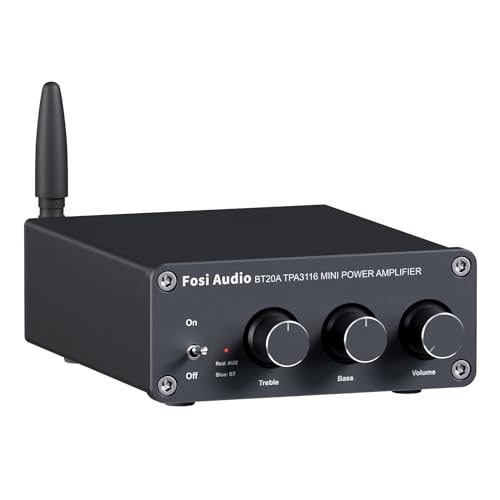
The Fosi BT20A is a compact, entry-level 2-channel amplifier delivering up to 100W per channel. It emphasizes ease of setup, Bluetooth input, and straightforward tone controls, making it ideal for small rooms, dorm setups, or patios. Best for users seeking a simple, wireless-ready upgrade without a lot of mounting complexity. Limitation: less robust chassis for rugged automotive environments compared with dedicated car amplifiers.
Buying Guide
What to consider when choosing a 2-channel 100-watt amp:
- Power needs: Confirm the target speaker impedance (2 ohms, 4 ohms, etc.) and ensure the amplifier can deliver stable power at those loads.
- Input and connectivity: Decide between Bluetooth, USB, AUX, RCA, or mic inputs based on your source devices and use case.
- Environment and mounting: Car applications require robust shielding and heat management; home or DIY boards need proper enclosure and ventilation.
- Controls and tuning: Treble, bass, and volume controls help tailor sound; consider built-in crossovers for better speaker protection and sound shaping.
- Ease of installation: Some units are plug-and-play with standard car hitches; others demand soldering or enclosure fabrication.
- Scalability: For DIY projects, ensure the board or amp supports future upgrades or multiple input formats.
Frequently Asked Questions
- What does 100W per channel mean in practice?
It indicates the maximum continuous power the amplifier can deliver to each channel under specified conditions, affecting loudness and headroom. - Do I need a separate power supply for DIY amplifier boards?
Yes, most require a stable 12–24V DC supply with adequate current capacity to prevent voltage drop during peaks. - Is Bluetooth input reliable for car use?
Bluetooth is convenient, but in-car interference or line-of-sight issues can affect performance; consider a wired input for critical audio. - Can I use any 2-ohm speaker with these amps?
Not every amp performs equally at 2 ohms. Check the manufacturer’s impedance compatibility to avoid overloading. - Are these amps suitable for home theater use?
Some models are versatile for home setups, but car-focused units may lack room-correction features found in home theater amplifiers. - Which option is best for a beginner?
The BOSS CE102 or Fosi BT20A are typically simpler to install and configure, making them good starting points for new users.