Best 2 Way Crossover for Speakers: Top Picks for Clearer Audio and Easy Install
Answering the common need for clean, precise sound division, this guide highlights practical 2-way crossovers that help separate treble and bass for better speaker performance. These options suit DIY audio enthusiasts, car audio fans, and home theater setups alike. Each product section explains who benefits most, why it was chosen, and one important limitation to consider. A quick buyer’s table at the top summarizes the picks for fast comparison.
| Product | Best For | Key Benefit |
|---|---|---|
| Coliao 2pcs 400W Adjustable Speaker Crossover | Home audio setups seeking adjustable gain | High power handling with adjustable frequency points |
| DriSentri 2 Way Crossover 450W | Car and home audio requiring robust build | High-quality terminals and precise phase alignment |
| Audiopipe 300W 2 Way Crossover CRX-203 | Budget-conscious car audio | Gold-plated terminals and solid power handling |
| Fydun 300W 2 Way Car Crossover | Compact, sleek car installations | Solid heat-dissipation and easy wiring |
| DS18 PRO-CFX 2-Way Car Audio Crossover | Professional-grade car stereo tuning | High precision filtering for two components |
Coliao 2pcs 400W Adjustable Speaker Crossover

The Coliao set is designed for higher power handling with adjustable crossover points, making it suitable for mid-to-large room setups or powered speakers that require precise treble/bass management. Best for audiophiles who want direct control over frequency distribution and a clean, wide-range sound separation. The inductors use anaerobic copper winding and pure copper wire for improved efficiency. Limitation: setup may require some wiring familiarity to maximize the adjustable features.
DriSentri 2 Way Crossover 450W
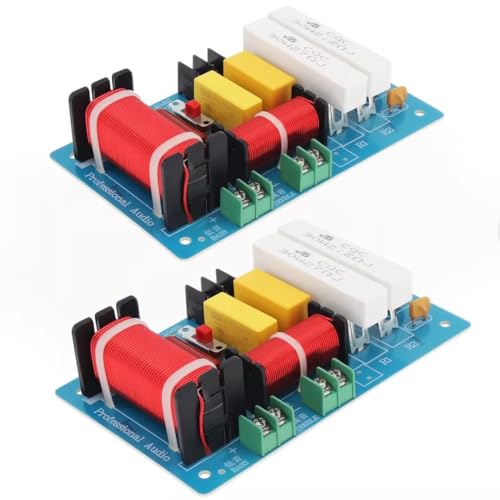
Best for users who want durable terminals and robust phase compensation. This model uses a 2850/2900 switch for frequency division, with 12dB low-pass and 18dB high-pass sections to promote clean sound separation. It’s well-suited for both home theater integration and car audio systems. A limitation: the frequency point switches require careful adjustment to match your speaker impedance for optimal results.
Audiopipe 300 Watts 2 Way Crossover CRX-203

Ideal for car audio enthusiasts seeking solid value and reliable performance. The CRX-203 features a 150W RMS / 300W peak rating with a 3.39–20kHz crossover range for tweeters. Best for budget-conscious buyers who want straightforward installation and dependable power handling. Caution: ensure compatible with your existing speaker components to avoid mismatched impedance.
Fydun 300 Watts 2 Way Car Crossover

Best for compact car installs needing effective heat dissipation and simple wiring. The design emphasizes tonal accuracy and easy installation with a heat-dissipation ABS housing. It uses a bass inductance and a tweeter capacitor to improve high-frequency stability. Limitation: the data suggests emphasis on ease of installation; exact impedance matching should be confirmed with your speaker set.
DriSentri 2 Way Crossover for Speaker, 250W

Best for budget-minded setups that still require good sound separation. Features a 2750/2800 switch adjustable point with 12dB low-pass and 18dB high-pass for phase compensation. The scientific wiring and calibration aim to match many speaker types. Limitation: compatibility with non-standard car audio systems may require additional tweaking.
Buying Guide: Key Considerations For 2-Way Speaker Crossovers
- Power handling: Choose a crossover rated for at least as much as your amplifier or speakers to avoid distortion or overheating.
- Crossover frequency options: Look for adjustable points to tailor treble and bass separation to your speaker lineup and room/acoustic environment.
- Filter order and slope: Higher dB per octave (e.g., 12dB, 18dB) offers steeper cuts. Decide if you need tighter separation or a smoother blend.
- Wiring and terminals: Durable, easy-to-connect terminals reduce installation time. Gold-plated contacts are a plus for corrosion resistance.
- Form factor and cooling: Car crossovers may need compact designs; home setups may benefit from active cooling features or heat-dissipation housing.
- Impedance compatibility: Verify impedance (4-8 Ohms commonly) to ensure proper integration with your speakers and amp.
- Mounting and durability: Solid housings and secure mounting options help maintain performance in mobile environments or vibration-heavy spaces.
Common Scenarios And Recommendations
- Car audio: For straightforward replacement or upgrade, consider crossovers with clear thermal management and robust terminals (e.g., Audiopipe CRX-203 or DriSentri 450W).
- Home audio: Look for adjustable points and effective phase compensation to maintain a coherent soundstage across a room (Coliao or DS18 PRO-CFX).
- Budget-focused setups: Prioritize models with solid mechanical construction and reliable components, ensuring compatibility with your speakers without overspending.
FAQ
- What does a 2-way crossover do? It splits audio into two frequency bands, directing treble to the tweeter and mids/bass to midrange or woofer for clearer, more controlled sound.
- Do I need a power-rated crossover? Yes. Matching the crossover’s power rating to your amplifier and speakers helps prevent distortion and component stress.
- Can I install a crossover in a car? Many models are designed for car use, featuring compact housings and simple wiring, but check impedance and mounting compatibility first.
- Is higher dB slope better? A steeper slope (higher dB per octave) provides sharper separation, which can reduce overlap but may require careful tuning for a natural blend.
- Should I choose passive or active crossovers? Passive crossovers are simple and inexpensive, suitable for many setups; active crossovers offer more precise control but require extra equipment and wiring.
- Can I mix brands in a system with crossovers? Yes, as long as impedance, power handling, and crossover points align with each component to maintain balanced sound.