
Best 2 Way vs 3 Way Speakers: Which Setup Fits Your Audio?
Buying decisions between 2-way and 3-way speaker systems hinge on how you value clarity, bass depth, and system flexibility. For compact installs or simple upgrades, 2-way crossovers are often sufficient. If you crave more precise frequency separation and crisper highs with better midrange control, a 3-way setup provides clearer division of labor among drivers. The top picks below target buyers who want clear guidance on when to select 2-way versus 3-way configurations, and how crossovers influence performance in car, home, or marine audio.
Summary of selected products
| Product | Best For | Key Benefit | Impedance / Power |
|---|---|---|---|
| HiQltyla 3 Way Speaker Crossover (2 Pack) | 3-Way setups and upgrades | Precise frequency separation across highs, mids, lows | 4-8 Ω, 200W peak |
| DriSentri 2pcs 3 Way Crossover | New 3-Way installations | Adjustable crossover points for tailored response | 4-8 Ω, 400W |
| Sundown Audio SA-6.5CS v.3 6.5″ 2-Way Components | High-fidelity 2-way components | Strong midrange and smooth silk-dome tweeter | 125W RMS per side |
| Acoustic Audio CS-IC83 In-Ceiling 8″ (2 Pair) | In-ceiling 3-way home theater | 3-way crossover for fidelity and easy integration | 8 Ω, 20-350W recommended |
| DriSentri 2 Way Crossover (80W) | Simple 2-way car audio upgrades | Smooth bass and treble separation | 4-8 Ω, 80W |
Note: All products listed are designed to integrate with separate drivers or speaker systems to optimize 2-way or 3-way configurations. The selection emphasizes crossover quality, impedance compatibility, and practical installation notes to help buyers compare effectively.
HiQltyla 3 Way Crossover: 2 Pack

Best for: 3-way speaker systems requiring clear separation across high, mid, and low bands. This unit supports 200W peak power and works with 4-8 ohm impedance. The 860Hz and 6000Hz division points help tailor midrange and treble articulation. The build uses a bass inductor and MKP/MPX capacitors for improved sonic clarity.
Why it’s selected: It provides robust component quality for home or car audio upgrades and is easy to install with screw terminals, reducing the need for welding.
Caution: Confirm your speaker’s impedance and power handling before pairing to avoid overloading the crossover.
DriSentri 2pcs 3 Way Crossover

Best for: Upgrading to a full 3-way system with adjustable crossover points (2550Hz to 2600Hz). Aimed at users who want precise control over how bass, mid, and treble blend together, compatible with 4-8 ohm speakers and up to 400W. Three blue-framed inductors emphasize robust construction.
Why it’s selected: The adjustable crossover points help tailor the response to different drivers, improving overall fidelity when upgrading existing setups.
Caution: Higher power ratings require compatible drivers; ensure your amplifier and speakers can handle the load.
Sundown Audio SA-6.5CS v.3 6.5″ 2-Way

Best for: 2-way component setups that require strong midrange and smooth highs with a capable 125W RMS per side rating. The carbon fiber cone and damped silk dome tweeter deliver balanced, non-fatiguing sound in a compact package.
Why it’s selected: It provides a strong 2-way reference for comparison against 3-way crossovers, illustrating how a single high- and mid-range pairing performs without a dedicated midbass driver.
Caution: Requires an appropriate amplifier and enclosure design to maximize efficiency and avoid distortions at higher volumes.
Acoustic Audio CS-IC83 In-Ceiling 8″ (2 Pair)
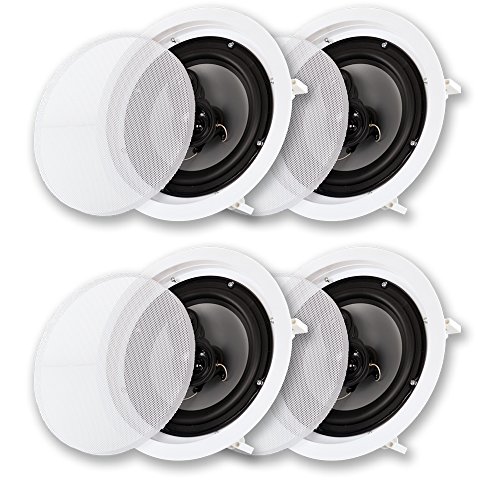
Best for: In-ceiling 3-way installations where space constraints exist but a multi-driver approach is desired. Rated for 20-350W per speaker with an 8-ohm impedance, these speakers use a three-way passive crossover for wider fidelity.
Why it’s selected: They integrate 8″ woofers with polypropylene cones and soft-dome tweeters, offering a practical 3-way reference for ceiling installations, including paintable grills for aesthetics.
Caution: Cut-out size and mounting depth should be verified to fit typical ceiling cavities and ensure unobstructed installation.
DriSentri 2 Way Crossover (80W)

Best for: 2-way car audio upgrades where a compact solution is preferred. The crossover uses a 2800Hz point to separate bass and treble effectively, handling 80W with low distortion while preserving dynamic detail.
Why it’s selected: It provides a practical baseline for comparing 2-way performance versus 3-way systems, highlighting how crossover placement affects high-frequency extension.
Caution: Ensure the tweeters and woofers match the impedance and power rating to maintain sound quality and avoid clipping.
Buying Guide
Do you need a 2-way or a 3-way system?
2-way systems combine one high-frequency driver and one woofer, offering simplicity and compactness. They are often easier to install and cost-effective for small rooms or basic listening. 3-way systems add a dedicated midrange driver, providing improved voice clarity and more even power distribution across the spectrum. Consider room size, listening habits, and amplifier headroom when choosing.
How important are crossover points and driver quality?
Crossover frequency determines how the frequency spectrum is divided between drivers. Sharper, well-designed crossovers reduce driver overlap and distortion, yielding crisper highs and cleaner bass. Look for crossovers with adjustable points and low-distortion inductors or quality capacitors for better fidelity.
What about impedance and power handling?
Most car and home audio drivers use 4-8 ohms. Match the crossover impedance to speaker impedance and ensure the amplifier can safely deliver the rated power. Avoid pushing drivers beyond their rated wattage to prevent overheating and distortion.
What installation considerations matter?
Inline crossovers should be placed where they won’t rattle or overheat. In-wall or in-ceiling installations require proper enclosure design or mounting depth. For marine or outdoor setups, choose weather-resistant components and sealed enclosures to maintain longevity.
How should I compare 2-way and 3-way options?
Compare the perceived clarity of mids and highs, bass extension, and the impedance stability under load. A well-matched 3-way system often yields cleaner separation in busy passages, while a good 2-way setup can deliver solid overall performance with less complexity and cost.
FAQ
- What is the main difference between 2-way and 3-way speakers? – A 3-way system splits the signal across three drivers (tweeter, midrange, woofer) for better frequency separation, while a 2-way system uses two drivers (typically woofer and tweeter).
- Can I upgrade a 2-way system with a 3-way crossover? – Yes, if you add a dedicated midrange driver and ensure impedance and power handling match your existing setup.
- Do crossovers affect sound quality? – Yes. High-quality crossovers reduce driver interaction, resulting in cleaner highs and more precise bass.
- Is higher wattage always better? – Not necessarily. The system must be matched to the amplifier and drivers to avoid distortion and overheating.
- Are in-ceiling or marine speakers suitable for 3-way setups? – They can be, but installation space, enclosure, and weather resistance are important considerations.
- Should I choose a 2-way or 3-way for a small room? – A quality 2-way can perform very well in small rooms, though a 3-way may offer more detail if driven by adequate amplification.