
Quick Overview: Choose a 2-zone speaker selector to route audio between two speaker pairs or to manage two separate listening areas. Below is a summary table of the selected products to help you compare core features at a glance.
| Product | Brand | Key Feature |
|---|---|---|
| Premium 2 Zone Speaker Selector Switch Box | SOLUPEAK | Passive 2-way A/B speaker switching, no power required |
| A ADWITS 2-Channel Speaker Switcher Selector Box | ADWITS | Terminal clamps, play one pair or both simultaneously |
| OSD 70V 2-Zone Speaker Selector w/Volume | OSD Audio | 70V compatible, 200W per zone, built-in volume controls |
| Douk Audio VU102 2 Zone Speaker Selector Box | Douk Audio | 2-in-1-out or 1-in-2-out modes, VU meter, remote |
| XtremPro 2 Way Speaker Switch With Volume | XtremPro | Compact 1-in-2-out selector with per-pair control |
Premium 2 Zone Speaker Selector Switch Box – SOLUPEAK SP2
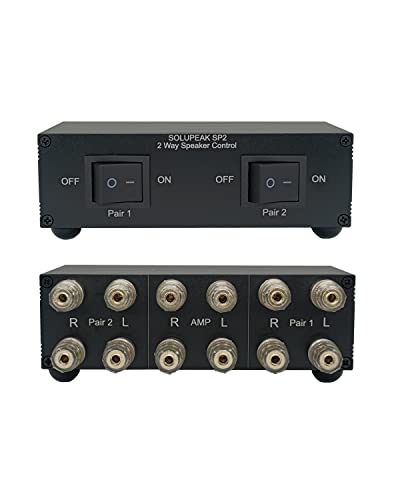
The SOLUPEAK SP2 is a passive 2-way stereo speaker switcher designed to control up to two pairs of speakers from a single stereo amplifier. It requires no external power supply and uses simple A/B switches to select which pair plays or to combine outputs depending on wiring. This makes the unit straightforward to install in small home setups or basic distributed audio systems. The passive design minimizes complexity, but users should confirm speaker impedance compatibility with their amplifier to avoid overload.
A ADWITS 2-Channel Speaker Switcher Selector Box

ADWITS provides a 2-way stereo speaker control featuring terminal clamps for secure wiring. The selector allows using two pairs of speakers with a single amplifier, offering options to play either pair or both simultaneously. The product targets low-cost distributed audio applications in residential and light commercial environments. Its terminal clamp connections suit users who prefer screw-down wiring versus banana plugs.
OSD 70V 2-Zone Speaker Selector With Volume Control

This OSD Audio selector is built for dual-zone management in 70V commercial systems. Each zone includes a dedicated volume control and handles up to 200W per zone. The 70V compatibility makes it suitable for restaurants, retail spaces, offices, and outdoor distributed systems that rely on constant-voltage speaker lines. The per-zone power handling supports robust installations, but ensure matching transformer taps on your speakers when integrating into a 70V network.
Douk Audio VU102 2 Zone Speaker Selector Box

The Douk Audio VU102 combines a speaker selector with amplifier switching and visual metering. It supports modes for comparing two amplifiers to one speaker pair (2-in-1-out) or routing one amplifier to two speaker pairs (1-in-2-out). The large VU meter and included IR remote improve monitoring and convenience. Each channel is rated up to 200W and features isolated grounds to reduce interference when comparing gear. This unit targets audiophiles, studios, and users who frequently A/B test components.
XtremPro 2 Way Speaker Switch With Volume Control

XtremPro’s compact selector offers 1-in-2-out control with individual volume adjustments for each speaker pair. Rated for conventional residential impedance ranges, it provides per-pair control and maintains impedance consistency for 4–8 ohm loads. The metal non-slip chassis and simple controls are aimed at consumers looking to expand a single amplifier to multiple listening areas while preserving basic load management.
Buying Guide: How To Choose A 2-Zone Speaker Selector
Choosing the right 2-zone speaker selector depends on system type, speaker wiring, and usage. Review the factors below before purchasing.
System Compatibility
- Impedance And Amplifier Load: Confirm the selector maintains safe impedance for your amplifier when multiple speakers are connected. Passive A/B selectors can alter load; check rated ohms and maximum wattage.
- 70V vs Low-Voltage Systems: For commercial or long-distance runs, prefer a selector designed for 70V constant-voltage systems. Home hi-fi typically uses low-voltage 4–8 ohm setups.
Power Handling And Safety
- Wattage Ratings: Match the selector’s per-channel or per-zone wattage rating to your amplifier and speaker RMS capabilities to avoid clipping or damage.
- Heat Dissipation: Higher-power setups may require selectors with robust housings or ventilation. For sustained high-volume use, check thermal design and reviews for overheating reports.
Features And Functionality
- Volume Controls: Built-in per-zone volume knobs add practical flexibility for different rooms or zones.
- Switching Modes: Units with 2-in-1-out or 1-in-2-out modes help A/B testing or amplifier comparisons without rewiring.
- Connection Types: Choose between banana plug jacks, binding posts, or terminal clamps based on cabling preference and installation permanence.
Installation And Use Cases
- Home Stereo Expansion: Simple passive switchers or compact 1-in-2-out boxes work well for adding a second pair of speakers to a living room or patio.
- Commercial Distributed Audio: Use 70V-capable selectors with per-zone volume controls for restaurants or retail environments.
- Studio And Gear Comparison: Consider selectors with isolated grounds and A/B modes for amplifier or speaker comparisons to prevent ground loops and interference.
Durability And Build Quality
- Materials: Metal housings and secure binding posts improve longevity in permanent installs.
- Switch Quality: Look for robust mechanical switches and clear detents for reliable zone selection.
Comparison Perspectives
- Passive vs Active: Passive selectors require no power and are simple, but may affect impedance. Active/selectors with transformers or impedance-matching circuitry can protect amps in complex setups.
- Home Use vs Commercial Use: Home users prioritize simplicity and low cost; commercial setups need 70V compatibility, higher wattage handling, and per-zone attenuation.
- Feature Trade-Offs: Extra features (VU meters, remotes, volume knobs) add convenience but also increase complexity and cost. Match features to actual needs.
Use these criteria to narrow choices: verify impedance and wattage, decide if 70V support is required, and pick connection styles that match your cables. For comparison tasks, select models with isolated inputs or A/B modes to avoid interference during testing.