
Best 200 Watt Integrated Amplifier for Your System
Looking for a 200 watt integrated amplifier to power passive speakers at home, in a garage, or on a patio? This guide highlights five strong options suited for different needs—whether you want clean Class D efficiency, warm tube-inspired tone, or hybrid warmth with modern features. Each choice is described with who it’s best for and why it stands out, plus a practical caveat. Use the quick comparison table to narrow down your pick before reading deeper into each product.
| Product | Best For | |
|---|---|---|
| Fosi Audio BT20A | Budget-friendly rooms and small venues | Compact, simple setup with solid 100W x2 output per channel |
| Juson Audio JTA100 | Warmth and versatility for turntables and streaming | Vacuum tubes preamp with multiple inputs and BT 5.0 |
| FLYINSKY Class A/AB (Gold) | Premium tone and dynamic headroom | Hybrid class A/AB with tube-like warmth and US power design |
| Fosi TB10D | Desktop or small-scale setups with flexible use | 600W total with flexible bass/treble and multiple roles |
| Fender Rumble 200 V3 | Bass players needing a compact, powerful combo | 200W Class D, built-in effects, portable for gigs |
Note: Each product below is presented with a concise rationale, who it’s best for, and a potential limitation to consider before purchase.
Fosi Audio BT20A Bluetooth Stereo Amplifier
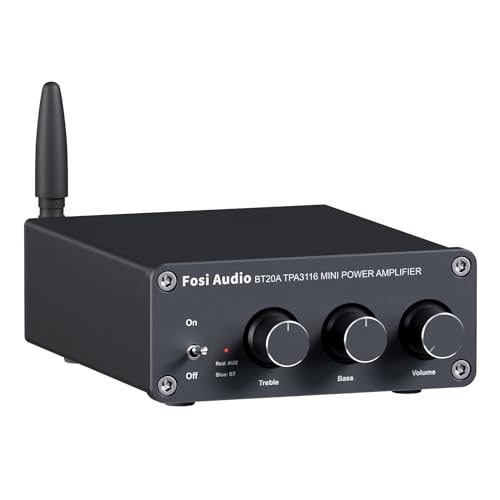
Best For: Budget-minded homes and small spaces where easy Bluetooth streaming is valued. This 2-channel integrated amp delivers up to 100W per channel, suitable for bookshelf or compact passive speakers. It is simple to set up with a one-touch switch and straightforward bass/treble tuning to suit room acoustics.
Why Selected: It offers reliable, no-frills power in a compact package, making it a solid entry point for new setups or secondary rooms like offices or patios. The lack of complex features keeps it easy to install.
Caution: It may not provide ample headroom for demanding, power-hungry speakers at high listening levels in large spaces. Consider pairing with efficient speakers.
Juson Audio JTA100 2026 Version 200W Vacuum Tube Hybrid

Best For: Audiophiles seeking warmth and flexibility with multiple inputs, including BT 5.0 and a phono option for turntables. The tube preamp adds a lush character while preserving solid transistor power for dynamic performance.
Why Selected: Its combination of vacuum-tube preamp and versatile inputs makes it ideal for users consolidating a turntable, streaming, and headphone listening in one unit.
Caution: The hybrid design can be more complex to calibrate for optimal balance if you’re aiming for a very clinical, flat response.
FLYINSKY Class A/AB Hybrid Stereo Amp 200W x2

Best For: Enthusiasts who want a high-end feel with tube-like warmth and robust US power design for demanding speakers. It switches between Class A at low levels and Class AB for dynamic peaks, delivering a strong musical foundation.
Why Selected: The use of premium components and a dual-transformer supply aims to deliver stable performance with lower noise and a richer midrange, beneficial for critical listening.
Caution: The unit may be heavier and require more careful setup regarding power and ventilation in compact spaces.
Fosi Audio BT20A Pro Bluetooth 5.0 Amplifier
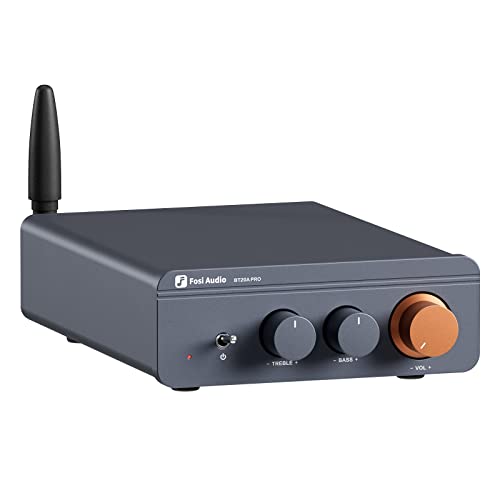
Best For: Users wanting higher output and upgrade options within the same family, suitable for small living rooms or outdoor setups where Bluetooth streaming is convenient and space is limited.
Why Selected: The Pro version doubles available power per channel and supports Bluetooth 5.0 with a memory pairing feature, offering a more resilient wireless experience for everyday use.
Caution: While more powerful, the compact chassis can still limit when paired with inefficient or high-demand outdoor speakers in very large spaces.
Fender Rumble 200 V3 Bass Guitar Combo Amplifier

Best For: Bass players needing a portable, powerful bass amp with built-in effects and a robust 200W class D power stage. The combo design is ideal for practice rooms or small gigs.
Why Selected: It offers strong bass extension and practical features like a headphone/monitoring option, making it a versatile option beyond standard stereo use.
Caution: It is a bass-focused amp, so overall music playback qualities for full-range stereo listening may differ from dedicated hi-fi amplifiers.
Buying Guide
What to consider when choosing a 200 watt integrated amplifier:
- Speaker compatibility: Check impedance and sensitivity to match the amp’s power output and avoid underpowered or overworked drivers.
- Signal source and inputs: Confirm available inputs (BT, AUX, phono, optical) align with your turntable, streamer, or media player.
- Sound character: Decide between a clean Class D design, valve-inspired warmth, or hybrid A/B performance based on your listening goals.
- Room size and placement: Larger rooms benefit from higher headroom; compact models suit desks, shelves, or outdoor patios.
- Built-in features: Bluetooth pairing ease, tone controls, remote control, and subwoofer output can influence convenience and setup.
- Reliability and heat: Class D designs are efficient, but tube-based or hybrid amps may require ventilation in enclosed spaces.
Frequently Asked Questions
- What does 200W per channel mean for home audio?
It indicates the amplifier’s potential power output per channel, which affects loudness and headroom with suitable speakers.
- Is a hybrid amplifier better than a pure solid-state one?
Hybrid designs aim to combine warmth from tubes with solid-state power, offering a different tonal character than pure solid-state amps.
- Do I need a dedicated preamp with these integrated amps?
Not typically. Integrated amplifiers include both preamplification and power amplification in one unit.
- Can I run a turntable with these amplifiers?
Some models include phono inputs for turntables; others do not. Check the product’s input options before buying.
- Will Bluetooth work well for hi-fi listening?
Bluetooth offers convenient wireless streaming, but wired connections often provide lower latency and higher fidelity.
- What is headroom, and why does it matter?
Headroom is the extra power available beyond the listening level; it helps avoid clipping during dynamic peaks.