Best 200 Watt Stereo Receiver: Top 5 Picks for Clear, Powerful Sound
If you’re shopping for a 200 watt stereo receiver, you want reliable power, versatile inputs, and easy setup for home listening or karaoke. This guide highlights five solid options that balance price and performance. The picks below are suited for small-to-medium rooms, home theaters, or party spaces where you want clear sound and flexible connectivity. Each product section explains who it’s best for and why it’s selected, plus any practical limitations.
| Product | Best For | Key Benefit |
|---|---|---|
| Sony STRDH190 2-ch Home Stereo Receiver | Casual listeners and vinyl enthusiasts | Phono input and Bluetooth for versatility |
| YAMAHA R-S202BL Stereo Receiver | Two-zone setups and Bluetooth fans | Advanced circuitry with dual-system speaker support |
| Donner Stereo Receivers Home Audio Amplifier | Home theaters and multi-room setups | High peak power with multiple inputs |
| Pyle PDA29BU 200W Stereo Power Amplifier | Karaoke and multimedia rooms | 200W peak power with multiple inputs |
| Pyle PDA9HBU Wireless BT Stereo Amplifier | Compact spaces needing many inputs | 11 input modes including HDMI and Bluetooth |
Sony STRDH190 2-ch Receiver With Phono and Bluetooth

This Sony model provides a straightforward 100 watts per channel into 8 ohms, plus a phono input for turntables and built-in Bluetooth for wireless streaming. Best for buyers seeking a budget-friendly, easy-to-use receiver with vinyl compatibility and solid daily listening power in small to medium rooms.
- Best for vinyl lovers who want a simple setup with Bluetooth convenience.
- Better for casual listening rather than high-end home theater.
Caution: The stated 100W x 2 RMS may be lower than some 200W models, so expect comfortable listening rather than room-filling, ultra-pressurized sound in larger spaces.
Yamaha R-S202BL Stereo Receiver
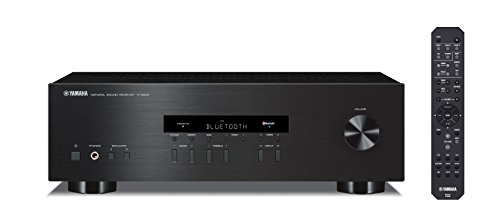
Yamaha’s R-S202BL offers advanced circuitry and a dual-system speaker option, plus Bluetooth for streaming. It’s well-suited for two-room setups or households that want separate speaker zones or an enhanced tuner with FM/AM presets. The design emphasizes clear frequency response across a broad range.
- Best for households needing two speaker zones with strong tonal balance.
- Choose this if you value dedicated speaker selection for two systems.
Caution: The product includes a wide frequency response spec; ensure your speakers are properly matched to maintain optimal bass performance.
Donner Stereo Receivers Home Audio Amplifier

Donner delivers a 1000W peak power multi-channel receiver with 4-channel control and multiple input options, including Bluetooth and USB. It’s a strong pick for larger spaces or multi-room setups where higher peak power can deliver impactful sound. The unit supports various input modes to fit most modern devices.
- Best for larger living rooms or home theaters needing higher peak output.
- Better for users who want multiple inputs and easy remote control features.
Caution: This model emphasizes peak power; ensure your speakers can handle the load without distortion at higher volumes.
Pyle PDA29BU 200W Stereo Power Amplifier
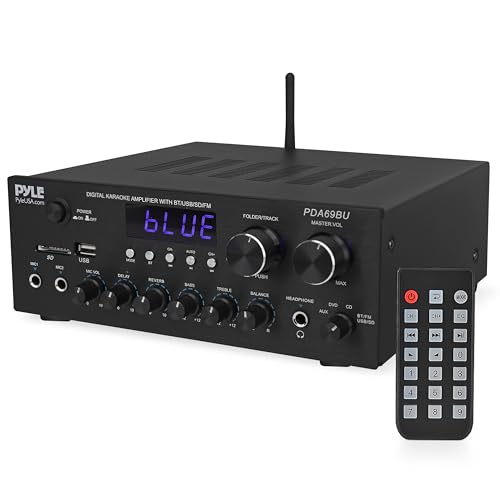
The PDA29BU provides 200W peak power with 100W RMS, and supports multiple inputs—RCA, mic inputs, USB, SD, Bluetooth, and FM radio. It’s a strong choice for karaoke setups or home theaters where you want robust amplification without a heavy audio processor in the signal chain.
- Best for karaoke nights or multimedia rooms needing dependable power.
- Choose this if you want a versatile input slate with easy mic control.
Caution: As a dedicated power amplifier, ensure you pair it with appropriate preamps and speakers to maintain audio fidelity.
Pyle PDA9HBU Wireless BT Stereo Amplifier

This Pyle model is a compact, feature-rich Bluetooth stereo amplifier with 11 input modes, including HDMI, optical, coaxial, phono, and USB. It supports turntables directly via a built-in phono preamp and offers multiple connection options for TVs, streaming devices, and traditional audio gear. It’s ideal for compact spaces needing diverse inputs and easy switching.
- Best for small rooms needing many inputs and HDMI passthrough.
- Choose this if you want a single box to handle most modern and legacy sources.
Caution: When using HDMI input, verify compatibility with your TV’s audio output mode to avoid sync issues.
Buying Guide: Key Considerations for 200 Watt Receivers
How much power do you actually need? Match receiver power (RMS per channel) to your speaker load (ohms and impedance) and room size. If you plan to drive 8-ohm speakers in a small to medium room, 50–100W RMS per channel is usually sufficient; higher peak ratings can deliver louder scenes in larger spaces but require compatible speakers.
What inputs do you need? If you own a turntable, look for a built-in phono preamp. For modern devices, Bluetooth or USB inputs are convenient. HDMI or digital coaxial/optical can simplify connections for TVs and streaming devices.
Two-zone or multi-room capabilities can be a deciding factor for households with separate listening areas. Look for receivers that clearly list speaker terminals and remote control support for multiroom setups.
Sound quality vs. features. Some models emphasize bass and treble control, digital processing, or preset tuners. Consider how much you value tone shaping versus raw power and input variety.
Size and installation. Check the physical dimensions and the weight, especially if mounting under a shelf or placing on a compact entertainment stand. Cooling and ventilation can influence performance in longer listening sessions.
FAQ
- What does RMS power mean on a stereo receiver?
- Is Bluetooth on a stereo receiver enough for streaming?
- Do I need a dedicated subwoofer with a 200W receiver?
- Can I use any speakers with these receivers?
- What is the benefit of a phono input?
- Which receiver is best for karaoke use?
RMS power indicates the continuous, usable power delivered to speakers. It is a more accurate measure of real-world performance than peak power, which is brief and can be misleading.
Bluetooth provides convenient wireless streaming but may add compression. For higher fidelity, connect via wired inputs or use a receiver with support for higher-quality codecs or streaming apps.
A subwoofer can enhance bass response in small rooms; it’s optional but beneficial for cinema or party setups where deep bass improves immersion.
Speakers should match the receiver’s impedance (often 4–8 or 6–16 ohms). Verify the receiver’s rated impedance range and ensure your speakers fall within that range for optimum performance.
A phono input lets you connect a turntable with a built-in or external phono preamp. It is essential for vinyl playback without an extra external preamp.
Receivers with multiple mic inputs, echo or reverb controls, and dedicated bass/treble adjustments are better suited for karaoke and party environments.