Best 2500 Watt Monoblock Amps for Subwoofers in 2026
If you need dedicated power for a monster subwoofer or a multi-sub setup, a 2500 watt monoblock amplifier is a strong option. These amps are designed to deliver high current to a single channel, helping your bass stay tight and loud with minimal distortion. This guide highlights five top candidates, explains who each is best for, and provides practical buying cues to compare power, impedance, and features. The buyers described here range from entry‑level installers to audio enthusiasts seeking maximum headroom.
| Product | Best For | Key Strength |
|---|---|---|
| Crunch Ground Pounder GP-2500.1 | Budget-minded bass enthusiasts | High power at 2 ohms |
| Planet Audio AC2500.1M | Factory radio users needing both high/low input options | Low and high level inputs |
| Taramps Smart 3 Bass | High-efficiency, multi-impedance setups | Multi-Impedance, 0.5–2 ohms |
| Skar Audio RP-2000.1D | RMS power with flexible bass control | 2,000W RMS at 1 ohm |
| Orion Cobalt CBA2000.1D | Durable Class D option for sustained bass | 1/2/4 ohm stability |
Crunch Ground Pounder GP-2500.1 2500 Watt Monoblock Amplifier

Power: 1x1250W @ 4 ohms, 1x2500W @ 2 ohms. This model targets users who want strong single-channel output with solid 2-ohm performance. Best for: budget-conscious buyers seeking high wattage on a single channel for a subwoofer without needing multiple channels. Caution: spec emphasis is on peak-like measurements; verify real-world performance with your sub and electrical system to avoid underpowered bass in demanding tunes.
Planet Audio AC2500.1M Monoblock Car Amplifier

Power: 2500W max at 2 ohms, 1250W at 4 ohms into one channel. Features both high-level and low-level inputs to accommodate factory radios or aftermarket units without RCA outputs. Best for: users upgrading from factory sound who need flexible input options and strong subwoofer drive. Caution: performance can vary with vehicle electrical systems; ensure adequate wiring and alternator capacity in your install.
Taramp’s Smart 3 Bass Monoblock

Power: 3000W RMS into 0.5–2 ohms, Multi-Impedance design. Best for: those who want maximum flexibility with impedance tuning and high efficiency. Caution: advanced users may need proper cooling and electrical setup to sustain continuous high-power output in hot environments.
Skar Audio RP-2000.1D Monoblock
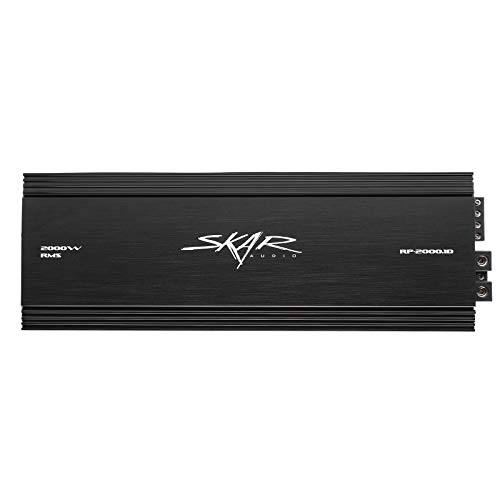
Power: 2,000W RMS @ 1 ohm, 2,800W peak. Features on-board Bass EQ with +6 or +12 dB boost at 45Hz. Best for: drivers seeking integrated bass shaping without a separate processor. Caution: 1 ohm operation is power-hungry; ensure wiring and electrical system support sustained lows.
Orion Cobalt CBA2000.1D Monoblock

Power: 2000W max, 500W RMS, stable at 1/2/4 ohms. Best for: users needing a durable Class D design with stable multi-impedance options. Caution: lower RMS rating means less sustained power than some peers; ensure your sub’s sensitivity and enclosure are matched to avoid inefficiencies.
Hifonics BG-2500.1D Brutus Gamma

Power: 2500W mono, Class D with MOSFET output and electronic crossovers. Best for: users who want efficient cooling and a robust chassis with controlled bandwidth. Caution: some configurations may require careful tuning of the crossover and bass boost to avoid overemphasis in certain songs.
Buying Guide: Key Considerations For 2500 Watt Monoblock Amps
- Power and impedance: Check RMS power at your target impedance (commonly 1, 2, or 4 ohms). A 2500W rated amp often delivers peak values that differ from continuous RMS output. Choose an impedance that matches your subwoofer’s rating from the manufacturer.
- Inputs and compatibility: If your head unit lacks RCA preouts, consider high-level (speaker-level) inputs. If you have RCA outputs, low-level inputs are preferred for cleaner signal transfer.
- Efficiency and cooling: Class D designs usually run cooler and more efficient for high-power subs. Ensure adequate ventilation and consider a heat sink or enclosure with airflow.
- Protection features: Look for thermal, overload, and short-circuit protection. Indicators on the amp can help diagnose issues during setup and use.
- Wiring requirements: High-power monoblocks demand stout power and ground wiring. Plan for appropriate gauge (often 1/0 to 4 AWG depending on the install) and a fused power supply close to the battery.
- System tuning: A built-in bass EQ or crossovers can simplify setup. However, these should be used in conjunction with proper subwoofer enclosure design to avoid distortion.
- Vehicle electrical system: A 2500W class D amp can strain electrical supply in smaller or older vehicles. Upgrades to alternator, battery, and capacitors may be necessary for reliable performance.
FAQ
- What is RMS power and why does it matter for a 2500W monoblock?
RMS reflects continuous, real-world output. It matters because it indicates how much steady power the amp can deliver to a sub without overheating or distortion. - Do I need a subwoofer that matches the amp’s impedance?
Yes. Choose a subwoofer that matches the amp’s stable impedance (1, 2, or 4 ohms) to avoid inefficiency or damage. - Is Class D better than other classes for high power subs?
Class D designs are typically more efficient and produce less heat at high power, which is beneficial for subwoofers in compact spaces. - Can I use a 2500W amp with my factory radio?
It depends on inputs. If the amp supports high-level inputs, you can connect it to factory radios; otherwise, you may need an RCA adapter or line-out converter. - What should I consider about wiring when using a 2500W amp?
Plan for heavy-gauge power and ground cables, proper fusing near the battery, and a solid grounding point to minimize noise and prevent voltage drop. - Is built-in bass EQ essential?
Not essential, but it can help tailor bass response. Rely primarily on proper enclosure design and subwoofer tuning for best results.