
Best 3.5 Mm Jack Amplifier: Top 5 Portable DAC/AMP Picks for Any Budget
Answering the headfi need: these 3.5 mm jack amplifiers boost headphone volume, clarity, and bass for a wide range of devices. They’re best for music lovers who want richer sound from phones, laptops, or portable players, and for users seeking compact amps with gain controls. The top picks below balance impedance compatibility, output power, and practical features. A quick buyer’s table follows to compare key specs at a glance.
Product Quick View (selected amps best for everyday listening, travel, and desktop use):
| Product | Impedance Range | Best For | Key Benefit |
|---|---|---|---|
| Neoteck 16-300 Ohm Portable Headphone Amplifier | 16-300Ω | Mobile users and seniors | Low noise, two-stage gain, aluminum housing |
| eSynic Rechargeable 16-300Ω Portable Headphone Amplifier | 16-600Ω | Audiophiles on the go | High SNR, rechargeable with long runtime |
| PROZOR 16-300Ω Portable Headphone Amp | 16-300Ω | Casual and semi-pro listening | Two-stage gain, Type-C charging |
| TNP Portable 3.5mm Headphone Amplifier | 16-600Ω (typical) | Budget-friendly versatility | Analog volume knob, RCA input option |
| Douk Audio U3 PRO HiFi Mini DAC/AMP | 18-600Ω | Desktop and high-impedance cans | High-power output, replaceable op-amps |
Neoteck 16-300 Ohm Portable Headphone Amplifier
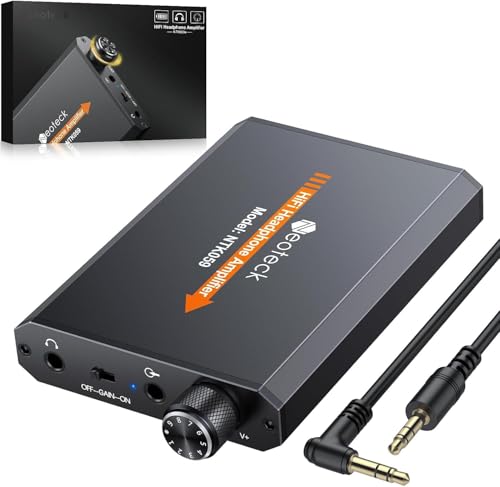
Best for everyday mobile listening with wide impedance support. It handles 16-300Ω headphones and claims SNR greater than 120dB with THD+N around 0.0003%, offering low noise and clean tone. The two-stage gain and 3.5 mm output give clearer stereo with refined dynamics for most portable devices. Aluminum matte case reduces interference and improves heat resistance, making it comfortable to hold and resilient for travel.
casual listeners, seniors, and commuters who want simpler, reliable amplification on the go. Limitations: may be underpowered for very demanding high-impedance cans at extreme volume; consider higher output models if you frequently drive high-end headphones.
eSynic Rechargeable 16-600Ω Headphone Amplifier

Best for audiophiles who need broader impedance support and long battery life. This model covers 16-600Ω, offers a high signal-to-noise ratio (>100dB) and very low THD+N (as low as 0.0003%). The two-stage gain switch helps tailor output to different headphones, while a rechargeable design provides 12+ hours of playback. It’s a strong balance of performance and portability for frequent travelers or laptop use.
users with a mix of IEMs and high-impedance cans seeking clean, detailed sound. Limitations: larger than ultra-compact sticks, and some users may not need the higher impedance range if they only use low-impedance IEMs.
TNP Portable 3.5mm Headphone Amplifier

Best for budget-conscious users who still want meaningful improvements in clarity and detail. It supports 3.5 mm and 6.3 mm outputs and inputs, with a smooth analog volume knob and a dedicated power switch. It can be powered by Micro-USB or a DC adapter included in some bundles, offering flexible use with a wide range of devices. The device notes three-prong impedance handling and a simple, straightforward design.
beginners or those who want a cost-effective upgrade for phones, laptops, or portable players. Limitations: may not deliver as much headroom for demanding headphones compared with higher-end models.
Douk Audio U3 PRO HiFi Mini DAC/AMP

Best for desktop listening and high-impedance headphones. It offers up to 1500 mW into 32Ω and supports 18Ω to 600Ω headphones, enabling strong drive across a wide range of cans. A built-in voltage boost circuit keeps the supply stable from a 5V input, producing ultra-low distortion. An OP+BUF architecture with a replaceable op-amp socket provides potential customization for enthusiasts seeking specific tonal signatures.
enthusiasts and professionals who want desktop-grade power in a compact footprint. Limitations: requires more care with component upgrades and may be more complex for casual users.
Buying Guide
Key considerations when choosing a 3.5 mm jack amplifier include impedance compatibility, output power, and power source. Below are practical questions to guide selection.
- What impedance range do your headphones use? If you have 16-32Ω IEMs and up to 600Ω cans, look for a model labeled 16-600Ω compatibility.
- Do you need portable or desktop power? Battery-powered units excel for travel, while desktop amps offer maximum headroom.
- Is a gain switch important? Two-stage gain helps match output to sensitive IEMs and hard-to-drive high-impedance headphones.
- What connectivity is required? Ensure 3.5 mm input/output suffices, or check for additional options like RCA or 6.3 mm jacks if you have diverse gear.
- Is frequency response andTHD+N specification critical? Higher SNR and lower THD+N indicate cleaner audio, especially for critical listening.
- Should you consider upgradeable components? Some models (like Douk Audio U3 PRO) offer replaceable op-amps for tonal customization.
FAQ
- What does THD+N tell me? It measures total harmonic distortion plus noise; lower percentages indicate cleaner sound.
- Can a 3.5 mm amplifier improve laptop audio? Yes, it can increase loudness and improve dynamics when the laptop’s output is insufficient.
- Do I need an amp if I use Bluetooth headphones? Not typically; Bluetooth headphones have built-in amplification and DAC, but a wired amp can improve wired headphones with higher impedance.
- Which is best for high-impedance headphones? Amp models with 16-600Ω support and higher output power generally perform better with high-impedance cans.
- Is portability compromised by power? Portable amps balance size and runtime; desktop models usually offer more power but fewer mobile conveniences.
- Are op-amps important? In amps with interchangeable op-amps, the op-amp choice can subtly affect tone and noise.