Best 3-Channel Audio Mixer Options for Streaming and Studio Use
Answering the search intent for a compact, three-channel mixer, these picks cover simple setups, podcasting, and small studios. Best for solo streamers or small-cohort productions needing basic sub-mixing without complex routing. The top products suit creators who want flexible input options, direct hardware control, and easy PC or mobile connectivity.
Summary of selected products:
| Product | Channels | Best For | Key Benefit |
|---|---|---|---|
| Mini Audio Mixer, 3-Channel by cooidea | 3 | Podcasting and gaming | Pure analog with zero latency |
| YGiTK Mini Audio Mixer, 4 Channel | 4 | Small setups needing flexible routing | Independent level controls |
| Jyker 4 Channel Stereo Line Mixer | 4 | Rehearsals and live practice | Mono/Stereo switch per channel |
| Mackie Mix5 5-Channel | 5 | Compact project studios | Low-noise performance and mic pre |
| LZSIG Mini Audio Mixer, 4-Channel | 4 | Multi-source routing | Ultra-low noise with multiple outputs |
Mini Audio Mixer by cooidea — 3-Channel

Features include 3 independent input channels with a choice between Stereo and Mono modes. In Mono, smart panning assigns channels to Left, Center, and Right for a structured stereo image. Note: It does not provide phantom power and does not support microphones. Dual outputs with direct-coupled design minimize phase shifts and low-frequency loss. The device is ideal for PC streaming, gaming, keyboards, and other line-level sources that require clean, latency-free routing.
Best for: Podcasters or streamers who need a compact, high-speed sub-mixer for line-level sources and separate headphone monitoring. Not recommended for microphone use or phantom-powered gear.
Limitations: No phantom power; not suitable for dynamic or condenser mics without an external preamp.
YGiTK Mini Audio Mixer — 4 Channel

This 4-channel mixer provides independent volume control for each input and supports Stereo/Mono switching. It accepts 6.35mm and 3.5mm plugs, making it compatible with a wide range of instruments and devices. It is suitable for small gigs, home studios, keyboards, guitars, bass, and dynamic mics when used with appropriate preamps or interfaces. It emphasizes low-noise performance and straightforward routing.
Best for: Users who need flexible input options and per-channel control in a compact footprint. Choose this if you value explicit stereo/mono routing per channel.
Limitations: Includes more channels than strictly required for a 3-channel setup; ensure your devices align with 4-channel routing needs.
Jyker 4 Channel Stereo Line Mixer

Designed to combine multiple line-level sources into a single stereo output, this 4-channel mixer includes independent level controls for each input and dedicated Mono/Stereo routing for each channel. It suits studios, rehearsals, streaming, and multimedia setups where precise balance and flexible routing are required. The compact form factor supports easy transport between locations.
Best for: Small studios or live practice setups where separate control over four inputs improves balance and clarity.
Limitation: One extra channel beyond a strict 3-channel need; consider whether you will utilize all inputs routinely.
Mackie Mix5 5-Channel Compact Mixer

Mackie Mix5 offers a five-channel platform with a mic/line input, two stereo line inputs, and studio-grade EQ. It emphasizes low-noise performance and high headroom, making it suitable for compact project studios, voice work, and small live setups. Phantom power is available for compatible condenser microphones, expanding its versatility in more traditional recording environments.
Best for: Users who want a balance of mic-friendly features and simple routing in a small footprint. Good for podcasting and small music projects that may require phantom-powered mics.
Limitation: Slightly larger than 3-channel models; more channels might be unnecessary for strictly three-source configurations.
LZSIG Mini Audio Mixer — 4 Channel
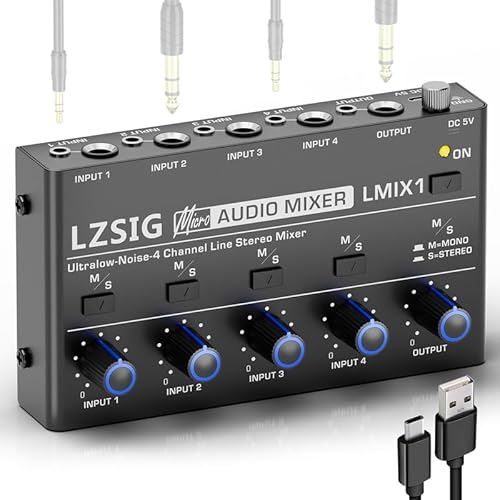
4-IN-1 line mixer supports multiple sources such as electronic drums, keyboards, guitars, and computers, mixing them into a single stereo or mono output. It emphasizes ultra-low noise with MPS power management and ROHM low-noise op-amps. It is compatible with 3.5mm and 6.35mm cables, offering a compact solution for expanding audio setups or basic mixer systems. Mono/Stereo switching adds routing flexibility for diverse setups.
Best for: Builders expanding a compact setup with multiple line sources and a need for clean, low-noise signal paths.
Limitation: Four channels may exceed a strict three-source need; plan usage to maximize channel utilization.
Buying Guide: How to Choose a 3-Channel (or Closest 3-Channel) Mixer
- Channel purpose: Decide if you need built-in mic preamps, line-level inputs only, or both. If you plan to use microphones, prioritize models with phantom power or that support external preamps.
- Connectivity: Check input/output options (1/4″, 3.5mm, XLR, USB). Ensure compatibility with your guitar, keyboard, or computer interface.
- Routing and mono/stereo options: Look for per-channel mono/stereo switching and smart panning to optimize your stereo image for streaming or recording.
- Latency and signal path: For live monitoring or streaming, select designs that advertise zero-latency sub-mixing or pure analog paths to minimize delay.
- Size and power: Smaller desks demand compact form factors; verify power requirements and whether USB power is sufficient for all channels.
- Build and noise: Metal enclosures and ground-loop isolation help reduce hum. Ultra-low-noise designs are preferable for quiet rooms and small studios.
- Price vs. features: More channels add flexibility, but a true three-channel mixer with essential routing may better fit budget-conscious buyers.
Frequently Asked Questions
- Do I need phantom power for a 3-channel mixer? Not typically. Phantom power is required for condenser mics, usually via a mixer with dedicated mic preamps. If you only use line-level sources, phantom power is not needed.
- Can I use a 4-channel mixer as a 3-channel setup? Yes. You can use three inputs and ignore the fourth, or route additional sources to the same outputs as needed.
- Is USB connectivity essential for streaming? USB audio interfaces simplify computer integration, but some dedicated mixers rely on analog routing and external interfaces. Choose based on your workflow.
- What is “mono/stereo switching” good for? It lets you decide how a channel contributes to stereo balance, useful for vocals, instruments, or playback that you want in mono for clarity.
- Is latency a concern with analog mixers? Analog, direct-coupled designs generally offer near-zero latency, which is advantageous for real-time monitoring and streaming.
- Should I buy a 3-channel mixer or a 4-channel one? If you anticipate adding more devices later, a 4-channel option provides future-proofing; otherwise, a true 3-channel model keeps things simple and affordable.