
Best 3 Octave MIDI Controller for Portable Music Production
The best 3-octave MIDI controller is ideal for portable studios, classroom setups, and live sketching. This guide highlights five compact controllers that cover essential features like velocity-sensitive keys, programmable pads, and intuitive transport controls. It helps buyers choose devices based on hands-on feel, DAW compatibility, and expandability. The top picks are suited for beginners seeking plug-and-play USB MIDI, intermediate producers needing reliable keybeds, and hybrid players who want quick control over instruments and effects.
Quick comparison at a glance:
| Product | Best For | Key Features |
|---|---|---|
| Arturia MiniLab 3 Universal MIDI Controller | Creative workflow and hands-on control | Velocity-sensitive keys, 8 drum pads, 4 faders |
| M-AUDIO Keystation Mini 32 MK3 | Portable piano feel for travel musicians | 32 mini keys, velocity curves, plug-and-play |
| Akai MPK Mini Plus 37-Key | Expanded range for melodic/harmonic playing | 37-key keybed, CV/Gate, MIDI I/O, NKS ready |
| midiplus X3 mini USB MIDI keyboard | Budget-friendly, compact controller | Ultra-compact, basic keyboard controls |
| Donner N-32 MIDI Keyboard | Educational and road-ready practice | 32 velocity-sensitive keys, built-in teaching courses |
Arturia MiniLab 3 Universal MIDI Controller, White

The Arturia MiniLab 3 is designed for musicians who want a compact controller with responsive playability. It offers premium velocity-sensitive keys and a workflow that supports muting tracks, punching in drum pads, and adjusting faders with tactile ease. Best for producers who value hands-on control during sketch sessions, sound design, and quick DAW mapping. A potential limitation is that some users may want more faders for complex mixes, which is outside this 4-fader setup.
Best for: Producers who need a portable, expressive keyboard with integrated pads and faders for fast arrangement and performance. The included flow and keybed are optimized for hands-on sessions without a mouse.
Why selected: It balances portability with expressive playability and DAW integration, making it a versatile option for on-the-go music creation.
Limitations to note: Four faders may feel limited for larger projects; consider a small surface with additional control if you frequently mix on the go.
M-AUDIO Keystation Mini 32 MK3 USB MIDI Controller

The Keystation Mini 32 MK3 emphasizes portability with 32 mini keys and selectable velocity curves. This makes it suitable for travelers and bedroom studios seeking a piano-feel controller without a full-sized keyboard. Best for players who value a simple, driver-free plug-and-play setup for Mac or Windows. It is less feature-rich for advanced sound design, as it focuses on core playability rather than extensive modulation controls.
Best for: Musicians who want a compact, travel-friendly keyboard with customizable note response and straightforward DAW integration.
Why selected: Its compact keybed and velocity options support a natural piano feel while keeping a slim profile for mobile setups.
Limitation to note: With fewer transport controls and pads, it’s less suited for those who rely on hardware samplers or extensive on-device sequencing.
Akai MPK Mini Plus 37-Key USB MIDI Keyboard Controller

The MPK Mini Plus expands beyond 25 keys with a 37-key keybed, giving three octaves for melodic and harmonic lines. Its USB-powered design makes it a strong choice for compact studios or mobile rigs. Best for creators who want more range than a standard mini while retaining portability. It supports CV/Gate and MIDI I/O for connecting modular gear, plus Native Kontrol Standard (NKS) integration for streamlined control from supported software. A potential trade-off is the need to learn its expanded control surface and mappings for advanced use.
Best for: Beat makers and melodic performers who need a broader keyboard range without sacrificing portability. The CV/Gate and MIDI I/O expandability is a plus for hybrid setups.
Why selected: It offers a richer playing range and flexible connectivity, aligning with users who experiment with external gear and software instruments.
Limitation to note: Complexity of mappings may require more setup time for full integration with certain DAWs.
midiplus X3 mini USB MIDI keyboard Controller
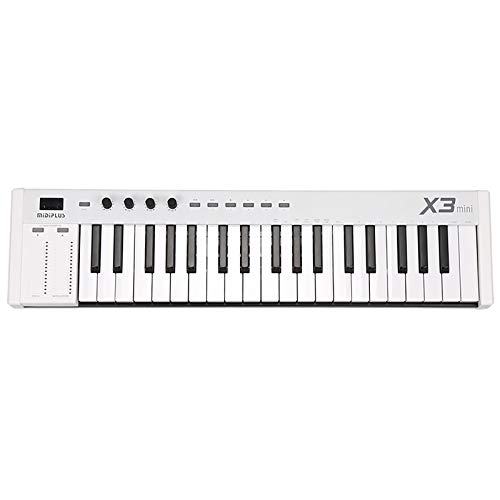
The midiplus X3 mini is a budget-friendly, ultra-compact controller intended for quick music ideas and travel setups. It provides basic keyboard controls in a small footprint, making it a good entry point for beginners or as a simple MIDI input for mobile rigs. Best for learners and hobbyists who want to experiment with MIDI without a larger controller. It may be less suitable for producers who require velocity sensitivity or extensive performance features beyond basic notes.
Best for: Beginners and budget-conscious buyers seeking a tiny, portable MIDI keyboard to complement software instruments.
Why selected: Its minimal size and cost make it an approachable option for learning and on-the-go practice.
Limitation to note: It lacks the extended feature set of higher-end models, such as advanced pads, faders, or pitch/modulation wheels.
Donner N-32 MIDI Keyboard

The Donner N-32 offers 32 velocity-sensitive keys and a built-in learning-focused design with teaching courses. It targets learners who want guided practice and a compact controller for a structured study routine. Best for students, beginners, and educators seeking an affordable, feature-balanced option that supports on-the-road practice and basic composition. A potential limitation is that it emphasizes teaching content, which may be less appealing to advanced users seeking heavy production features.
Best for: Students and beginner players who benefit from built-in tutorials and a compact keyboard for practice.
Why selected: The integrated teaching courses provide a structured learning path alongside standard MIDI control.
Limitation to note: The curriculum features may not align with all advanced production workflows or complex live setups.
Buying Guide
Key considerations when choosing a 3-octave MIDI controller include key action, portability, and control surface depth. The following questions help map features to needs:
- Do you need velocity-sensitive or semi-weighted keys for expressiveness?
- Is portability the top priority, or do you require more knobs, pads, or faders for hands-on control?
- Will you connect to external gear via CV/Gate or MIDI I/O, or mainly use it with a computer?
- Which DAWs do you use, and does the controller offer native integration or robust mappings?
- Do you want built-in teaching content or tutorials for guided practice?
Practical buying paths:
– For on-the-go production with expressive playing: Arturia MiniLab 3 or M-AUDIO Keystation Mini 32 MK3 are strong options due to their balance of key quality and portability.
– For expanded range and modular setups: Akai MPK Mini Plus 37-Key provides more keys and CV/Gate connectivity, plus NKS readiness for software control.
– For learners or educators: Donner N-32 offers built-in teaching courses and a compact form factor, useful for structured practice.
– On a tight budget or ultra-portable needs: midiplus X3 mini is a simple entry point to start experimenting with MIDI control.
Choosing between models depends on whether you prioritize key feel, output range, external connectivity, or built-in learning resources. Always verify DAW compatibility and consider how you will map controls to your typical workflow.
FAQ
- What does “3-octave” mean in a MIDI controller?
It refers to the keyboard range, spanning roughly three octaves of notes, which is often 37 or 32 keys in compact models.
- Are these controllers plug-and-play with most DAWs?
Generally yes for USB MIDI controllers, but some features may require software mappings or drivers depending on the model.
- Do 3-octave controllers support external gear?
Many do via CV/Gate or MIDI I/O; verify specific model ports if you plan to connect modular synths or sequencers.
- Which is best for live performance?
Controllers with more assignable knobs, pads, and faders (like Arturia MiniLab 3) tend to be preferred for performance control.
- Is a larger keyboard better for beginners?
Not necessarily. A 3-octave model is often ideal for beginners due to portability, while still offering enough range to practice scales and melodies.