
Find balanced, full-range ceiling speakers that deliver clear highs, defined mids, and deep bass for home theater, multi-room audio, and damp locations. Below is a quick comparison of selected 3-way ceiling speakers to help you decide which model fits your room, amp power, and installation needs.
| Product | Driver Size / Type | Key Feature |
|---|---|---|
| YAMAHA NS-IW280CWH (Pair) | 6.5″ Woofer, 3-Way | Natural Yamaha sound, easy install |
| Acoustic Audio CS-IC83 (5-Pack) | 8″ Woofer, 3-Way | Large 8″ woofers, full-range 40Hz–20kHz |
| Acoustic Audio CS-IC83 (3 Pair Pack) | 8″ Woofer, 3-Way | High power handling, paintable grills |
| Polk Audio 70-RT | 7″ Sub + 2.5″ Mid + 0.75″ Tweeter | Power Port tech for deeper bass |
| Polk Audio RC80i (Pair) | 8″ Woofer, 2-Way (moisture-resistant) | Moisture protection for baths/kitchens |
YAMAHA NS-IW280CWH 6.5″ 3-Way In-Ceiling Speaker System (White, Pair)

The YAMAHA NS-IW280CWH pair offers a new Natural Sound tuning typical of Yamaha’s consumer audio line. The system uses 6.5″ PP mica cone woofers and a 3-way layout to reproduce low-to-mid frequencies with clarity. The design emphasizes an easy installation approach suited for retrofit projects and drywall mounting. This model is appropriate where cabinet depth is limited and you want a neutral tonal balance for music and movies. Wiring and crossover implementation follow a passive approach; check mounting depth and cut-out dimensions before ordering.
Acoustic Audio By Goldwood CS-IC83 8” 3-Way In-Ceiling Home Theater Speaker (5 Speakers)
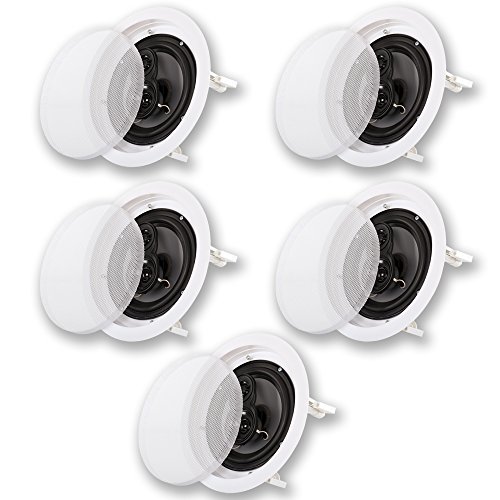
This 5-speaker pack is a full set aimed at whole-room or home theater installs. Each speaker is a 3-way design with 8″ poly cone woofers, poly mica midranges, and 13mm soft dome tweeters. The speakers include 3-way passive crossovers to increase fidelity and deliver a claimed frequency response of 40Hz–20kHz. Installation uses a pressure-lock mounting system and paintable ABS grills. These units suit large rooms needing greater low-frequency output than smaller 6.5″ models.
Acoustic Audio CS-IC83 In Ceiling 8″ Speaker 3 Pair Pack 3 Way Home Theater

This 3-pair pack repeats the CS-IC83 platform with emphasis on power handling (recommended 20–350W per speaker) and efficiency (~95dB). The combination of polypropylene cones, butyl surrounds, and progressive spiders aims to improve durability and low-end control. Spring-loaded terminals and paintable frames simplify wiring and finishing. Suitable for installers deploying multiple speakers across open floor plans or multi-room audio zones.
Polk Audio 70-RT 3-Way In-Ceiling Speaker

The Polk 70-RT is a dedicated 3-way in-ceiling design featuring a 7″ subwoofer, 2.5″ midrange, and 0.75″ dome tweeter. Polk’s patented Power Port and driver geometry aim to deliver extended bass down to the mid-30Hz range while limiting distortion from ceiling reflections. The unit includes installation templates and a rotating cam mount for a secure fit. Use this where deeper bass extension is needed from an in-ceiling speaker without adding an external sub.
Polk Audio RC80i 2-Way Premium In-Ceiling 8″ Round Speakers (Set of 2)
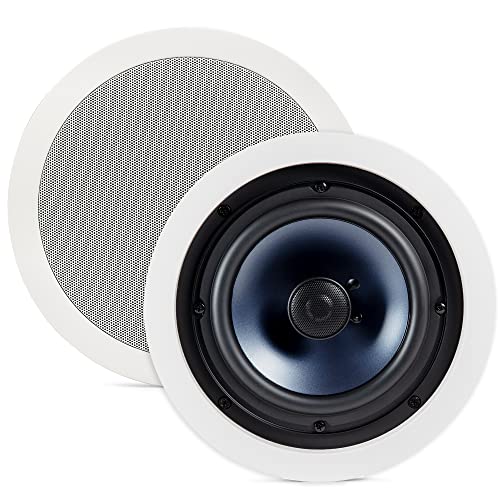
Although specified as a 2-way model, the RC80i is included because it’s commonly chosen in installations where humidity resistance matters. It pairs an 8″ Dynamic Balance woofer with an aimable 1″ tweeter and features a rubber moisture-seal for damp locations like bathrooms or covered porches. The mineral-filled polymer cone helps damping for lifelike sound. Consider this set when durable moisture protection is a priority alongside broad in-ceiling coverage.
Buying Guide: How To Choose The Right 3-Way Ceiling Speaker
Selecting the right 3-way ceiling speaker depends on room size, installation constraints, source power, and listening goals. Use the checklist below to compare options.
Driver Configuration And Sound Goals
- True 3-Way vs 2-Way: A true 3-way speaker separates low, mid, and high drivers for clearer midrange detail. If deep low-end from the ceiling is required, a 3-way with a dedicated sub/woofer driver or Power Port tech helps.
- Woofer Size: Larger woofers (7–8″) generally produce more bass and fill larger rooms; 6.5″ models suit smaller rooms or where thinner ceiling cavities exist.
Frequency Response And Efficiency
- Frequency Range: Look for extended low-frequency response (under 50Hz) if you want full-range sound without a subwoofer.
- Efficiency / Sensitivity: Higher sensitivity (dB @ 1W/1m) requires less amplifier power for a given volume; important if using low-power receivers.
Power Handling And Amplifier Matching
- Recommended Power: Match speaker power handling to your amplifier’s RMS output. Speakers with broad power ranges are more forgiving.
- Impedance: Most home ceiling speakers are 8 ohm; ensure your amplifier supports the load for multi-speaker arrays.
Installation Considerations
- Mounting Depth & Cutout Size: Verify ceiling cavity depth and cutout diameter before purchase — some speakers need shallow depths while others require more space.
- Mounting System: Cam-lock, pressure-lock, or screw clamps affect speed and security of retrofit installations.
- Pre-Construction Options: If building new walls/ceilings, look for brackets or pre-construction housing compatibility.
Room Acoustics & Placement
- Coverage Pattern: Wide dispersion suits living areas and open plans; aimable tweeters allow better on-axis response in asymmetric rooms.
- Placement: For surround setups, follow recommended speaker distances and heights; for whole-home audio, space speakers evenly for consistent coverage.
Environment And Durability
- Moisture Resistance: Choose moisture-sealed speakers for bathrooms, kitchens, and covered outdoor areas.
- Paintable Grilles: Many models include paintable frames and grills to blend with decor.
Features To Compare
- Crossovers: Higher-quality passive crossovers improve clarity between drivers and reduce overlap artifacts.
- Tweeter Design: Soft dome vs metal tweeters impact perceived detail and brightness; aimable tweeters allow tuning for listening positions.
- Warranty & Support: Consider brands with clear product support and documentation for installers.
Compare driver sizes, frequency specs, mounting depth, and power handling across shortlisted models to match your room size and amplification. If deep bass is essential, pair in-ceiling 3-way speakers with a dedicated subwoofer or select a model with enhanced porting technology.