Best 3 Way Monitor Speakers for Clear, Studio-Quality Sound
Answering the demand for true 3-way monitor speakers, this guide highlights five capable options suitable for home studios, living rooms, and compact entertainment setups. These speakers maximize clarity across lows, mids, and highs with dedicated drivers and advanced crossovers. They’re best for audio enthusiasts who want precise mixing, immersive music, and cinematic playback without external subwoofers. The top picks balance size, power, and feature sets for different rooms and budgets. Below you’ll find direct product links, concise why-to-pick notes, and a practical buying guide to help you compare at a glance.
Summary of Selected Products
| Product | Type | Best For | Notable Benefit |
|---|---|---|---|
| Sony CS Speakers SS-CS5M2 | 3-Way Bookshelf | Small spaces, bookshelf setups | Compact footprint with a 3-driver configuration |
| ULTIMEA BS-3 | 3-Way Powered Bookshelf | Home theater and immersive listening | Edge horn and BassMX for clear highs and deep bass |
| Edifier MR5 | 3-Way Active Studio Monitor | Home studio with room compensation | Hi-Res audio, multiple inputs |
| Kali Audio IN-5 | 3-Way Studio Monitor | Neutral mixes, recording | Coaxial driver for accurate imaging |
| ADAM Audio A8H-R | 3-Way Powered Studio Monitor | Professional reference listening | High-end 8″ woofer and DSP |
Sony CS Speakers SS-CS5M2 3-Way 3-Driver Hi-Res Bookshelf (Pair)

Features: Bookshelf speakers (pair), compact bookshelf design for small spaces, 3-way, 3 driver bookshelf speaker system, 5.12 in. woofer boosts low-end frequencies.
Best for: Small rooms, tight bookshelf setups where space is limited; users who want a three-driver arrangement without a large cabinet. This model emphasizes a stronger low end for compact form factors.
Why selected: The Sony SS-CS5M2 provides a straightforward, space-friendly 3-way design that yields more controlled bass than typical two-way bookshelf speakers. It’s a practical entry point for buyers prioritizing compact size with three drivers.
Caution: The compact cabinet may limit deep bass extension in very large rooms; pairing with a subwoofer could be considered if deeper bass output is needed.
ULTIMEA BS-3 3-Way Powered Bookshelf

Features: Dedicated 3-Way Acoustic Design with a 2.75” midrange, 5.25” woofer, 1” tweeter; grille-free design; Edge Horn technology; BassMX for deep 50 Hz bass with minimal distortion.
Best for: Living rooms or home theaters where a larger, more cinematic soundstage is desired without a separate subwoofer. The grille-free look emphasizes driver visibility and modern aesthetics.
Why selected: This model combines explicit three-way clarity with a design that emphasizes treble focus and deep bass reach, making it a strong all-around performer for music and movie audio.
Caution: Grille-free styling may expose drivers to dust or accidental impact; consider placement with protection in mind.
Edifier MR5 2.0 Studio Monitor

Features: 3-way active crossover with 5″ woofer, 3.75″ mid driver, 1″ silk dome tweeter; 46 Hz–40 kHz frequency response; Hi-Res Audio with 24-bit/96kHz wired and wireless LDAC; room compensation via rear knobs and app.
Best for: Home studios and desktop setups needing precise monitoring, flexible inputs, and room adaptation controls for accurate translation of mixes.
Why selected: The MR5 provides a well-rounded 3-way active design with practical room tuning options and modern wireless capabilities, making it a versatile choice for producers and music lovers alike.
Caution: Wireless LDAC and app features may require compatible devices and setup steps for optimal use.
Kali Audio IN-5 5-Inch Studio Monitor
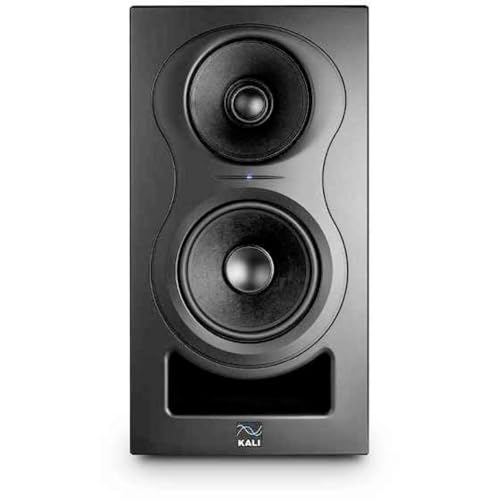
Features: 5″ coaxial midrange with 1″ tweeter, 160W tri-amped system, boundary EQ, XLR/TRS/RCA inputs; true point-source imaging with hyper-realistic localization; 3-way imaging with detailed soundstage.
Best for: Recording, mixing, and production environments where accurate imaging and neutral translation are critical across various playback systems.
Why selected: The IN-5’s coaxial driver design minimizes phase issues and provides precise on-axis imaging, a key criterion for critical listening and accurate mixes.
Caution: The 5″ woofer is more compact; in very large rooms, consider pairing with other room treatments or larger monitors for overall impact.
ADAM Audio A8H-R 8-Inch 3-Way Monitor (Right)

Features: 3-way powered studio monitor with an 8″ low-frequency driver and onboard DSP (right channel) plus a 3.5″ midrange driver; designed for high-end professional monitoring in studio and post-production environments.
Best for: Professional studios and serious enthusiasts seeking high-fidelity, reference-grade monitoring with robust bass extension and detailed high-frequency response.
Why selected: The A8H-R represents a higher-tier 3-way monitor option with advanced DSP and a larger woofer, offering detailed translation for complex mixes and cinema-quality playback.
Caution: Higher price and larger footprint; ensure you have adequate space and power available for optimal performance.
Buying Guide: Key Considerations For 3-Way Monitor Speakers
- Larger 3-way designs often require more room and careful speaker placement for balanced imaging. In small spaces, consider bookshelf-sized models with sufficient bass from a dedicated sub if needed.
- A true 3-way system uses dedicated drivers for lows, mids, and highs, plus a high-quality crossover to separate bands cleanly. This generally yields clearer mids and more controlled bass than 2-way designs.
- Powered models simplify setup and ensure adequate headroom. Match wattage to room size and listening levels to avoid distortion.
- Look for a mix of line-level and digital inputs (XLR/TRS, RCA, HDMI ARC in some cases) to fit your gear. Wireless options offer convenience but verify Bluetooth codecs and latency if used for professional work.
- Some models include room compensation or DSP features. These help adapt the sound to your space but may add complexity to the setup.
- If your goal is critical mixing, prioritize accurate imaging and flat response. For music listening, you may prefer a warmer, bass-forward sound with more forgiving room interaction.
- Higher-end 3-way monitors deliver refined sound but come at a higher price. Consider future upgrades, such as adding a sub, if you expect your needs to grow.
Frequently Asked Questions
- What is a 3-way monitor speaker? A 3-way monitor uses three separate drivers (bass, midrange, and treble) plus a crossover to split frequencies, delivering clearer, more detailed sound across the spectrum.
- Are 3-way monitors better for home use than 2-way? They can be, especially for mids and highs, but they require more space, power, and proper placement to fully benefit from the design.
- Do I need a subwoofer with 3-way monitors? Not always, but large or deep bass demands may benefit from a dedicated sub for extended low-end output in larger rooms.
- Which connection should I choose for best sound quality? XLR/TRS connections are typically preferred for balanced, noise-resistant audio, especially in studio settings. RCA is common for consumer gear.
- Can I use studio monitors for home theater? Yes, with appropriate room setup and calibration. Some models support HDMI ARC or other digital inputs for easy integration with TVs and receivers.
- What should I consider when buying 3-way monitors? Consider room size, listening goals (mixing accuracy vs. enjoyment), driver size, and whether you want active (powered) or passive designs with an external amp.