
Upgrade your car audio with 3-way speakers that deliver clearer highs, defined mids, and fuller bass. Below is a quick comparison of selected 3-way speakers to help you choose the right match for your vehicle and listening preferences.
| Product | Driver Size | Peak Power | Notable Feature |
|---|---|---|---|
| Pioneer TS-A1671F | 6.5″ | 320W | Wide frequency response (37 Hz–31 kHz) |
| JBL Stage 3637F | 6.5″ | — | Edge-driven dome tweeter |
| Rockford Fosgate R165X3 | 6.5″ | 180W | Coaxial 3-way stereo pair |
| JVC CS-J6930 | 6″x9″ | 400W | Carbon mica woofer + dedicated midrange |
| CT Sounds Meso 6.5” Component Set | 6.5″ | 500W Max (set) | 3-way component design for high output |
Pioneer A-Series TS-A1671F 6.5” 3-Way Speakers (Pair)

The Pioneer TS-A1671F features a true 3-way design with separate drivers for lows, mids, and highs to produce a balanced soundstage. Its listed maximum power handling is 320 watts with continuous handling at 70 watts, making it suitable for upgraded factory systems and modest aftermarket amplifiers. The speaker claims a wide frequency response from 37 Hz to 31 kHz, which suggests enhanced treble reproduction and deeper bass compared to many stock speakers. Installation adaptors are included to ease replacement into common factory locations.
JBL Stage 3637F 6.5″ Three-Way Car Speaker

The JBL Stage 3637F uses edge-driven dome tweeters and larger woofer cones to increase output and efficiency. JBL highlights improved sensitivity and a smoother high-frequency response, which helps articulate vocals and cymbals. These features make the Stage 3637F a practical choice when replacing factory speakers to get clearer highs and better midrange presence without major system changes.
Rockford Fosgate R165X3 6.5″ 3-Way Coaxial Speakers (4 Pack)

The Rockford Fosgate R165X3 is a common factory-replacement 3-way coaxial offering. Designed for broad compatibility, this set includes multiple speakers for door and rear installs. The R165X3 emphasizes reliable performance and ease of installation. The product listing references shipping and dimensions, and the speakers are marketed as a practical upgrade for everyday listening and improved detail compared to many OEM units.
JVC CS-J6930 6″x9″ 3-Way Car Speakers

The JVC CS-J6930 is a 6″x9″ 3-way design combining a carbon mica woofer, a dedicated midrange driver, and a polymer dome tweeter. The configuration aims to deliver stronger mids and lows while improving treble clarity. With a peak power rating of 400 watts and a wide frequency range (listed to 30 Hz–22 kHz), these speakers are positioned as an OEM-style upgrade for vehicles with 6×9 openings that need more output and better tonal separation.
CT Sounds Meso 6.5” 3-Way Component Speaker Set
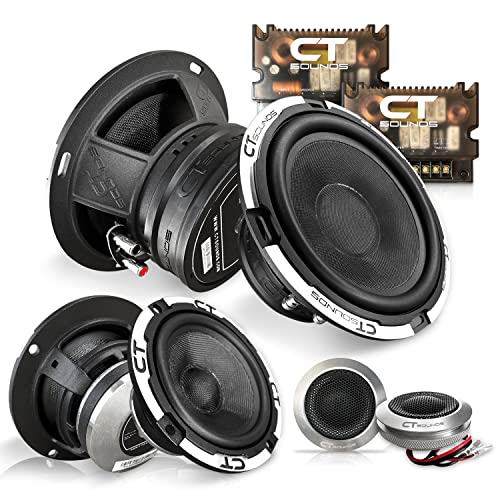
The CT Sounds Meso 6.5” component set provides a dedicated component approach with separate mid/woofer, midrange, and tweeter elements. The listing cites 250W RMS (500W peak) per set and a 4-ohm impedance, claiming the ability to play very loud with low distortion. As a component 3-way system, it offers more flexibility in speaker placement and tuning compared to coaxial 3-ways, which can improve imaging and staging when paired with proper crossovers and amplification.
Buying Guide: How To Choose The Right 3-Way Car Speakers
Selecting the best 3-way car speakers depends on vehicle fit, listening goals, and system support. Key factors to compare are listed below.
Driver Configuration And Sound Balance
- 3-Way Architecture: Offers dedicated drivers for lows, mids, and highs for improved clarity and separation over 2-way designs.
- Coaxial vs Component: Coaxials are easier to install and space-efficient. Component 3-way sets allow optimized placement of tweeters and midranges for better staging.
Power Handling And Amplification
- RMS vs Peak: RMS (continuous) values indicate realistic power handling; peak values are short-term maxima. Match speakers to an amplifier with appropriate RMS power for clean output.
- Sensitivity: Higher sensitivity speakers require less amplifier power to reach a given volume and are preferable if you plan to use factory head units.
Frequency Response And Tonal Goals
- Low-End Extension: Larger woofers (or 6″x9″ formats) and stronger cone materials tend to produce deeper bass. Check the low-frequency cutoff if bass is important.
- Midrange Clarity: A dedicated mid driver in true 3-way setups improves vocals and instruments.
- Tweeter Quality: Edge-driven domes or polymer domes affect treble smoothness and detail; aim for a natural high end without harshness.
Fitment And Installation
- Speaker Size: Confirm door or factory mounting size (e.g., 6.5″, 6×9″, 5.25″) and depth to avoid clearance issues.
- Adapters And Hardware: Some aftermarket speakers include adaptors for direct fit; component sets may need custom mounting and wiring for crossovers.
Materials And Durability
- Cone Materials: Polypropylene, carbon-mica, and treated paper each offer trade-offs in stiffness, weight, and damping for accurate sound reproduction.
- Surround And Weather Resistance: UV-resistant cones and durable surrounds help longevity in hot, humid car interiors.
System Integration And Tuning
- Crossover Quality: Built-in or external crossovers determine how well the drivers blend. Component 3-ways usually benefit most from higher-quality crossovers and tuning.
- Amplifier Pairing: Match speaker impedance and power handling to your amplifier to maximize fidelity and prevent damage.
- EQ And Sound Processing: Adjusting equalization can correct vehicle acoustics and improve perceived clarity and bass response.
Comparison Perspectives
- Budget Upgrades: Coaxial 3-ways such as Rockford Fosgate and select JBL models offer noticeable improvements over stock speakers with minimal installation complexity.
- Balanced All-Rounders: Pioneer A-Series and JVC 6″x9″ designs target listeners who want wider frequency coverage and better bass without adding external amplification in some cases.
- High-Output/Tunable Setups: Component 3-way systems like CT Sounds Meso are best for users planning an amplifier and custom tuning to maximize staging and SPL.