
Best 3-Way Stereo Speakers for Rich Home Audio in Any Room
Answering the search for the best 3-way stereo speakers, this guide highlights five solid options across bookshelf, floorstanding, and powered designs. The selections aim to balance clarity, bass, and soundstage for different listening spaces and use cases. Ideal buyers include small-room listeners seeking compact speakers, home theater starters, vintage turntable enthusiasts, and stereo listeners wanting enjoyable mids and highs with fuller low end. The table below summarizes each pick for quick comparison.
| Product | Type | Best For | Key Benefit |
|---|---|---|---|
| Sony SS-CS5M2 3-Way Bookshelf (Pair) | Bookshelf | Small spaces, primary stereo setup | Compact 3-way with boosted low end |
| Saiyin 3-Way Passive Bookshelf (Single) | Passive Bookshelf | Classic hi-fi, budget setups | Dedicated drivers for clear highs, mids, bass |
| Polk Audio T15 100W Bookshelf (Pair) | Bookshelf | Starter home theater | Balanced sound with deep bass at modest volume |
| Sony SS-CS3 3-Way Floor-Standing | Floorstanding | Large rooms, front channels | Strong 3-way design with robust cabinet |
| ULTIMEA BS-3 3-Way Powered Bookshelf | Powered Bookshelf | Studio-like monitoring and wireless setups | Dedicated midrange and BassMX enhanced bass |
Sony SS-CS5M2 3-Way Bookshelf (Pair)

Best for small spaces and listeners who want a fuller, room-filling sound from a compact form. These bookshelf speakers use a 3-way, 3-driver configuration to deliver clear highs with a strong low end from the 5.12-inch woofer. They suit desktop setups, apartment living rooms, and secondary listening rooms where space is at a premium. The 3-way design helps separate bass, mids, and highs for cleaner overall balance.
Who it’s best for: small-area listeners needing clear audio without oversized cabinets, and those establishing a versatile stereo system in a bedroom or office.
Limitations: compact woofers may not project as much bass in very large rooms; placement away from walls is recommended to maximize bass and minimize boundary boost.
Saiyin 3-Way Passive Bookshelf Speakers 5.25inch Woofer

Best for traditional hi-fi setups and turntable lovers who already own an amplifier. These are passive speakers; a receiver or amplifier is required, with speaker wires not included. The true 3-way design allocates tasks to a dedicated tweeter, midrange, and woofer, which helps reduce muddiness and keeps highs, mids, and bass distinct. The 5.25″ woofer enables deeper bass than typical compact models, down to 48 Hz when properly powered.
Who it’s best for: users building a dedicated audio system with an external amp or receiver, aiming for precise vocal clarity and classic stereo performance.
Limitation: requires separate amplification; not suitable for Bluetooth-only setups or wireless streaming without additional hardware.
Polk Audio T15 100 Watt Bookshelf Speakers

Best for beginners building a home theater or stereo system on a budget. The T15 employs a 0.75″ tweeter and a 5.25″ Dynamic Balance driver to deliver clear vocals, balanced sound, and solid bass at modest listening levels. Its front-ported design helps with bass extension and room placement flexibility, and it can be used as front, left-right, or rear speakers in a larger system.
Who it’s best for: entry-level listeners seeking straightforward, reliable performance without sacrificing room-filling sound.
Limitation: may require a separate subwoofer for deeper bass in larger home theater rooms or very loud playback scenarios.
Sony SS-CS3 3-Way 4-Driver Floor-Standing (Black)
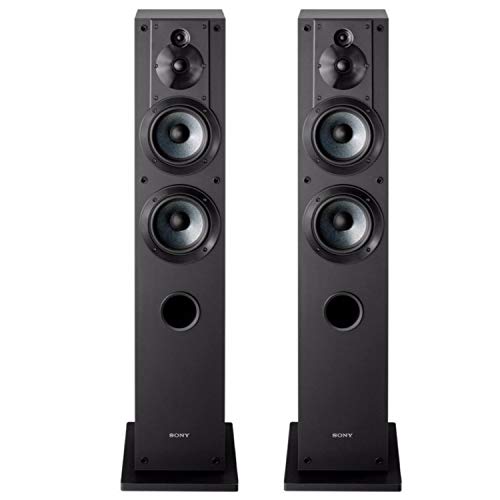
Best for larger living spaces and front-channel use in a home theater. As a floor-standing 3-way with four drivers, this model emphasizes a richer soundstage and more robust bass than smaller bookshelf designs. The design supports strong cabinet construction and wider dispersion for a fuller room coverage. It handles a wide frequency range with better impact for movies and music alike.
Who it’s best for: listeners who want big-room presence without adding external towers or subwoofers; suitable as a main left/right pair in a mid-size living area.
Limitation: larger footprint may not fit compact rooms; placement away from walls helps avoid bass buildup and acoustic muddiness.
ULTIMEA BS-3 3-Way Powered Bookshelf

Best for studio-like listening and powered-setup convenience. The BS-3 uses a 5.25″ woofer, a dedicated midrange, and a tweeter in a powered configuration. Edge Horn Technology directs treble toward the listening area for clearer highs and wider dispersion. Built-in amplification simplifies setup and reduces cabling needs, while BassMX technology delivers deeper bass with minimal distortion for room-filling sound.
Who it’s best for: users preferring compact, self-contained monitors for a desktop or small studio, or anyone who wants to minimize setup complexity without sacrificing multi-way clarity.
Limitation: built-in amplification may limit future upgrades if you want to move to higher-powered external amplification or reconfigure a larger system.
Buying Guide: Key Considerations for 3-Way Speakers
- Room size and layout: Larger rooms benefit from floorstanding 3-way designs or powered monitors with good bass extension. Smaller rooms are often better with compact bookshelf models to avoid overpowering space.
- Speaker type: Passive speakers require an amplifier or receiver; powered/shelf models include built-in amplification. Choose based on preferred setup simplicity.
- Driver configuration: A true 3-way design uses separate woofer, midrange, and tweeter drivers to reduce driver interference and deliver clearer mids and highs.
- Placement: Front-ported vs. rear-ported designs affect bass performance. Positioning near walls can boost bass but may muddy imaging; experiment with toe-in and distance from walls.
- Impedance and power handling: Ensure the amplifier or receiver can drive the speaker’s impedance and handle peak power without distortion.
- Use case: For movies, prioritize dynamic range and bass; for critical listening, emphasize accurate mids and highs.
- Wiring and compatibility: Passive speakers require speaker wire and compatible amplifiers. Check connector types and wiring length for your room.
Frequently Asked Questions
- What makes a speaker a 3-way design?
Answer: A 3-way speaker uses three separate drivers (typically woofer, midrange, and tweeter) to handle different parts of the frequency spectrum, reducing driver interference and improving overall clarity. - Do I need a subwoofer with 3-way speakers?
Answer: Not always. Some 3-way speakers provide strong bass on their own, but larger rooms or deep bass preferences may benefit from a subwoofer. - Are powered 3-way speakers easier to set up?
Answer: Yes. Powered models have built-in amplifiers, simplifying connections and reducing the number of components. - Which setup is best for a small apartment?
Answer: Compact bookshelf 3-way speakers, like the Sony SS-CS5M2, offer good balance and spatial efficiency without overwhelming the room. - Can I use 3-way speakers for a home theater?
Answer: Yes. They can serve as front speakers or main channels, delivering clear dialogue and immersive sound when paired with appropriate center, surrounds, and a subwoofer. - How should I place floorstanding vs. bookshelf speakers?
Answer: Floorstanding speakers are best for larger rooms with more space, while bookshelf speakers fit tighter spaces and can be positioned on stands or shelves for optimal imaging.