
Find the right 3-way tower speaker for music, movies, or gaming by comparing driver layouts, cabinet design, sensitivity, and room fit. Below is a quick comparison of the featured models to help you scan options before detailed reviews.
| Model | Brand | Key Feature |
|---|---|---|
| Sony SSCS3 (Single) | Sony | Hi-Res Audio, 3-way coaxial 4-driver system |
| Sony SS-CS3 (Pair) | Sony | 3-way 4-driver design with super tweeter |
| SVS Ultra Evolution Titan | SVS | Quad 6.5″ woofers in force-balanced opposed array |
| Polk Signature Elite ES60 | Polk Audio | 3-way, 1″ tweeter + three 6.5″ woofers, Power Port |
| Cerwin-Vega SL-12 | Cerwin Vega | 12″ woofer with dedicated midrange for punch and clarity |
Sony SSCS3 3-Way Floor-Standing Speaker (Single) – Black

This Sony SSCS3 tower is sold individually and aims to integrate into stereo or home theater systems. It uses a three-way coaxial, four-driver speaker system designed to cover a wide frequency range and deliver consistent imaging. The model is Hi-Res Audio compatible, making it suitable for higher-resolution sources.
- Driver Layout: Coaxial midrange/tweeter with additional drivers for expanded output.
- Use Case: Modular for building 5.1.2 Dolby Atmos setups with complementary Sony CS speakers.
- Cabinet: Floor-standing design intended for home theater or music listening.
Sony SS-CS3 3-Way 4-Driver Floor-Standing Speaker – Pair (Black)
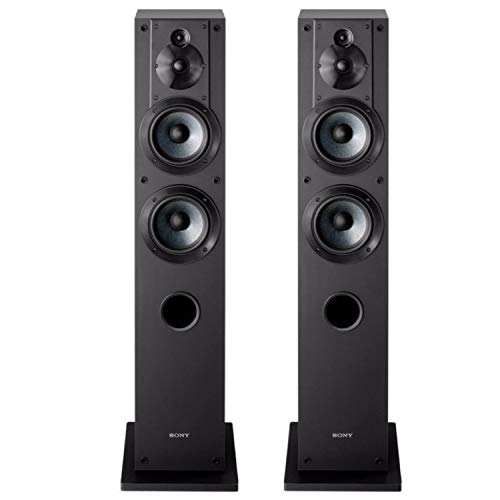
The SS-CS3 pair is a widely referenced entry-level 3-way tower option from Sony. It features a 1″ polyester main tweeter, 3/4″ super tweeter, and dedicated mid/bass drivers. The claimed 145W peak power and 6 Ohm nominal impedance provide compatibility with many AV receivers.
- Three-Way Design: Separate drivers for highs, mids, and lows help frequency separation.
- Components: Super tweeter for extended treble and a robust cabinet for reduced resonance.
- Best Fit: Readers seeking a matched stereo pair or front towers in a home theater.
SVS Ultra Evolution Titan 3-Way Tower Speaker – Each (Black Oak)

The SVS Ultra Evolution Titan is a high-performance 3-way tower with a Force-Balanced Opposed Array of quad 6.5″ woofers. Its acoustically-centered architecture targets coherent imaging and even bass distribution across a listening area.
- Bass Design: Opposed array reduces cabinet vibration while delivering deep, even bass.
- Driver Materials: Composite glass-fiber cones for stiffness and controlled pistonic behavior.
- Application: Suited for dedicated listening rooms and larger living rooms where output and accuracy matter.
Polk Signature Elite ES60 Tower Speaker – Contemporary Walnut

Polk’s ES60 is a 3-way tower with a 1″ Terylene tweeter and three 6.5″ woofers arranged in a Dynamically Balanced Acoustic Array. The design includes Polk’s Power Port technology intended to increase bass output while minimizing port noise.
- Array & Crossover: 2.5-way cascading crossovers for controlled transition between drivers.
- Bass Approach: Power Port technology to reduce turbulence and extend low frequencies.
- Compatibility: Hi-Res Audio certified and marketed for Dolby Atmos/DTS:X systems.
Cerwin-Vega SL-12 12″ 3-Way Floor Tower Speaker
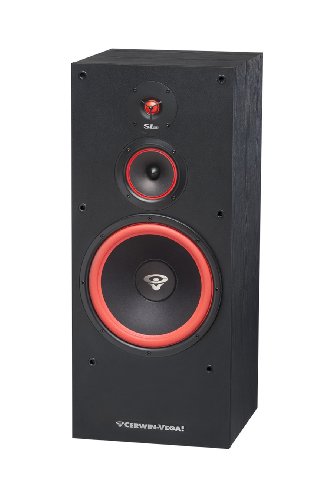
The Cerwin-Vega SL-12 emphasizes low-frequency impact with a 12″ woofer and includes a dedicated 5.25″ midrange for vocal clarity. Its 3-way system aims to deliver punchy bass while preserving midrange detail.
- Woofer Size: Large 12″ driver for enhanced low-end output and impact.
- Midrange Focus: Dedicated mid driver intended to improve vocal presence.
- Use Cases: Systems that prioritize bass-heavy music or require presence in larger rooms.
Buying Guide: How To Choose The Right 3-Way Tower Speaker
Understand Driver Configuration — A true 3-way design separates low, mid, and high frequencies across dedicated drivers. This reduces intermodulation and improves clarity in complex material.
Consider Placement And Room Size — Larger woofers and multiple woofers deliver greater SPL and deeper extension but need room space. Opposed-array designs and well-damped cabinets reduce cabinet vibration in high-output setups.
Check Sensitivity And Impedance — Higher sensitivity (dB/W/m) makes speakers easier to drive with modest amplifiers. Nominal impedance (commonly 4–8 ohms) determines amplifier compatibility; match speakers to your receiver’s capability.
Assess Cabinet And Porting — Ported designs (e.g., Power Port) increase bass output but may introduce port noise if poorly implemented. Sealed or force-balanced arrays can offer tighter bass and reduced turbulence.
Evaluate Tweeter And Crossover Design — Tweeter material and the crossover slope affect imaging and treble smoothness. Super tweeters or coaxial arrangements can improve high-frequency dispersion.
Driver Materials And Build Quality — Stiffer cone materials (e.g., glass-fiber composites) control breakup and improve transient response. Solid bracing and cabinets reduce resonances that color sound.
Match To Source And System — If using higher-resolution sources or Atmos content, consider Hi-Res certification and compatibility with Dolby Atmos speaker top modules or complementary center/subwoofer channels.
Compare Power Handling And Dynamic Headroom — Look at peak power and recommended amplifier power for headroom during dynamic passages without distortion.
Consider Aesthetics And Footprint — Tower speakers vary in height and finish; ensure they physically and visually fit the room and furniture layout.
Listen When Possible — Specifications help narrow choices, but auditioning speakers with familiar tracks or in-store demos provides the best sense of tonal balance, imaging, and bass performance.
Multiple Comparison Perspectives
- Performance vs. Price: Entry-level 3-way towers offer broad performance at lower cost; premium units focus on refined imaging and engineering.
- Bass Extension vs. Room Size: Larger drivers and multiple woofers benefit larger rooms; compact towers may be preferable in smaller spaces to avoid boomy bass.
- Accuracy vs. Liveness: Some designs emphasize flat, neutral reproduction for critical listening; others prioritize energetic, impactful sound for movies and pop/EDM.
- Compatibility: Ensure amplifier power and room acoustics match the speaker’s sensitivity and dispersion characteristics.