
Best 300 Watt Per Channel Amplifiers for High-Power Car Audio Systems
Answering the needs of serious car audio enthusiasts, this guide highlights 300 watt per channel amplifiers that deliver strong, clean power at 2 ohms. The selected models are suited for demanding multi-speaker setups, including subwoofers and full-range drivers, in cars, ATVs, and boats. Each pick is evaluated for best-use case, installation flexibility, and practical limitations. Below, you’ll find concise, comparison-friendly details to help you choose the right amp for your system and installation constraints.
Summary table of selected products:
- PRV Audio MDX1200.4: 4 x 300W @ 2Ω, bridgeable for higher output
- Recoil DI1200-4: 4 x 300W @ 2Ω, versatile controls and protection
- Taramp’s TS 1200: 4 x 300W @ 2Ω, full-range with crossovers
- CT Sounds CT-300.4D: 4 x 450W @ 2Ω (rated) but designed for robust 2Ω operation
- T300HS: 300W + 300W per channel, 2.0 channel board with TPA3255
PRV Audio MDX1200.4 2 Ohm Mini 4 Channel Amplifier
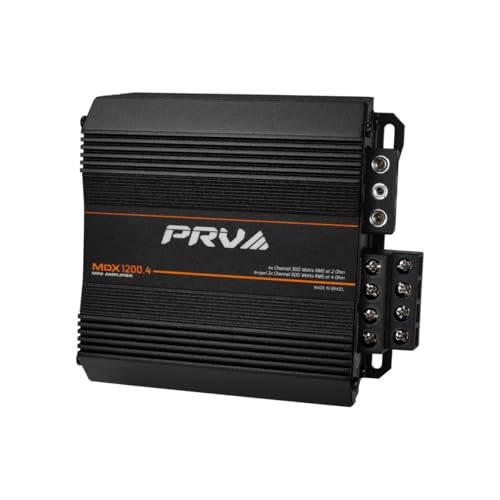
Best for: Power-hungry multi-speaker systems in tight vehicle spaces where 2-ohm stability matters. This amp provides 4 x 300W RMS at 2Ω and can be bridged to double output per channel pair, enabling flexible configurations for front-to-rear or bridge-to-sub setups.
Why selected: It specifies true RMS performance at 2Ω, with digital Class D efficiency and the ability to bridge two channels for higher output. This makes it a straightforward upgrade for compact builds seeking high sustained power without excessive heat or size.
Caution: The listing emphasizes 2Ω and bridging; ensure your speaker impedance and wiring plan support 2Ω and bridged modes to avoid overload.
Recoil DI1200-4 Full-Range Class-D 4-Channel Amplifier

Best for: Versatile four-channel setups requiring strong 2Ω performance with extensive tone controls. RMS ratings include 300W x4 at 2Ω and 210W x4 at 4Ω, with bridged output at 4Ω for higher power to select channels.
Why selected: It offers a high-speed MOSFET supply and robust protection circuitry for long sessions. The adjustable gain, LPF, HPF, and bass EQ enable precise tuning across a multi-speaker system.
Caution: The manufacturer notes a broad feature set; confirm your wiring and protection configuration matches the install to maximize reliability.
Crown XLi800 Two-Channel 600-Watt Amplifier

Best for: Two-channel setups needing solid, reliable power and straightforward operation. Provides 300W continuous per channel into 4 ohms, with a bridged option that can deliver more when configured for higher impedance loads.
Why selected: Crown amps are known for dependable, pro-grade performance and simple integration with PA or car audio systems. The XLi800 is a compact option for folks who prioritize durability and consistent output.
Caution: Power ratings at 4 ohms; for a “300W per channel at 2Ω” use case, verify that the system impedance matches the amplifier’s ratings and that you’re not overdriving the load.
Taramp’s TS 1200 Watt 4-Channel Amplifier

Best for: Demanding multi-speaker systems where 2Ω operation and high power per channel are required. This model delivers 4 x 300W RMS at 2Ω or 2 x 600W bridged at 4Ω, with full-range capability and tuning features.
Why selected: It’s designed for high output with robust protection, making it a strong match for enthusiasts who push their audio systems toward stadium-level playback in a car or UTV.
Caution: Ensure wiring, fusing, and installation meet the demands of bridged configurations to avoid improper loading or overheating.
CT Sounds CT-300.4D 1800W RMS Full-Range 4-Channel Amp

Best for: High-power four-channel systems that demand robust RMS output with clarity at 2Ω. Rated 450W x4 @ 2Ω, with 4-channel MOSFET supply for efficient operation and strong headroom.
Why selected: The CT Sounds line is known for bold power delivery and tailored tuning options, making it a solid choice for audiophile-grade car installs that still require brute force for bass or full-range channels.
Caution: This unit’s higher output at 2Ω means careful speaker matching and enclosure design. Verify compatibility with existing components before upgrading.
Buying Guide: Key Considerations For 300W Per Channel Car Amplifiers
- Impedance and power: Confirm the speaker impedance you plan to use and ensure the amp delivers 300W per channel at that load (commonly 2Ω). Bridging modes can increase per-channel power but require compatible drivers.
- Channel configuration: Decide between 4-channel amps for full-range or separate bridged channels for subwoofers. Multi-channel amps simplify wiring and reduce space compared with single-channel high-power amps.
- Efficiency and heat: Class D designs offer high efficiency and cooler operation in compact spaces. Look for features like protected MOSFET power supplies and thermal protection for reliability.
- Controls and tuning: Independent bass/treble, LPF/HPF crossover options, and adjustable gain help tailor sound to vehicle acoustics. A good tuning interface reduces the risk of overloading speakers.
- Installation considerations: Check mounting depth, wiring gauge, fuse protection, and remote turn-on compatibility. Factory radio integration (where applicable) and OEM-ready inputs can simplify installs.
Frequently Asked Questions
- What does “300W per channel at 2Ω” mean? A: It means each channel can deliver 300 watts of continuous power when the speaker load is 2 ohms. Power increases or decreases with different impedances and bridged configurations.
- Is 4-channel power better than 2-channel with bridged outputs? A: It depends on your system. Four channels provide flexibility for four speakers; bridged channels offer higher power to specific speakers like subwoofers, but require compatible drivers and wiring.
- How important is amplifier efficiency? A: Highly important for heat management and battery draw. Class D amplifiers provide high efficiency, allowing more output with less heat in small spaces.
- Can I mix different brands in a single system? A: Mixing is possible but not ideal. Consistency in power capability and crossover compatibility helps maintain balanced sound and reduces risk of driver damage.
- What should I consider when bridging channels? A: Ensure the bridged channel is designed for the intended impedance, and verify the load does not drop below the amp’s safe range. Use appropriate speaker drivers rated for the bridge load.
- Do these amps require professional installation? A: Not always, but proper wiring, impedance matching, and protection integration often benefit from professional installation to maximize performance and reliability.