
Best 3500 Watt 2-Channel Amplifier Buyer’s Guide
Answering the search intent: for readers seeking high-power, two-channel car amplifiers around 3500 watts, these options balance raw power with practical tuning features. The top picks are best for car audio enthusiasts upgrading front/rear speakers, or building a strong subwoofer setup in two-channel configurations. Each listed option highlights who it’s best for and why it stands out, with clear trade-offs to help you decide.
Summary table of selected products
| Product | Wattage (Approx.) | Best For | |
|---|---|---|---|
| AUDIOTEK AT3500S 2-Channel | Up to 3500W | Two-channel setups or bridged mono sub duty | Tri-mode operation and heavy heat sink |
| ORION CBA3500.4 Cobalt Series | 3500W (4-channel) | 4-channel systems needing robust power | Low-level inputs; MOSFET supply |
| Orion CBA2500.2 Cobalt Series | 2500W (2-channel) | Two-channel car audio with high power | Efficient Class A/B design |
| Pyramid PB3818 | Up to 5000W (2-channel bridgeable) | High-output two-channel builds | MOSFET, bass boost, crossovers |
| Taramps HD 3000 | 3000W RMS (2 Ohm) | Powerful two-channel systems with 2-ohm stability | Class D architecture |
AUDIOTEK AT3500S 2 Channel Class AB Car Amplifier

Features include up to 3500 watts of power, two-channel operation, bridgeable mode, and a tri-mode setup for mixed speaker and subwoofer arrangements. The heavy aluminum heat sink supports thermal management during demanding playback, and the MOSFET supply helps maintain controlled power delivery. This amp is best for buyers who want robust two-channel performance with the option to bridge for higher mono output.
- Best for upgraded front/rear speakers or a bridged sub setup
- Better for users who value a stable 2-ohm operation and heat management
- Avoid if you need a compact, ultra-light unit for limited space
Skar Audio RP-3500.1D Monoblock Class D Power Amp
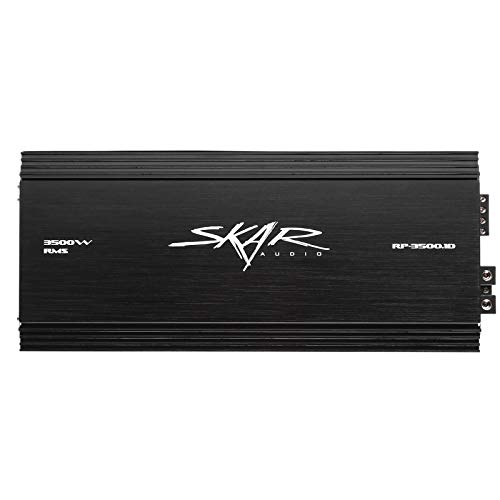
Reference: This is a 3500W Class D monoblock amplifier with a remote subwoofer level control. It delivers peak power near 3500W and is stable at low impedance, making it ideal for a high-output sub setup. Best for bass-focused builds where a single-channel amp is preferred for the sub, but note it is a monoblock design rather than a true two-channel unit.
- Best for subwoofer-focused systems needing high power
- Better for installers prioritizing remote level control
- Avoid if you specifically need a two-channel stereo configuration
ORION CBA3500.4 Cobalt High Efficiency 4-Channel Amp

This 4-channel amplifier delivers robust power with a MOSFET supply and low-level inputs. It’s designed to power car speakers across four channels with strong frequency response and efficient operation. Best for multi-speaker setups needing high continuous power; suitable when you want balanced performance across channels, not just sub duty.
- Best for multi-speaker configurations needing consistent power
- Better for users who want low-level input compatibility
- Avoid if you strictly need a two-channel amplifier for a two-speaker + sub setup
ORION CBA2500.2 Cobalt High Efficiency 2-Channel Amp
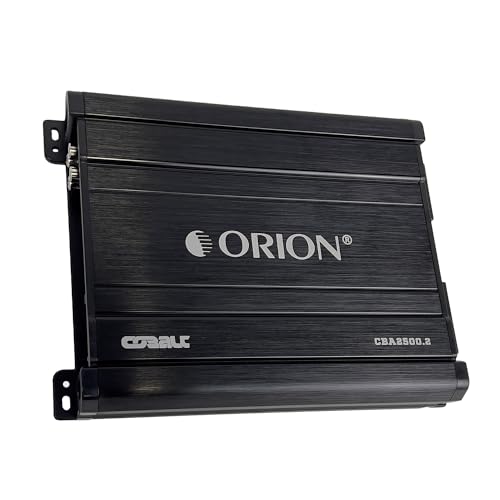
Two-channel amplifier with 2500W continuous power. This option is best for two-channel systems requiring substantial output without bridging. It emphasizes efficiency and MOSFET-based power, making it a practical choice for two-channel setups that demand high power per channel.
- Best for high-power two-channel systems
- Better for setups where space is adequate and two channels are sufficient
- Avoid if you specifically need 3500W per channel or a dedicated sub amp
Pyramid PB3818 2 Channel Car Stereo Amplifier

Offers up to 5000W bridgeable two-channel output, with MOSFET power supply and crossovers. This unit is suitable for very high-output two-channel builds or bridged configurations to drive subs. Best for users who want maximum wattage and flexible crossovers, but ensure space and electrical system can handle the load.
- Best for extreme two-channel or bridged sub setups
- Better for users who need adjustable crossovers and bass boost
- Avoid if you need compact dimensions or simple two-channel only, due to higher power draw
Buying Guide
Power needs and speaker configuration
- Two-channel vs. mono-block: If you want stereo sound across two full-range channels, prioritize two-channel models. For big subwoofers, a high-watt mono-block can be ideal.
- Impedance compatibility: Check whether the amp is stable at 2 ohms or 1 ohm. Lower ohm stability means more possible power but requires proper electrical and thermal management.
Efficiency, heat management, and build quality
- Class AB vs. Class D: Class AB can deliver clean, linear sound with more heat; Class D delivers higher efficiency and less heat, suitable for high-power subs or multi-channel setups.
- Heatsinking and chassis design: A heavy aluminum heat sink helps maintain performance during long listening sessions.
Inputs, controls, and installation considerations
- Low-level inputs (RCA) provide compatibility with most head units; confirm input types before purchase.
- Remote bass/level controls are helpful for sub tuning in real-time without changing head unit settings.
Budget and installation environment
- Consider space, wiring gauge, and vehicle electrical capacity. High-power amplifiers can draw more current, so ensure your alternator and wiring are up to the task.
- Bridging capabilities: If you plan to run subs, confirm if the amp supports bridging and the resulting impedance.
FAQs
- Q: What is the difference between a 3500W two-channel amp and a 3500W mono amp? A: A two-channel amp powers two separate outputs, suitable for stereo speakers, while a mono amp delivers increased power to a single channel, typically used for subwoofers.
- Q: Is 2-ohm stability important for a 3500W amp? A: Yes, 2-ohm stability allows higher current delivery; ensure your wiring and components can handle the load.
- Q: Should I choose Class D or Class AB for a high-wattage amp? A: Class D offers higher efficiency and heat management at high power, while Class AB may deliver cleaner traditional sound at the cost of more heat.
- Q: Do I need a remote bass control? A: A remote bass control helps adjust sub level on the fly without touching the head unit, useful for tuning while driving.
- Q: Can I bridge a two-channel amp for more power? A: Some two-channel amps support bridging to create a higher-output single channel; verify the model’s bridging option and impedance limits.
- Q: How do I ensure compatibility with my car’s electrical system? A: Check total wattage, consider wiring gauge (4 AWG or thicker for high power), and ensure your alternator and battery can handle the load.