
Compact Guide: This article compares five 15-inch subwoofers and ready-made enclosures relevant to building or selecting a 4‑15 inch subwoofer box. Below is a quick summary table of the selected products to help you match drivers to box types before the detailed sections.
| Product | Type | Key Feature |
|---|---|---|
| Skar Audio EVL-15 D4 | Subwoofer (single) | 2,500W peak, dual 4Ω |
| Skar Audio SDR-15 D4 Pair | Pair of subs | Sold as package, 1,200W peak each |
| H YANKA BSF-15-4 | Subwoofer (single) | 2,000W max, paper cone |
| CT Sounds Bio 15” | Subwoofer (single) | 1,000W max, dual 4Ω |
| Q Power Q Bomb 15″ Ported Enclosure | Ported box | Dual vented chamber, MDF |
Skar Audio EVL-15 D4 Subwoofer
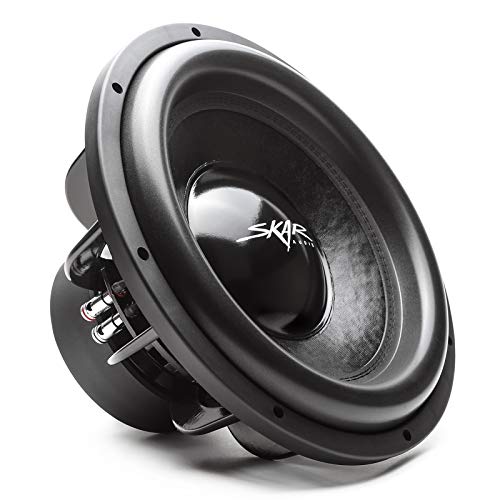
This 15-inch competition-grade subwoofer from Skar Audio lists a peak power of 2,500 watts and RMS of 1,250 watts. Its dual 4-ohm configuration and 3″ high-temperature voice coil support high power handling and long-term thermal stability. For a 4-driver box layout, wiring options with dual 4Ω coils provide flexibility to achieve desired final impedance for your amplifier.
- Features high-temperature dual voice coil for heavy-duty use.
- Suitable for sealed or ported high-displacement boxes when planning large-volume enclosures.
- Consider venting size and internal bracing—this driver can produce significant excursion requiring sturdy cabinet design.
(2) Skar Audio SDR-15 D4 Pair

This listing contains two SDR-15 D4 15-inch drivers. Each driver has a peak of 1,200W and RMS of 600W, featuring a 2.5″ high-temp 4-layer copper voice coil. Sold as a pair, these are often used in multi-sub arrays or matched with enclosures designed for two drivers per chamber in a 4-driver build.
- Pair packaging simplifies matching drivers in multi-sub boxes.
- Lower RMS than competition models but still viable for balanced systems.
- When planning a 4×15 layout, pairs can be mounted in dual-chamber ported boxes or stacked sealed compartments for compact fits.
Skar Audio SDR-15 D4 Single Subwoofer

The single SDR-15 D4 shares specifications with the pair variant: 1,200W peak and 600W RMS, plus a 2.5″ copper voice coil. For DIY builders, single-driver units are useful when designing custom 4×15 arrays—either four separate sealed boxes, two dual-chamber enclosures, or a larger shared ported enclosure.
- Good option when mixing models or staging phased arrays.
- Voice coil and motor structure support moderate excursion for accurate low frequencies.
- Plan chamber volume per Thiele/Small parameters for optimal response.
H YANKA BSF-15-4 15 Inch Subwoofer

The H YANKA BSF-15-4 lists a high 2,000W max and 1,000W RMS. It uses a 15-inch paper cone and a black aluminum basket with a dual 2.5″ voice coil. The spec sheet highlights a wide frequency range and competition-focused magnet assembly, suggesting powerful output and substantial cone excursion.
- High RMS rating makes it suitable for demanding ported enclosures tuned for deep bass.
- Paper cone and large motor indicate strong low-end presence; consider damping and bracing in box design.
- Dual 4Ω wiring flexibility supports both mono and bridged amplifier schemes for 4-sub systems.
CT Sounds Bio 15” Dual 4-Ohm Subwoofer

The CT Sounds Bio 15” specifies 1,000W max and 500W RMS with a 2.4″ 4-layer copper voice coil. It is a lighter-rated alternative for builders seeking efficient 15″ drivers with good thermal handling. This model can be used in multi-driver sealed or ported boxes where lower excursion and tighter bass are desired.
- Balanced option for smaller enclosures or under-seat installations in custom crates.
- Lower RMS supports compact ported tuning for faster transient response.
- Pairing four of these or mixing with higher-rated models requires careful amplifier matching to avoid clipping.
Q Power Q Bomb 15″ Ported Subwoofer Enclosure

This ported 15-inch enclosure from Q Power features a dual vented chamber design, 0.75-inch MDF construction, and a bed liner finish. It’s offered as a ready-made box suitable for one or two 15″ drivers depending on model and internal volume. For DIY builders, using its dimensions as a reference can speed up construction of a four-driver multi-chamber ported cabinet.
- Dual vented chamber design promotes deeper low frequencies and controlled airflow.
- MDF and bed-liner finish improve durability and interior damping.
- Spring-loaded terminals simplify wiring for multiple drivers in parallel or series arrangements.
Q Power Q Bomb Single Vented 15″ Enclosure

The single vented chamber variant provides a different tuning characteristic than the dual chamber box. For a 4×15 project, combining single and dual chamber designs—or mirroring chamber volumes—can alter the system’s overall transient and low-frequency response. Q Power’s reliable MDF construction gives a practical baseline for DIY scaling.
- Single vent tuning typically offers punchier mid-bass compared to dual vent designs.
- Useful as a benchmark when calculating required volume per driver in multi-sub builds.
- Terminal choice facilitates cascading boxes for multi-enclosure builds in trunks or cargo areas.
Buying Guide: Choosing The Right 4×15 Subwoofer Box Design
Designing a 4 15-inch subwoofer box requires balancing driver specs, enclosure volume, tuning, wiring, amp power, and vehicle space. Below are key considerations and comparison perspectives to guide selection or blueprint development.
Driver Specifications And Compatibility
- RMS vs Peak: Use RMS ratings to match amplifier continuous power. Avoid sizing amps solely on peak numbers.
- Voice Coil Configuration: Dual 4Ω coils offer wiring flexibility. Four dual-4 drivers can be wired to reach many final impedances—plan wiring to match your amplifier’s optimal load.
- Thiele/Small Parameters: Obtain each driver’s Fs, Vas, Qts for accurate box volume and tuning calculations.
Enclosure Type And Volume
- Sealed Boxes: Smaller volume, tighter bass, better transient response. Typically require more power to reach same SPL.
- Ported Boxes: Larger volume with tuned ports for deeper extension and higher efficiency at tuned frequencies. Requires careful port area and length calculations for four drivers.
- Bandpass/Chambered Designs: Offer high output in narrow bands but are complex and less flexible for mixed music.
Wiring And Impedance Management
- For four dual 4Ω drivers, common wiring topologies include series-parallel to achieve final impedances like 1Ω, 2Ω, or 4Ω—pick what your amp handles efficiently.
- Series wiring raises impedance and can reduce current draw; parallel lowers impedance and raises required current—both affect power delivery and thermal stress.
Structural Considerations
- Material: 0.75″ MDF is standard for stiffness and low resonance. Use internal bracing where large panels can flex under pressure.
- Bracing And Damping: Large four-driver boxes need heavy bracing and internal damping to control standing waves and panel vibrations.
- Port Placement: Place ports to avoid turbulence and ensure smooth airflow—use flared ports when possible to reduce noise.
Vehicle Fit And Practicality
- Measure cargo/trunk space and shape your box design to fit while maintaining required internal volume.
- Consider modular designs (two dual-chamber boxes) for easier installation and flexibility in cargo use.
Amplifier Matching And Thermal Management
- Choose an amplifier that can deliver recommended RMS at the box’s final impedance without clipping.
- Allow airflow and ventilation around amps and consider thermal protection features to prevent overheating in high-power 4×15 systems.
Comparison Perspectives
- Power Handling vs Efficiency: High-RMS drivers require more robust enclosures and amps but yield louder SPL; efficient drivers can deliver good output with less amp power.
- Sealed vs Ported Sound: Sealed for tight, musical bass; ported for extension and SPL. For multi-sub cars, blended approaches can provide the best of both worlds.
- Ready-Made vs DIY: Ready enclosures (Q Power) simplify build time and tuning assumptions, while DIY allows optimization for specific driver Thiele/Small parameters and vehicle constraints.