
Best 4 Channel Microphone Mixer Options for Home Studio and Podcasting
Finding the right 4 channel microphone mixer comes down to your setup, connectivity, and whether you need passive or active operation. This guide highlights five solid choices across different use cases, from compact home studios to portable podcast setups. Best for: home studios needing clean preamps, podcasters requiring flexible inputs, and broadcasters seeking compact, reliable routing. Below is a quick comparison to help you decide which model fits your workflow.
| Product | Best For | Key Benefit |
|---|---|---|
| Shure SCM268 | Small studios and live events | Phantom power and transformer-based isolation |
| SQWRWY 4-Channel | Simple, passive signal routing | No power needed, clean summing |
| YGiTK Mini Audio Mixer | Compact multimedia setups | 4 inputs with flexible 3.5mm and 6.35mm jacks |
| LZSIG Mini Audio Mixer | Multi-source small rigs | Ultra-low noise with 4-in-1 design |
| TKLBLS 4 Channel Podcast | Streaming and recording | 4 channels with 48V phantom and DSP-ish features |
Shure SCM268 4-Channel Microphone Mixer

The Shure SCM268 is designed for small studios and live sound environments that require multiple microphone inputs with built-in processing. It features one unbalanced aux output, five unbalanced aux inputs, and a built-in low-cut filter along with transformer-based isolation for cleaner signal routing. This model is best for buyers who value reliability and the traditional Shure build in compact form. A potential limitation is the reliance on unbalanced outputs for certain setups, which may be more susceptible to noise over long cable runs.
Who it’s best for and why
- Best for: small studios, houses of worship, or live event setups needing multiple mic inputs with simple routing.
- Why selected: robust reputation, built-in features like low-cut filter, and practical aux routing capabilities.
SQWRWY 4-Channel Passive Microphone Mixer

This passive mixer combines four mic or line sources into a single balanced output without external power. It preserves balanced audio quality thanks to transformer isolation and supports both XLR and TRS connections. It’s best for scenarios where you want a simple, noiseless summing solution and already have a powered mixer or interface downstream. A caveat is that it provides no onboard amplification or phantom power, so condenser mics must be powered elsewhere.
Who it’s best for and why
- Best for: podcasting setups that need clean, passive summing of multiple mics.
- Why selected: power-free operation, reliable signal integrity, and flexible input options.
YGiTK Mini 4-Channel Audio Mixer

The YGiTK unit offers four inputs with independent level controls and flexible output modes, supporting both 6.35mm and 3.5mm connections. It is compact and suitable for small clubs, home studios, or portable podcast setups. The device emphasizes low-noise performance and ease of use, but users should expect basic features without extensive onboard effects. It’s a practical choice when you need quick, reliable routing in a tight space.
Who it’s best for and why
- Best for: travelers, small venues, or desk setups needing quick input-to-output routing.
- Why selected: versatile input compatibility and simple, independent channel control.
LZSIG Mini Audio Mixer
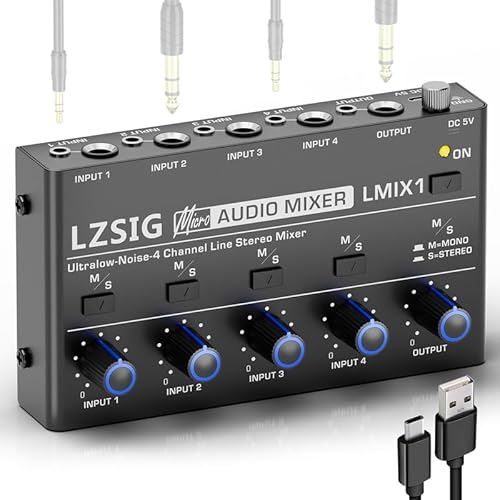
The LZSIG 4-channel mixer is built for flexible multi-source routing with ultra-low noise output. It supports four inputs and can switch between mono and stereo, making it suitable for simple home studios or live setups requiring clean, reliable sound. A potential limitation is that the unit is designed for straightforward mixing rather than extensive effect processing, so users needing deep routing or advanced features may need additional gear.
Who it’s best for and why
- Best for: users who want a compact, quiet mixer for multiple sources (instrument, mic, etc.).
- Why selected: professional-grade noise performance in a small package and flexible mono/stereo modes.
TKLBLS 4 Channel Podcast Audio Mixer

The TKLBLS 4 Channel Podcast Mixer includes 48V phantom power, XLR inputs, and DSP-like effects via built-in processing. It’s suitable for home studios and streaming setups that require condenser mics and clear vocal capture. A caution is that this model emphasizes basic DSP-like features rather than full-fledged professional effects, so complex studio workflows may need additional gear.
Who it’s best for and why
- Best for: podcasters and streamers needing phantom power and straightforward on-device processing.
- Why selected: supports condenser mics with phantom power and convenient USB-like input options for recording and streaming.
Buying Guide: Key Purchase Considerations For 4-Channel Mixers
Do you need active or passive operation?
Active mixers include built-in amplification and often phantom power, ideal for lower-noise mic preamps. Passive options rely on external amplification or interfaces and are simpler, sometimes cheaper, but may require additional gear to drive outputs.
How many microphones and sources do you plan to connect?
Count inputs carefully. If you plan to connect more than four mics or include instruments, consider a model with flexible input types (XLR and TRS) and good headroom to prevent distortion.
Is phantom power a requirement?
Condenser microphones require 48V phantom power. If you use only dynamic mics, phantom power is optional, but most modern four-channel mixers offer it for versatility.
What kind of outputs do you need?
See whether you need balanced outputs for long cable runs, unbalanced aux sends for monitoring, or USB/line outputs for computer integration. Passive units often rely on external interfaces for final amplification or recording.
Does the device include noise control and filtering?
Low-cut filters and noise reduction help when recording near HVAC systems or in small rooms. Look for units that explicitly mention a low-cut or high-pass filter on the mic inputs.
Portability and space considerations
For mobile setups, prioritize compact form factors and robust build quality. Some units are designed to travel easily and are ideal for on-the-go podcasts or remote sessions.
FAQ
What is a 4-channel mixer best used for?
It is best for routing multiple microphones or line-level sources to a single output or recording device, suitable for small studios, podcasts, or live events.
Do I need phantom power for my microphones?
Only if you use condenser mics. Dynamic mics do not require phantom power. Check your mic specs and the mixer’s phantom power capability.
What’s the difference between passive and active mixers?
Passive mixers require external amplification and power stages, while active mixers include internal amplification, preamps, and sometimes built-in effects or processing.
Can I use a 4-channel mixer with a computer?
Yes. Many mixers provide line-level or USB/analog outputs that feed into a computer’s audio interface or mixer-capable software.
Which features matter most for podcasting?
Independent channel level controls, phantom power for condenser mics, clean preamps, low-noise performance, and straightforward routing to a single interface or recorder.
Is buzzing or hum common with small mixers?
It can be caused by grounding issues, cable runs, or poor shielding. Choose a model with good isolation and proper grounding, and keep cables organized to minimize noise.