
Best 4 Inch Bookshelf Speakers for Small Rooms and Turntables
Answering the common question, these 4-inch bookshelf speakers offer compact footprint with clear, balanced sound suitable for small rooms, home theaters, or setup with turntables. This guide focuses on models that pair well with compact receivers or integrated amps and are ideal for near-field listening, computer desks, or bookshelf setups. The top picks below are best for budget-conscious living spaces, versatile multimedia use, or casual critical listening. A quick summary table is included to compare key points at a glance.
Product Comparison at a Glance
| Product | Best For | Impedance | Notable Note |
|---|---|---|---|
| Saiyin 5″ Woofer Passive Speaker | Critical listening in compact rooms | 4 Ohms | Passive; requires amp/reciever |
| Pyle 4” Mini Cube Bookshelf Speakers (PCB4BK) | Home theater on a budget | 8 Ohms | Video shielded; lightweight |
| RIOWOIS Passive Bookshelf Speakers (Turntable Friendly) | Turntable + amp setups | Passive (amp needed) | Silk dome horn tweeter |
| Dayton Audio Classic B40 | Hi-fi listening in small spaces | 4 Ohms | Dedicated crossover; sealed cabinet |
| Klipsch R-41M | Audiophile-leaning small room setup | 8 Ohms | Tractrix horn; 4″ woofer |
Saiyin 5″ Woofer Passive Speaker

Best for: Critical listening in compact spaces where a dedicated amp or receiver powers passive speakers. It uses a 20mm silk dome tweeter for refined highs and a 4-ohm impedance requiring a compatible amplifier. The design prioritizes vocal clarity and a compact footprint.
- Pros: Crystal-clear vocals; compact dimensions (6.5″ W x 10.6″ H x 7.5″ D).
- Cons/Limitations: Wired connection only; speaker wires not included; not wireless.
Why selected: It emphasizes vocal detail and clarity ideal for near-field listening with turntables or small stereo setups when paired with a suitable 4-ohm amp.
Pyle Home 4” Mini Cube Bookshelf Speakers

Best for: Entry-level home theater setups and compact desktops where 8-ohm impedance and small footprint fit the room and budget.
- Pros: Full-range mini system; suitable for small spaces.
- Cons/Limitations: 8-ohm impedance may be less efficient on some older amps.
Why selected: A straightforward, space-saving option that integrates easily into budget home theater arrangements and computer desks.
RIOWOIS Passive Bookshelf Speakers (Turntable Friendly)
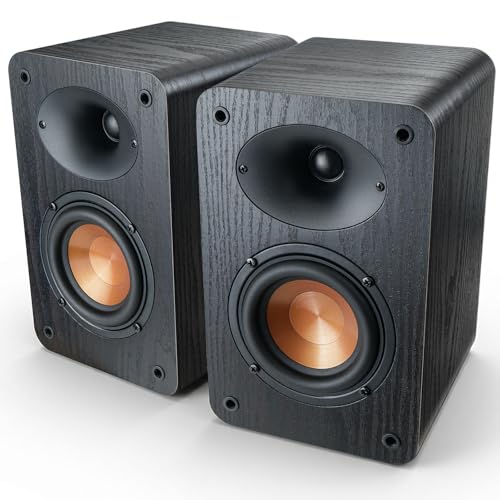
Best for: Turntable setups and compact rooms seeking a rich soundstage with detailed highs from a silk dome tweeter.
- Pros: Silk dome horn tweeter for clear highs; deep bass extension with rear bass port.
- Cons/Limitations: Requires separate receiver or amplifier; speaker wires not included.
Why selected: Combines a refined high-frequency experience with efficient bass from a compact enclosure, making it flexible for various small-room configurations.
Dayton Audio Classic B40

Best for: Small to medium rooms where a true hi-fi two-way bookshelf speaker with a dedicated crossover is desired.
- Pros: 4″ woofer + 1″ silk dome tweeter; balanced low-end performance.
- Cons/Limitations: Passive design requires an amplifier or receiver.
Why selected: The sealed acoustic suspension cabinet and crossover design emphasize controlled bass and clear highs, suitable for balanced daily listening in limited spaces.
Klipsch R-41M Reference Bookshelf Speakers

Best for: Audiophile-leaning users in small rooms seeking dynamic sound with a horn-loaded tweeter.
- Pros: Tractrix 90×90 square horn and 4″ spun-copper IMG woofer deliver detailed highs and lively mids.
- Cons/Limitations: Nominal impedance listed as 8 ohms; may pair best with solid-class A/B or efficient amplifiers.
Buying Guide
How to choose the right 4 inch bookshelf speaker
- Amplifier compatibility: Most 4-ohm speakers require a compatible 4-ohm amp. If your receiver is legacy 8-ohm only, consider 8-ohm models like Klipsch R-41M or Dayton B40 variants or plan for a new amp.
- Room size and placement: For small rooms, a compact footprint with a sealed or front-ported design helps manage bass without boominess. Horn tweeters can enhance perceived clarity in near-field listening.
- Use case: Turntable integration favors passive speakers with robust bass extension and clear mids. Computer desks or media setups benefit from compact, shielded designs and high-sensitivity models for lower-power amps.
- Impedance and efficiency: Lower impedance (4 ohms) can demand more from your amplifier. If you have a modest amp, 8-ohm models may deliver better compatibility and reliability.
- Build and cabinet design: Sealed cabinets reduce low-end coloration and are easier to place near walls. Horn-loaded designs improve high-frequency detail but can sound brighter in untreated rooms.
Practical comparison questions
- Which speaker is best for a turntable setup? Riowois passive models and Saiyin passive designs pair well with a receiver or amplifier and emphasize vocal clarity and detailed highs.
- Is a 4-inch woofer enough for my living room? It can be, if amplified properly and placed with room considerations; for larger spaces, consider a powered option or a subwoofer integration.
- Should I choose an 8-ohm model? Yes if your amplifier is optimized for 8-ohm loads or if you want broader compatibility with older receivers.
FAQ
- What does passive vs. powered mean? Passive speakers require an external amplifier or receiver; powered speakers have built-in amplification.
- Can I use bookshelf speakers with a turntable? Yes, with a compatible receiver or amplifier; avoid direct connections from the turntable to passive speakers without a preamp if needed.
- Do 4-inch speakers need a subwoofer? Not always, but adding a subwoofer can improve low-end performance in larger rooms.
- Are 4-inch speakers good for home theater? They can be, especially in smaller rooms or as satellite channels in a larger system.
- What should I consider for wall mounting? Check for built-in mounting options or compatibility with wall-mount kits and consider wall reflections that affect sound quality.
- Which brand offers the best value for 4-inch bookshelf speakers? Value depends on your room, amp, and listening preferences; Dayton Audio and Klipsch provide proven designs with strong performance in compact formats.