
Best 4 Inch Speaker Driver Options for Compact Sound Upgrades
Looking for a 4 inch speaker driver to upgrade small enclosures, car doors, or portable speakers? This guide highlights five solid 4″ drivers that balance efficiency, bass response, and clarity. Best for compact enclosures, budget projects, or lightweight car audio upgrades. The top picks are listed with who they’re best for, why they stand out, and a brief caution where relevant. A quick comparison table follows to help you decide at a glance.
| Product | Best For | Key Benefit | Limitation |
|---|---|---|---|
| Dayton Audio PC105-4 | Compact sealed enclosures, midrange emphasis | Smooth roll-off with poly cone | Moderate bass in very small boxes |
| Dayton Audio RS100-4 | Budget full-range in small cars | Low-distortion motor for clarity | Limited high-end extension |
| PRV Audio 4MR60-NDY-4 | Portable or tight spaces, high efficiency | 60 W power handling, neodymium magnet | Requires careful crossover in multi-ways |
| CT Sounds BIO-4-COX | Aftermarket car installs, easy upgrades | 40 W RMS per driver, good 90–20k Hz range | Needs proper mounting for best off-axis response |
| Pioneer F-Series TS-F1035R | Car doors with coaxial setup | Coaxial design for full range with tweeter | Less flexibility for separate components |
Dayton Audio PC105-4 4″ Full-Range Poly Cone Driver

The Dayton Audio PC105-4 uses a poly damped woven glass fiber cone to control cone break-up and provide a smooth roll-off. A copper cap helps keep inductance under control, extending high-frequency response. The 1″ vented aluminum voice coil former and vented pole piece support higher power handling. Best for small sealed enclosures or compact midrange emphasis in a two-way system. Choose this if you want a clean, natural high end with solid midrange performance in a tight space. Avoid if you need strong bass extension from a very small enclosure, as high bass output may be limited by box size.
Dayton Audio TCP115-8 4″ Treated Paper Cone Midbass Woofer 8 Ohm

The TCP115-8 features a treated paper cone and a robust motor for efficiency and compact enclosures. Its 1″ diameter 4-layer voice coil improves power handling and low-frequency response, while the aluminum former keeps the voice coil cool for sustained high-power use. Best for compact car speakers or small portable systems where efficient, strong midbass matters. This option is better for moderate bass in smaller boxes; expect less deep bass than larger woofers in the same enclosure.
Dayton Audio RS100-4 4″ Reference Full-Range Driver 4 Ohm
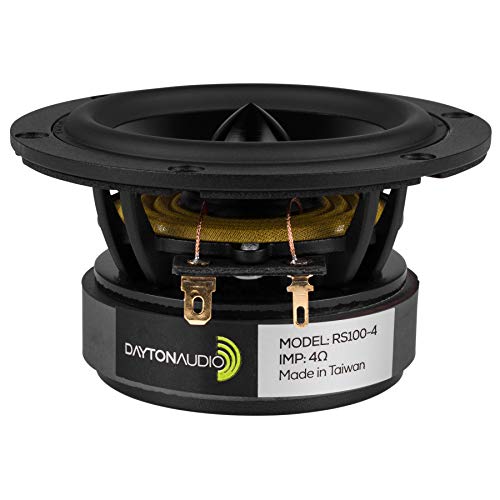
The RS100-4 provides full-range capabilities, aiming to reproduce as broad a frequency range as possible with a focus on low distortion. Its long-excursion motor and low-loss surround help deliver strong bass performance for a 4″ speaker. Best for compact enclosures where a full-spectrum sound matters more than ultra-high efficiency. A limitation is that some users might notice less efficiency compared with magnet-stronger designs at the same power level.
PRV Audio 4″ Full-Range Neodymium Speaker 4MR60-NDY-4

The 4MR60-NDY-4 uses a neodymium motor to provide high efficiency and 60 watts peak handling in a compact 4″ driver. It’s well suited for portable speaker systems, line arrays, or tight automotive spaces. The broad 90–20,000 Hz frequency range with a flat midrange supports clear vocals and instruments. Best for small, high-efficiency builds where space is at a premium. Caution: precise crossover design is important to prevent midrange harshness in multi-driver configurations.
Pioneer F-Series TS-F1035R 4″ 2-Way Coaxial Car Speakers

These Pioneer TS-F1035R speakers offer a 2-way coaxial design that integrates a woofer and a tweeter for a balanced, immersive sound. They handle up to 150W peak power and 20W nominal, with 4-ohm impedance. Best for users seeking a ready-made upgrade that provides a broader sound field from a single unit. Choose this if you want a straightforward install with a full-range feel. Limitation: fixed coaxial design may limit flexibility for crossovers and tonal tuning compared with separate woofer/tweeter combos.
Buying Guide
What to consider before buying a 4″ driver
Enclosure type and size, power handling, and sensitivity determine the loudness and bass response you can achieve in small spaces. Full-range drivers prioritize simplicity, while midbass options focus on mid to low frequencies in compact enclosures. Neodymium magnets offer high efficiency in tight spaces but may require precise mounting and venting considerations.
Enclosure compatibility
- Sealed enclosures: Typically tighter bass; look for drivers with good midrange clarity.
- Ported enclosures: Can boost bass extension but require careful design to avoid port noise.
- Car door or panel mounting: Choose compact drivers with high efficiency and robust mounting.
Power and crossover considerations
- Match driver power handling with your amplifier’s output to avoid distortion or damage.
- For multi-driver systems, plan a crossover that smoothly splits frequencies between drivers.
Sound goals
- For vocal clarity and mids: favor drivers with low-distortion motors and smooth frequency response.
- For balanced all-around sound: consider coaxial designs that integrate tweeters for high-frequency detail.
Installation tips
- Use proper mounting depth and gasket material to prevent air leaks.
- Ensure wiring polarity is consistent to avoid phase issues.
Practical quick picks
- Best overall compact upgrade: Dayton PC105-4 for balanced mids and smooth highs.
- Better for budget builds: Dayton RS100-4 or CT Sounds BIO-4-COX.
- Best for car aftermarket upgrades: Pioneer TS-F1035R or PRV 4MR60-NDY-4 for efficiency and top-end extension.
FAQ
- What is the difference between a full-range and a midbass 4″ driver? Answer: Full-range aims to reproduce a broad spectrum in one unit; midbass emphasizes low and mid frequencies with better bass in modest enclosures.
- Do I need a separate tweeter with a 4″ driver? Answer: Not always. Coaxial 4″ speakers integrate a tweeter for a fuller range, while standalone drivers may require a separate tweeter for highs.
- Can these drivers work with a stock head unit? Answer: Yes, but your results depend on head unit power and impedance matching; plan crossover if using multiple speakers.
- Is aluminum voice coil better for heat dissipation? Answer: Aluminum voice coils can help with heat management, enabling higher power handling in compact designs.
- Which 4″ driver is best for tight spaces? Answer: Neodymium-magnet designs (like PRV 4MR60-NDY-4) offer high efficiency in small spaces, but ensure mounting fits your enclosure.
- Can I upgrade multiple 4″ drivers in a car? Answer: Yes, with appropriate crossovers and equalization, but ensure the impedance and power handling are compatible with the head unit or amplifier.