
Best 4-Microphone Podcast Setup for Multi-Host Recording
Answering your search for a complete 4-microphone podcast setup, this guide compares five ready-to-use bundles ideal for multi-host studios, panel discussions, and collaborative streams. Each option is evaluated for who it’s best for, why it’s a fit, and practical trade-offs. Perfect for beginners building a home studio or pros expanding a multi-host workflow.
Summary of selected products
| Product | Best For | Key Benefit |
|---|---|---|
| SquarockTek Podcast Equipment Bundle | Teams wanting all-in-one solution | Premium 4 mics, audio mixer, noise reduction |
| Movo 4-Person USB Bundle – UMX-1 | Plug-and-play USB workflow | Stable 4-mic hub with real-time monitoring |
| Hayner-Seek M100 Podcast Bundle | Compact, portable setups | Dual USB interfaces, 4 mics, built-in features |
| Movo 4-Person USB Bundle – UMX-2 | Professional multi-channel routing | 4-channel interface with broadcast mics |
| Movo PodPak4T 4-Pack | Studio-quality, ready-to-record | Cardioid mics, stands, accessories |
SquarockTek 4-Person Podcast Equipment Bundle

Best for all-in-one setups where the user wants a single starter kit. The bundle includes four dynamic microphones, sturdy desktop stands, monitor headphones, full cables, and a high-performance audio interface mixer. It’s designed for multi-host recording, live streaming, and voice-over work. The built-in noise reduction helps minimize ambient hum and room interference, providing stable vocal output with independent channel controls.
Who it’s best for: teams seeking plug-and-play simplicity with integrated effects and Bluetooth background music support. Avoid if you require phantom power-independent mics that only work with dedicated external processors.
Movo 4-Person USB Podcast Bundle – UMX-1
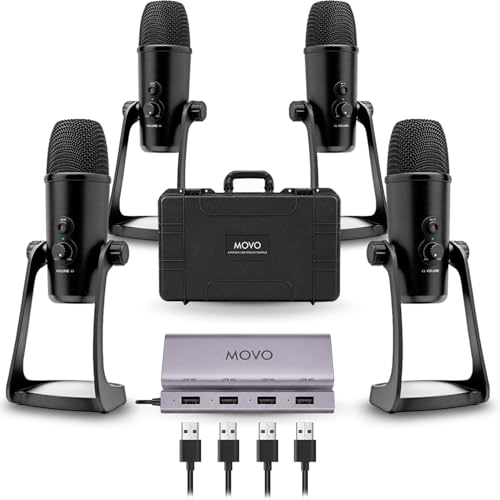
This kit prioritizes USB ease-of-use and live monitoring. It powers four USB mics through a dedicated 5V hub with real-time headphone monitoring, allowing hosts to hear themselves during recording. It’s ideal for family rooms or classrooms where quick setup and straightforward software compatibility matter most.
Who it’s best for: non-technical users who want fast setup without external audio interfaces. Better for: small groups needing immediate feedback while recording. Caution: reliance on USB power means cable management is essential to avoid clip-induced noise during long sessions.
Hayner-Seek M100 4-Person Bundle

Designed for four-person podcasts with upgraded dual USB interfaces and four dynamic mics. It emphasizes crystal-clear audio and a straightforward, all-in-one design aimed at home studios. The bundle offers independent MIC and INST volume faders to record vocal and instrument tracks simultaneously, making it suitable for mixed-content sessions.
Who it’s best for: podcasters who want a compact, all-in-one solution with simple controls. Choose this if you need instrument input along with vocal channels. Limitation: requires careful setup to balance mic levels when recording voices and live instruments together.
Movo 4-Person USB Bundle – UMX-2
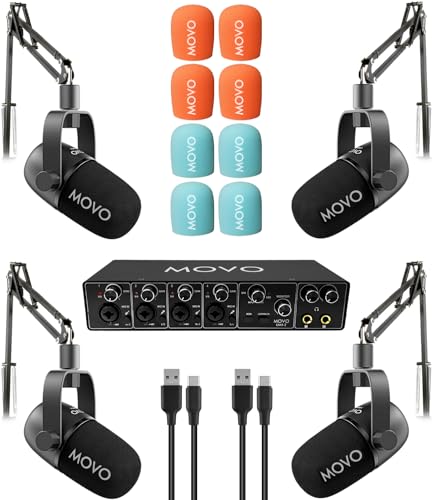
This package centers on a 4-channel USB audio interface with four CastMic dynamic mics and four boom stands. It’s a professional-sounding option ideal for multi-host discussions, panel interviews, and streaming. The four broadcast-quality dynamic mics provide clear vocal capture with strong background noise rejection.
Who it’s best for: those who want robust channel routing and direct monitoring for precise level control. Better for: environments with potential ambient noise. Caution: requires AC power to ensure consistent phantom- or mic-level performance where needed.
Movo PodPak4T 4-Pack Universal XLR Bundle

Studio-grade 4-person podcasting setup featuring four cardioid condenser mics with adjustable stands, pop filters, shock mounts, and XLR cables. It captures detailed vocals with a wide frequency response and requires phantom power for optimal performance, making it suitable for professional-sounding episodes.
Who it’s best for: podcasters who want a complete, broadcast-ready kit with expandability. Choose this if you need adjustable stands and professional accessories. Limitation: includes condenser mics requiring +48V phantom power, which may necessitate compatible power supplies.
Buying Guide: Key Considerations For A 4-Mic Podcast Setup
What type of connection do you prefer? USB bundles are simplest and great for quick setup, while XLR bundles offer better upgrade paths and studio-grade control. If you stream live, consider an interface with zero-latency monitoring and loopback capabilities to capture system audio.
How many hosts and guests will you accommodate? Four mic inputs are common, but verify that the included mics and interfaces actually support four independent channels with individual volume control. For large rooms, noise rejection and microphone directionality matter more.
What about phantom power? Condenser mics typically require +48V phantom power. Dynamic mics do not, which can simplify power needs but may trade off some sensitivity. Determine if your mics require phantom power and if your interface provides it on all channels.
Portability and setup time are practical factors. If you record on the go, a compact all-in-one bundle or USB-centric kit reduces setup time. For fixed studios, a multi-channel XLR setup may deliver superior sound with greater expandability.
Monitoring and feedback: real-time headphone monitoring helps hosts hear themselves live, enabling quick level adjustments. Look for a dedicated headphone output per host or a single mix with clear, independent level controls.
Frequently Asked Questions
- Do I need an audio interface for a 4-mic setup? Yes, most 4-mic configurations use an audio interface to convert analog signals to digital, manage levels, and provide monitoring.
- Are dynamic mics better than condenser for home studios? Dynamic mics are less sensitive to room noise, making them often better for untreated spaces. Condensers offer more detail but may pick up more ambient noise without proper treatment.
- Is phantom power necessary? It depends on the microphones. Condenser mics generally require it; dynamic mics usually do not.
- What is “monitoring” and why is it important? Monitoring lets hosts hear their own voices in real time, which helps maintain consistent levels and reduces surprises in the final recording.
- Can I mix USB and XLR mics in the same setup? Mixing USB and XLR work best on interfaces that support multiple input types, but USB mics typically do not pass phantom power and can limit routing options. If possible, stick to one consistent input type per channel.
- Which setup is best for beginners? USB-based bundles (UMX-1 or UMX-2) offer the simplest path to start recording with four mics quickly.