
Quick Overview: Below are compact 4-zone speaker selector switches that let a single amplifier feed up to four speaker pairs with individual control or impedance protection. The table summarizes key models covered in this article.
| Product | Brand | Key Feature |
|---|---|---|
| Pyle PSS4 | Pyle | Basic 4-zone selector |
| Pyle PSLSW4 | Pyle | 100W per channel, independent volume |
| Monoprice SSVC-4.1 | Monoprice | Impedance protection, volume |
| Monoprice 4-Channel | Monoprice | Up to 140W per channel option |
| OSD Audio ISS4 | OSD Audio | Impedance matching protection |
Pyle 4-Zone Speaker Switch Selector – PSS4
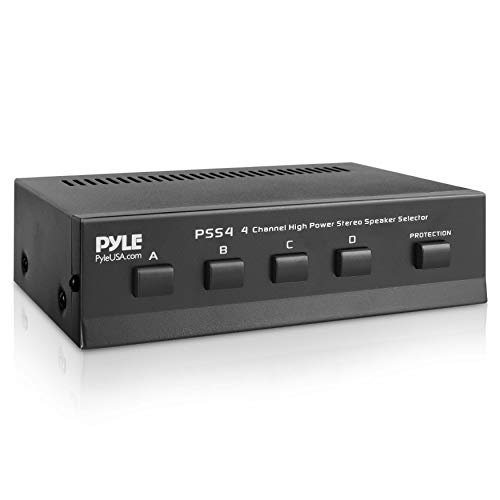
This Pyle PSS4 model provides a straightforward 4-zone speaker selector interface for connecting one amplifier to up to four speaker pairs. It uses selectable A/B/C/D switches to activate zones, making it suitable for simple multiroom setups. The selector is intended to distribute amplifier output to multiple passive speakers without integrated volume controls.
- Features: Speaker selector switches for four pairs
- Use Case: Basic distribution where independent zone level control and advanced impedance protection are not required
- Installation: Uses screw-terminals for speaker wiring
Pyle 4 Channel Speaker Selector Switch – PSLSW4
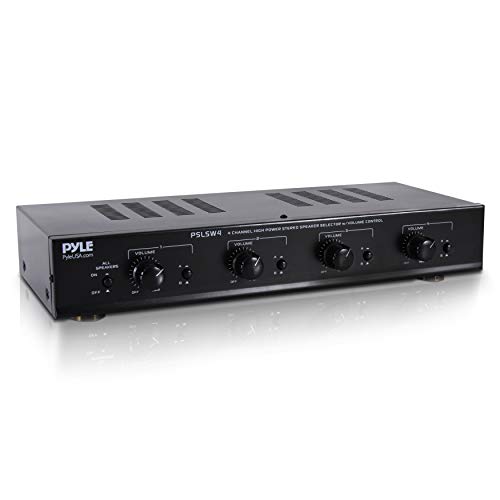
The Pyle PSLSW4 offers a compact tabletop design with independent volume control per zone and support for up to four speaker pairs. Rated for 100 watts max per channel (for use with 8-ohm speakers), it is positioned for home theater or stereo amplifier systems that need simple zone volume adjustments.
- Features: 100W max per channel, supports 8Ω speakers, individual volume knobs
- Connections: Screw-type terminals accept up to 14AWG wire
- Benefits: Zone-by-zone on/off and level control without extra electronics
Monoprice SSVC-4.1 Single Input 4-Channel
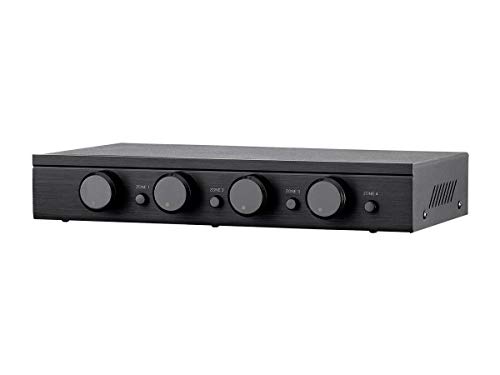
The Monoprice SSVC-4.1 adds automatic impedance protection circuitry, helping protect the amplifier when multiple zones are active. Each zone includes individual on/off buttons and volume controls. Power handling is specified at 100W continuous per channel with higher peak capability.
- Features: Impedance protection, individual zone controls, 5Ω/6Ω minimum amplifier impedance guidance
- Protection: Reduces risk of overloading the amplifier when multiple loads are connected
- Ideal For: Multiroom setups where amplifier safety and consistent performance matter
Monoprice 4-Channel Speaker Selector

This Monoprice 4-channel selector is engineered for distributing audio to up to four zones. It offers a selectable protection circuit: with protection enabled the unit supports up to 70W per channel; without it, the device supports higher output up to the stated maximum per channel. That flexibility helps match different amplifier capabilities and speaker loads.
- Features: Protection circuit toggle, supports up to 70W per channel with protection enabled
- Application: Situations requiring a balance between maximum output and amplifier load safety
- Installation Note: Confirm amplifier impedance and speaker ratings before disabling protection
OSD Audio 4 Zone Speaker Selector – ISS4

The OSD Audio ISS4 is built with heavier gauge steel housing and includes selectable impedance matching protection circuitry. It supports multiple pairs and is rated for use with amplifiers up to a specified wattage per channel when protection is engaged. The unit uses removable phoenix-style connectors for secure wiring termination.
- Features: Impedance matching protection, durable steel construction, screw-down phoenix connectors
- Benefits: Sturdy build for long-term installations and reliable cable termination
- Good For: Installations where durability and cable retention are priorities
Buying Guide: Choosing A 4-Zone Speaker Selector
Selecting the right 4-zone speaker selector depends on amplifier power, speaker impedance, desired control level, and installation style. Below are key considerations to compare models effectively.
Amplifier Compatibility And Power Handling
Match the selector’s per-channel wattage rating to your amplifier’s output. Pay attention to whether the rating is continuous or peak. If you plan to run multiple zones simultaneously, choose a model with impedance protection to avoid overloading the amplifier.
Impedance Protection
Impedance matching or protection circuitry is important when connecting several speaker pairs to one amp. Protection circuits help maintain a safe load for the amplifier and can prevent thermal shutdown or damage when multiple zones are active.
Zone Control Features
Decide whether you need simple on/off zone switching or individual volume controls for each zone. Volume controls increase flexibility but add complexity and sometimes size to the selector.
Wiring And Connectors
Look at connector types: screw terminals, phoenix removable blocks, or spring clips. Phoenix or screw terminals give secure terminations for in-wall or permanent installations. Spring clips are often faster for casual setups.
Installation Environment And Build Quality
Metal enclosures and 16-gauge steel provide durability for wall-mounted or commercial installations. Compact tabletop units fit entertainment centers and AV racks more easily.
Safety And Thermal Considerations
Ensure adequate ventilation around the selector and amplifier. Protection circuitry helps manage heat and electrical load, but correct installation and cable gauge are also critical to safe operation.
Multiple Comparison Perspectives
- Budget vs Feature Set: Basic switchers are cost-effective for limited needs; models with impedance protection or volume controls cost more but add flexibility and protection.
- Home vs Commercial Use: Rugged steel housings and secure phoenix connectors favor commercial installs; slim tabletop units favor residential setups.
- Power vs Safety: Disabling protection might yield higher output, but it increases amplifier stress. Prefer models with switchable protection if you may change amplifiers or speaker loads.
Use the table at the top and the feature lists in each product section to match a model to your amplifier, speaker impedance, and desired level of per-zone control.