
Quick Overview: Below are compact 4-zone speaker selectors with independent volume control and protection features suitable for home audio multi-room setups. The table summarizes the selected models to help you compare at a glance.
| Model | Brand | Key Feature |
|---|---|---|
| Monoprice SSVC-4.1 | Monoprice | Automatic impedance protection; individual zone volume |
| Pyle PSLSW4 | Pyle | Compact tabletop design; screw terminal connections |
| Pyle PSLSW4.5 | Pyle | Independent volume controls; slim profile |
| Pyle PLSHVC412 | Pyle | High power handling; rugged housing with heat sink |
| OSD Audio RSVC4 | OSD Audio | Amplifier protection; audiophile-oriented resistor network |
Monoprice SSVC-4.1 Single Input 4-Channel Speaker Selector
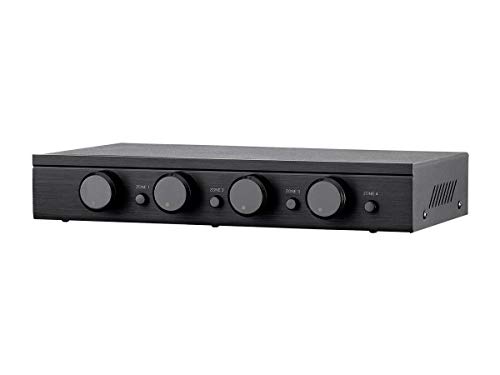
Brand: Monoprice. This unit is designed for a single amplifier feeding up to four speaker pairs. It features automatic impedance protection circuitry to guard the amplifier when multiple zones are active. Each zone has an individual on/off button and volume control for tailored listening. Rated handling capacity is 100 watts/channel continuous with 200 watts peak, and it specifies minimum amplifier impedance requirements depending on speaker loads. The selector is aimed at preserving amplifier safety while offering per-zone control in a simple form factor.
Pyle 4 Channel Speaker Selector Switch PSLSW4
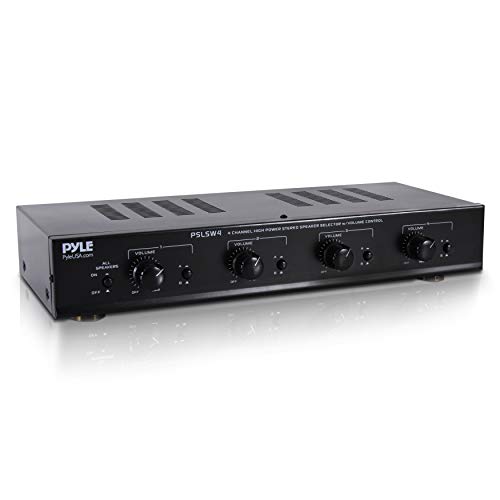
Brand: Pyle. The PSLSW4 supports up to four pairs of 8-ohm speakers and lists a 100W max per channel. It uses screw-type connector terminals that accept up to 14 AWG wire for secure wiring. The unit offers independent volume controls and push-button on/off for each speaker pair, making it suitable for small home theater or stereo systems needing a simple multi-zone distribution box. The compact tabletop design reduces footprint in AV racks or shelves.
Pyle PSLSW4.5 4 Channel Speaker Selector
Brand: Pyle. Very similar in scope to other Pyle 4-channel selectors, the PSLSW4.5 emphasizes independent volume controls and compatibility with up to four pairs of 8-ohm speakers at 100W per channel maximum. The slim, tabletop-friendly housing is intended to fit conveniently into home audio layouts. Termination style and installation simplicity make it a practical choice where separate zone level adjustment is required without complex wiring.
Pyle PLSHVC412 4 Channel High Power Stereo Speaker Selector

Brand: Pyle. The PLSHVC412 is positioned for higher power applications with 4 x 100W max per channel and a rugged housing including a cabinet heat sink. It supports up to four speaker pairs with screw terminals that accept up to 14-gauge wire. Individual speaker volume controls and push-button activation allow per-zone customization. The unit highlights build durability for installations where thermal management and repeated use are anticipated.
OSD Audio RSVC4 4X Speaker Selector w/Volume Control

Brand: OSD Audio. The RSVC4 is described as a higher-quality selector built to control four pairs of speakers while protecting amplifiers. It includes individual volume knobs for each zone and features a resistor-based protection/distribution network to allow multiple loudspeakers without overloading the amplifier. The unit lists compatibility with low-ohm amplifiers rated around 2 x 80 W RMS, making it suitable where distributed audio and amplifier safety are priorities.
Buying Guide: Choosing A 4-Zone Speaker Selector With Volume Control
Selecting the right 4-zone speaker selector involves matching amplifier capacity, speaker impedance, protection features, and installation needs. Below are key considerations and comparison perspectives to guide your decision.
Amplifier Power And Matching
- Power Handling: Check continuous and peak wattage specs for the selector and ensure your amplifier’s output falls within safe ranges for selected zones.
- Amplifier Rating: Note whether the selector is specified for compatibility with low-ohm or standard 8-ohm amplifiers. Some models are optimized for 2 x 80 W RMS class amplifiers while others expect 8-ohm loads.
Impedance Protection And Safety
- Automatic Impedance Protection: Protects the amplifier when multiple zones are active. Look for circuitry or resistor networks that manage load safely.
- Minimum Amplifier Impedance: Verify the minimum load the amplifier must see with multiple speakers connected (some models specify 4.6–6 ohm minimums depending on speaker configuration).
Zone Control And Features
- Independent Volume Controls: Essential for per-room level adjustments. Confirm knobs or sliders provide sufficient adjustment range and channel balance.
- On/Off Switching: Push buttons or switches for each zone simplify activation without changing volume settings.
- Connectivity: Screw terminals that accept 14 AWG or similar are common; ensure connector type suits your wiring skills and existing cables.
Build Quality And Thermal Considerations
- Housing And Heat Management: Higher-power models may include heat sinks or sturdier enclosures—useful if running long sessions or higher volume levels.
- Physical Footprint: Slim tabletop vs. larger rackable boxes affect where you can install the unit.
Compatibility And Use Cases
- Home Theater vs. Distributed Audio: For simple multi-room background music, compact selectors with resistor protection work well. For more demanding home theater or high-power setups, choose selectors specifying higher wattage and robust thermal design.
- Speaker Impedance Mixes: If mixing 4-ohm and 8-ohm speakers across zones, carefully review minimum amplifier impedance guidance for the selector.
Installation And Wiring Tips
- Label speaker runs and check polarity before connection to prevent phase issues.
- Use appropriate gauge wire (14 AWG commonly supported) for runs to maintain performance.
- Test one zone at a time initially to confirm amplifier stability and selector behavior.
Comparison Perspectives: Evaluate products by (1) protection method (automatic circuitry vs. resistor networks), (2) power handling relative to your amplifier, (3) physical design for placement, and (4) connector type for your wiring. Prioritize models that clearly document impedance behavior and protection limits to avoid amplifier stress when multiple zones run simultaneously.