
Best 5.1 Analog to Digital Audio Converters for Old AV Setups
Answer: A 5.1 analog to digital audio converter is ideal for upgrading legacy home theater gear by converting digital sources to 5.1 analog output. This guide highlights practical options for different needs, including compatibility with older receivers, ease of use, and multi-input versatility. Best for upgrading aging AV systems, home theaters with legacy amplifiers, or setups needing simple optical/coaxial-to-analog conversion.
Buyer type snapshot:
- Old AV receiver users needing 5.1 analog output from digital sources
- Home theater enthusiasts seeking easy, plug-and-play adapters
- People who want to preserve existing speaker setups while modernizing inputs
| Product | Best For | Key Benefit |
|---|---|---|
| SOUTHSKY 5.1/2.1 Audio Rush Digital Sound Decoder Converter | Old AV receivers needing 5.1 or 2.1 output | Dual SPDIF inputs and 6 RCA outputs with easy one-key switch |
| PROZOR 192Khz Digital to Analog Audio Converter (B088T8KW1C) | High-resolution digital-to-analog conversion | 192kHz/24-bit DAC with 5.1 channel support |
| PROZOR 192Khz DAC Converter (B0CZD74DY2) | Broad compatibility with multiple inputs | Built-in volume control and 5.1 channel decoding |
| Hubceuo 5.1 CH Audio Decoder | Versatile optical/coaxial to RCA | Supports AC-3, DTS, PCM with multiple digital inputs |
| Zopsc 5.1 Channel Audio Decoder | Home theater with standard digital outputs | True 5.1 surround outputs and dual digital inputs |
SOUTHSKY 5.1/2.1 Audio Rush Digital Sound Decoder Converter
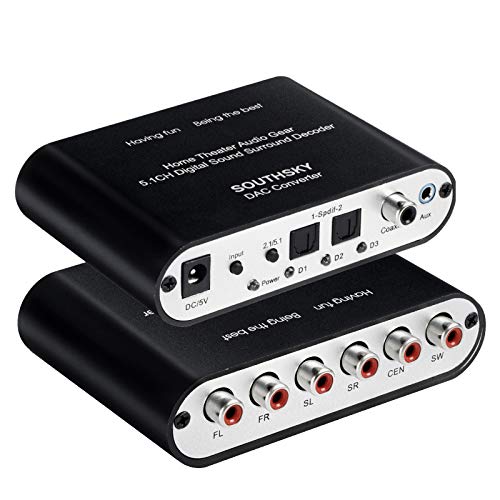
The SOUTHSKY model converts digital optical (SPDIF/Toslink) and coaxial signals to 6 RCA 5.1 channel or 2.1 channel analog audio. It supports LPCM, Dolby, and DTS/AC-3 decoding with a single switch to toggle between 5.1 and 2.1 output. Best for users upgrading an old AV receiver that needs a straightforward 5.1 option from digital sources. Limitation: relies on compatible source formats and may require correct input selection on startup. The device includes two SPDIF inputs, one coaxial input, and multiple analog outputs.
Why this is a fit: Clear 5.1/2.1 switching helps users switch between formats without reconfiguring their system. An ideal pick for aging multi-channel setups that still rely on analog outputs.
PROZOR 192Khz Digital to Analog Audio Converter (B088T8KW1C)
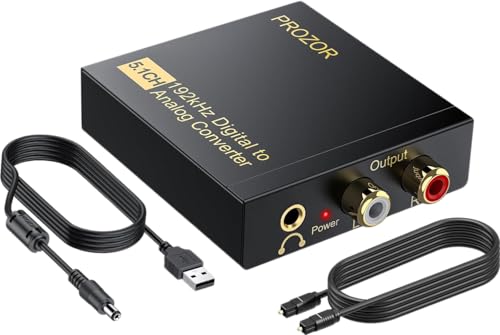
This PROZOR unit offers 192kHz sampling rate with 24-bit support, converting digital Optical and Coaxial inputs to L/R RCA analog outputs. It supports 5.1 channel formats (DTS, Dolby AC-3, PCM) and is designed for high-fidelity listening from Blu-ray players, HDTVs, or game consoles. Best for users who want high-resolution DAC performance. Caution: some televisions or players may require manual input selection for 5.1 decoding to take full advantage of the 192kHz capability.
Why this is a fit: The high sampling rate and robust decoding promise clearer audio transmission and compatibility with common home theater devices.
PROZOR 192Khz DAC Converter (B0CZD74DY2)

This PROZOR model emphasizes 192kHz/24-bit digital-to-analog decoding with built-in volume control. It converts Optical/Coaxial inputs to L/R RCA outputs and supports 5.1 channel audio (DTS, Dolby AC-3, PCM). It is a solid choice for users who want adjustable volume directly on the converter and straightforward setup. Limitation: volume range control may not replace a main receiver’s volume in some systems.
Why this is a fit: The integrated volume control helps balance levels without needing a separate preamp, making it a good fit for compact setups or streaming devices connected to older speakers.
Hubceuo 5.1 CH Audio Decoder

The Hubceuo decoder supports Digital AC-3, DTS, PCM and other formats, producing a 5.1 analog output from optical or coaxial inputs. It is compatible with a range of devices like set-top boxes and Blu-ray players. Best for users seeking broad compatibility and easy integration with multiple devices. Caution: some feature sets may vary by source format; ensure your source can output compatible surround signals.
Why this is a fit: Its versatility makes it suitable for mixed-source living rooms where multiple digital devices feed an analog 5.1 system.
Zopsc 5.1 Channel Audio Decoder

The Zopsc unit provides true 5.1 surround outputs with optical and coaxial input support. It is positioned as a reliable option for home theater setups using standard digital outputs. Best for users wanting six discrete channels to feed powered speakers or a 5.1-capable receiver. Limitation: check compatibility with your existing speaker impedance and amplifier inputs for optimal results.
Buying Guide
- Input formats: Look for devices with both optical (SPDIF Toslink) and coaxial inputs if you have multiple digital sources.
- Output channel support: Ensure the converter provides 5.1 channel RCA outputs (FL, FR, CEN, SL, SR, SW) to match your speaker layout.
- DAC quality and sampling rate: Higher sampling rates (e.g., 192kHz) and 24-bit support generally indicate better digital-to-analog conversion.
- Volume control: Built-in volume adjustment can simplify setup, especially when your receiver lacks a convenient front panel control.
- Ease of use: Devices with a simple “one-key” switch between 5.1 and 2.1 modes are advantageous for non-technical users.
- Compatibility: Verify Dolby Digital, DTS, and PCM support to ensure your media plays correctly in surround format.
- Caveats: Some decoders require correct input configuration on startup; system-wide balance may depend on speaker wiring and receiver compatibility.
FAQ
- What is a 5.1 analog to digital audio converter best used for?
It enables older AV receivers or speaker systems to receive 5.1-channel audio from digital sources like Blu-ray players or game consoles.
- Do I need a separate DAC if my receiver already decodes Dolby and DTS?
No, but a digital-to-analog converter can provide analog outputs for legacy speakers or if the receiver lacks certain inputs.
- Can these converters work with modern TVs?
Yes, when the TV provides optical or coaxial digital outputs and you connect to the converter’s analog inputs.
- Is 192kHz/24-bit support necessary for home theater use?
It improves potential fidelity, but many standard broadcasts and disc formats may not always utilize the full bandwidth.
- Will these units improve audio quality with cheap speakers?
They can provide better signal integrity, but speaker quality and amplification still limit perceived sound quality.
- Are all six channels always active in 5.1 mode?
Yes, when the source provides 5.1 data; otherwise, the device can simulate surround from stereo sources in some models.