
Best 5-Channel Class D Amps for Car Audio Upgrades in 2026
The top five 5-channel Class D car amplifiers below are chosen for balance, efficiency, and value. They’re best for multispeaker setups with a dedicated sub, or users seeking a single, compact amp to handle mids, highs, and bass. The buyers most likely to benefit include: DIY installers upgrading amplifiers in smaller vehicles, audio enthusiasts adding a separate sub, and installers needing a clean, space-efficient solution. The table summarizes key specs for quick comparison.
| Product | Max Power (5th Channel) | Channels | Best For |
|---|---|---|---|
| Stinger MT-1000.5 | 700W x 1 @ 1Ω | 5-Channel | Compact installs with strong sub support |
| Recoil RED1800.5 | 980W x 1 @ 2Ω | 5-Channel | High-power subs with flexible impedance |
| AudioControl EPICFIVE | 1100W RMS total | 5-Channel | Low-profile, easy head-unit integration |
| CT Sounds CT-1500.5D | 1000W @ 1Ω (CH5) | 5-Channel | Remote bass control and compact footprint |
| VEVOR 5-Channel | 1000W @ 2Ω (sub) | 5-Channel | Bridgeable bass power with clean sound |
Stinger MT-1000.5 Compact 5-Channel 1200W Class D Car Amplifier
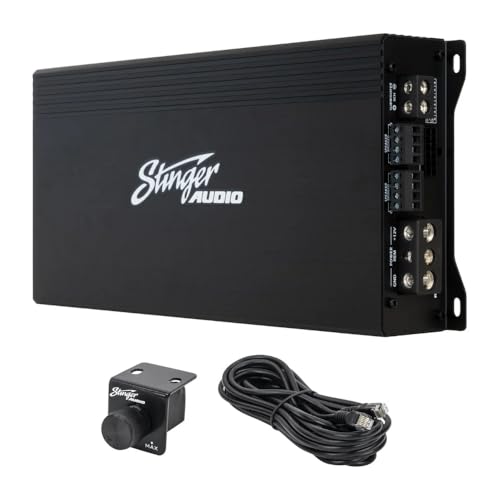
Best for small to medium installations needing a four-channel front stage plus a dedicated subwoofer channel. This digital Class D amp delivers up to 75W x 4 plus 300W x 1 at 4 ohms, or higher at lower impedances, with a compact 6.10″ L x 13.23″ W x 2.09″ H form factor. The MT-1000.5 supports high-level or low-level inputs for flexible wiring. Ideal for installers prioritizing space efficiency and solid bass response. A potential limitation is the reliance on proper heat management in extreme heat conditions.
Recoil RED1800.5 Class-D 5-Channel Amplifier

Best for systems requiring substantial subwoofer power with flexible impedance. The RED1800.5 delivers up to 1800W max, with RMS figures of 1280W x 1 @ 1Ω and 980W x 1 @ 2Ω, plus four 220W @ 2Ω or 140W @ 4Ω channels. It features a high-speed MOSFET supply and robust protection circuitry. If cooling or heat dissipation becomes an install concern, the amp’s heatsinks are designed to help. Caution: ensure proper airflow to avoid thermal throttling in very hot vehicles.
AudioControl EPICFIVE 5-Channel Car Amplifier

Best for installers seeking a low-profile, rugged unit with straightforward setup. The EPICFIVE is a compact Class D amplifier with 1100W RMS total output and low-profile dimensions. It includes line-level inputs suitable for aftermarket head units and has a built-in bass control knob option for easy remote tuning. Use this if you value simple dash or visor mounting and need clean, punchy bass response. Limitation: the integrated bass control is a feature, but external processors can still enhance complex systems.
CT Sounds CT-1500.5D 1800W RMS 5-Channel

Best for remote bass control and a compact footprint. The CT-1500.5D provides 1000W x 1 @ 1Ω for the sub channel and 210W x 4 @ 2Ω for mids and highs, plus 600W x 1 @ 2Ω for the sub depending on configuration. It ships with a remote bass knob for on-the-fly adjustment. Choose this if you want a straightforward, 5-channel setup with a dedicated sub channel in a tight space. Caution: all-channel power is strong; ensure your electrical system can handle peak loads.
VEVOR 5 Channel Class D Car Amplifier

Best for users wanting bridgeable bass power with clear sound. This amp offers up to 4 x 100W @ 4Ω / 4 x 200W @ 2Ω plus 1 x 1000W @ 2Ω for sub, and 1 x 500W @ 4Ω for a sub channel. It emphasizes low distortion (THD < 0.01%) and a high signal-to-noise ratio for clean output across the band. If you need the option to bridge channels for a submarine setup, this model provides a straightforward path. Limitation: actual bridged mode performance will depend on vehicle electrical conditions.
Buying Guide: Key Considerations For 5-Channel Class D Amplifiers
- Power distribution: Check the RMS power per channel at your chosen impedance. A strong CH5 sub channel matters if you want deep bass without a separate amp.
- Inputs and wiring: Decide between high-level (speaker) inputs or low-level (RCA) inputs based on your head unit. Some models offer both.
- Size and cooling: Class D amps are efficient, but space and airflow still matter. Measure mounting space and ensure adequate ventilation.
- Protection features: Look for thermal protection, short-circuit protection, and delay/fuse considerations to safeguard your system.
- Remote bass control: If you want on-the-fly adjustments from the driver’s seat, choose a model with a bass remote knob.
- Sound tuning: Independent high-pass/low-pass filters and subsonic filters help tailor the output to your speakers and subwoofers.
- Installation goals: For full-range sound plus sub, ensure the amp provides both clean mids/highs and strong bass with a dedicated sub channel.
FAQ
- What is a 5-channel Class D amplifier best for?
It’s ideal for systems needing four full-range channels plus a dedicated sub channel in one compact unit, simplifying wiring and space usage.
- Do I need a separate subwoofer amp?
Not necessarily. A 5-channel amp can power both speakers and a sub if it provides sufficient sub output and proper filter options.
- Is Class D sound quality good for high-end systems?
Yes, modern Class D designs offer clean, efficient power with low distortion, suitable for most car audio setups.
- What should I consider for installation space?
Check dimensions and mounting depth,plus airflow in the boot or under seats to prevent overheating.
- Can I mix high-level and low-level inputs?
Some models support both; choose accordingly if your head unit lacks RCA outputs.
- Is remote bass control necessary?
Not essential, but it improves bass tuning on the fly, especially for street competitive or multi-seat setups.