
Best 500 Watt Power Amplifier for Home and Stage
Answering the common buyer question: which 500-watt power amplifier fits home, karaoke, and small venue needs? This guide highlights five solid options based on power output, connectivity, and practical use cases. Each pick targets a different scenario—compact home setups, DJ/Karaoke, or rack-mount reliability. Readers will see who each model is best for and why, plus clear caveats to consider before buying. A quick comparison table follows to aid quick decisions.
| Product | Best For | Key Strength | Notes |
|---|---|---|---|
| Yamaha PX3 | DJs and small venues | Lightweight, DSP, configurable | Lightweight but powerful |
| Pyle PMX3500PH | Home karaoke and multi-input setups | Multiple inputs, USB/MP3, 70V/100V | Versatile for home use |
| Pyle PMSA126BU | Public address with mic control | 70V/100V, multiple outputs | Good for background PA |
| Rockwell Rockville RPA5 | Professional DJ or fixed install | 2-channel, built-in crossover | Solid for sub integration |
| Crown XLi1500 | Stage or larger PA rigs | 900W bridged, robust build | Powerful and reliable |
Yamaha PX3 Dual Channel 2x500W Lightweight Power Amplifier

Power: 500W per channel, total 1000W in stereo. Best for DJs and portable setups that require solid output without heavy weight. Onboard DSP (D-Contour) and configuration wizard streamline tuning for different spaces. The PX3 is lighter than many traditional PA amps, aiding transport and setup. Caution: fewer color-coded inputs may require reviewing connection options for complex rigs.
Pyle Bluetooth PA Mixing Amplifier PMX3500PH

Power: 500W peak. Best for home karaoke and mixed-media setups that benefit from USB/SD playback, mic inputs, and multiple digital and analog inputs. Includes FM radio and 70V/100V outputs, making it adaptable for various speaker configurations. Caution: built-in features are broad, but real-world reliability may vary with continuous pro use.
Pyle Public Address Amplifier PMSA126BU
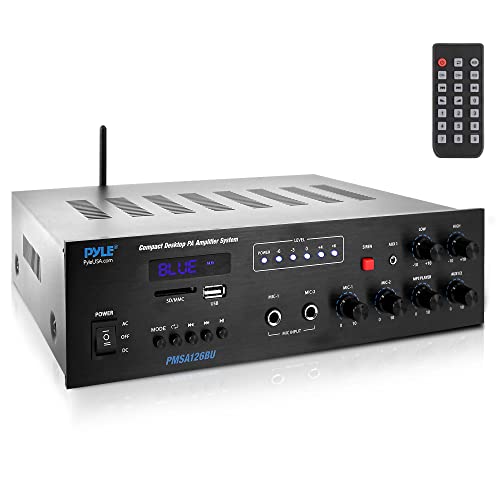
Power: 500W, with 100V/70V and 16-Ohm outputs. Best for PA-style installs and venues requiring versatile speaker compatibility. It includes USB input for MP3 playback and mic inputs, enabling simple background audio and announcements. Caution: 70V/100V systems require matching compatible speakers to maximize performance.
Pyle 4-Channel Bluetooth Amplifier with 500W Max

Power: 500W peak, supports four channels with Bluetooth audio streaming. Best for multi-room or multi-speaker home setups and small gatherings. Features include sub out, USB MP3, and mic inputs with echo. Caution: configuration is more consumer-focused; for pro DJ rigs, a dedicated mixer may offer more control.
Rockville RPA5 2-Channel Rack Mount Power Amplifier
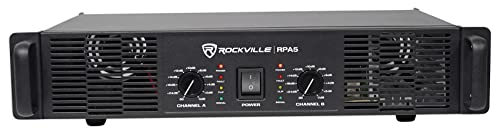
Power: 200W RMS per channel at 4 ohms, bridged up to 400W at 8 ohms. Best for fixed installations or DJ setups needing a compact, rack-mount solution with good cooling and protection. It also offers a built-in crossover for subwoofer compatibility. Caution: may require external subwoofers for deeper bass in larger rooms.
Crown XLi1500 Two-Channel 900W Bridged Amplifier

Power: 450W continuous at 4 ohms per channel; 900W bridged. Best for larger PA setups that require significant headroom and reliability. The Crown design emphasizes rugged performance in live scenarios. Caution: heavier and more expensive than compact options, and bridging requires careful impedance matching.
Crown CDi 1000 Two-Channel 500W @ 4Ω

Power: 500W @ 4Ω per channel; versatile with 70V/140V outputs. Best for commercial installations or mixed-venue applications requiring flexible output configurations. Caution: may be more feature-rich than needed for small rooms; ensure speaker compatibility for 70V or 140V systems.
Buying Guide
- Define your use-case: home karaoke, portable DJ, fixed PA, or venue installation. This determines the level of inputs, DSP, and bridged power you need.
- Power needs and impedance: 500W per channel is common, but bridged modes and 70V/100V options influence speaker compatibility. Always match amplifier channel power to speaker ratings.
- Inputs and outputs: consider mic inputs, USB/MP3 playback, Bluetooth, and speaker outputs. More inputs support versatile setups without separate mixers.
- Weight and form factor: rack-mount or portable amps affect installation and transport. Heavier amps may require dedicated stands or a stable rack.
- Cooling and protection: look for fans and built-in protection to guard against overheating in longer sessions.
- Reliability and context: Crown and Yamaha often emphasize durability for stage use, while Pyle models offer value with multi-function inputs for home setups.
FAQ
- What is a bridged amplifier, and when should I use it?
A bridged amplifier combines both channels to deliver higher voltage to a single speaker, effectively doubling available power. Use it when you need more output for a single speaker, ensuring the impedance matches the speaker’s ratings.
- Is 500W per channel sufficient for a small to mid-size venue?
Yes, for many DJ setups and small venues, 500W per channel provides solid headroom. In larger spaces, consider amplifiers with higher continuous power or multiple channels driving passive line arrays.
- Do I need DSP on a power amplifier?
DSP helps tailor sound for room acoustics, reducing feedback and optimizing bass/treble. If you’re not comfortable adjusting external processors, a model with onboard DSP can simplify setup.
- Should I choose Bluetooth-enabled amplifiers?
Bluetooth improves convenience for casual listening and streaming. For live performances, wired inputs are preferred for reliable latency and durability.
- What speaker impedance should I match with a 500W amp?
Common speaker impedances are 4 ohms and 8 ohms. Ensure the amplifier’s per-channel power aligns with the speaker’s impedance rating to prevent clipping or overheating.
- Are 70V/100V outputs necessary?
These systems suit distributed speaker setups. They’re essential in large spaces where many speakers receive uniform signal with reduced cable runs.