
Best 6 Channel Stereo Receiver Options for Home Theater and Karaoke
Looking for a reliable 6-channel stereo receiver to power home theaters, karaoke setups, or multi-room audio? This guide highlights five strong choices, detailing who each is best for and why. Each option supports multiple inputs, microphone channels, and Bluetooth, with clear advantages for specific use cases like PA, karaoke, or televised entertainment. The top picks are positioned for buyers seeking robust power, flexible inputs, and straightforward setup.
Buyer quick glance table
| Product | Best For | Key Strength | Notable Limitation |
|---|---|---|---|
| Donner MAMP6 | Karaoke and small home theaters | High 1000W peak power; Bluetooth 5.3; multiple inputs | No HDMI input |
| Pyle 6-Channel 600W (B07P9BBJM2) | Budget PA and home theater | 600W peak; Bluetooth; multiple inputs | Lower power ceiling than some peers |
| Pyle 6-Channel 2000W Hybrid (B08JMD3SN4) | Large karaoke or multi-room systems | Very high 2000W peak; multiple digital inputs | Complex feature set may require setup |
| Yamaha RX300A 5.2 | Home theater with Atmos-capable visuals | Dolby Atmos and 4K/8K support | 5.2 channels (not true 6-channel) for strict 6-channel needs |
| Pyle PTA66BT.5 6-Channel 600W | Commercial/worship spaces | Front-panel USB/SD; multiple mic inputs | Basic video pass-through; not full HDMI routing |
Donner MAMP6 6-Channel Receiver

The Donner MAMP6 delivers a 1000W peak power distributed across six independent channels (25W × 6 RMS). It supports up to six speaker groups with 4–16 ohms and offers Bluetooth 5.3, USB, FM, two microphone inputs, echo, and RCA inputs, plus optical and coaxial connections. This model suits small to medium home theaters or karaoke setups where multiple mic use and group speaker control are needed. Best for users who want strong mid-range power and flexible mic/effects control without HDMI input requirements. A potential limitation is the absence of HDMI input, which may matter for some smart TV setups.
Pyle Bluetooth Wireless Home Amplifier System – 6 Channel 750W

The Pyle 6-channel system provides 750W peak power and Bluetooth streaming, making it a solid pick for PA or home theater use. It includes USB, micro SD, AUX, RCA inputs, and two microphone inputs with echo features. It’s best for users who want a budget-friendly option with straightforward Bluetooth connectivity and multiple input sources. Choose this if you need reliable mic handling and simple operation; avoid if you require HDMI or highly detailed audio processing on a tight budget.
Pyle Bluetooth Hybrid 6-Channel 2000W
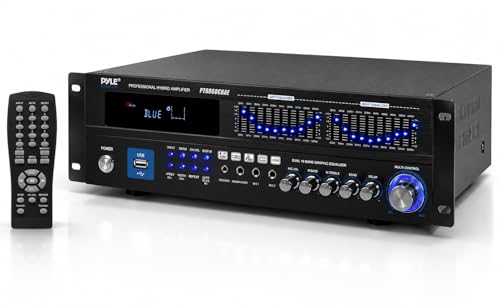
This hybrid model peaks at 2000W, with a broad input set including USB, AUX, RCA, optical and coaxial digital inputs, HDMI compatibility, and FM radio. It is a strong match for large karaoke rooms or multi-room systems that need substantial power and versatile digital inputs. It’s best for buyers who want a heavy-duty unit with extensive digital connections; consider that the feature-rich environment may require more setup and configuration.
Donner Bluetooth 5.0 4-Channel MAMP5

The Donner MAMP5 provides 440W peak power across four independent channels, with mic inputs, echo, USB/SD inputs, and FM radio. It’s suitable for smaller venues or compact studios where 4 channels suffice and budget is a priority. Best for smaller setups; better for people who don’t need six channels. A limitation is the reduced channel count compared to other 6-channel units.
Pyle PTA66BT.5 6-Channel 600W

The Pyle PTA66BT.5 delivers 600W peak across six channels with Bluetooth, mic inputs, USB/SD play, AUX, RCA, and a FM radio. It’s well-suited for worship or small-to-medium venues needing multiple mic inputs and simple playback options. Choose this if you want a budget-friendly, versatile amplifier with front-panel USB/SD and mic support; avoid if you require HDMI or advanced room calibration features.
Buying Guide
What matters most when picking a 6-channel receiver?
- Power needs: Match peak power to room size and speaker impedance. Higher peak power supports larger rooms or more demanding performances, but consider actual RMS power for ongoing use.
- Input and output options: Ensure the unit has Bluetooth, USB/SD, microphone inputs, and suitable line-level inputs for your gear. Optical/coaxial inputs help connect to smart TVs.
- Mic handling: If karaoke or PA use is planned, check echo, talkover, and mic input quality. More mic inputs allow two singers without swapping cables.
- Channel independence: Independent channel control helps customize zones or speaker groups. Look for units that can manage multiple groups with consistent levels.
- Setup and compatibility: HDMI pass-through, HDMI inputs, and ARC/eARC can simplify home theater wiring. If HDMI is not needed, prioritize analog and digital inputs that fit your devices.
Which factors should influence your choice?
- Intended use: Karaoke, home theater, worship spaces, or multi-room audio each demand different features.
- Speaker compatibility: Verify impedance (4–16 ohms) to avoid mismatched loads that could reduce performance or damage amps.
- Future expandability: Consider whether you will add more speakers or mics later and pick a unit with enough inputs and outputs.
- Ease of use: Simpler remotes and intuitive EQ controls help reduce setup time and improve live performance reliability.
Frequently Asked Questions
- What is a 6-channel stereo receiver best for?
It is ideal for small-to-mid sized karaoke setups, multi-speaker home theaters, and venues that require multiple mic channels and zone control. - Can these receivers power multiple listeners at once?
Yes, when paired with appropriate speakers, these receivers can drive multiple zones or groups for simultaneous audio output. - Do I need HDMI on a 6-channel receiver?
Not strictly; HDMI inputs are helpful for TV audio, but many models offer robust analog/digital inputs (optical/coaxial) that work with most TV setups. - Is higher wattage always better?
Higher wattage supports larger spaces and more speakers, but it’s essential to match the receiver’s power to speaker impedance and room acoustics for best results. - What should I consider for mic inputs?
Number of mic inputs, presence of echo or talkover features, and the ease of adjusting mic volume are all important for karaoke and live events. - Are Bluetooth-only inputs sufficient?
Bluetooth is convenient, but for best fidelity, prioritize units with wired inputs (USB, AUX, RCA) as a supplement to wireless streaming.