Best 61 Key Keyboard Keys for Beginner and Pro Players in 2026
Looking for a 61-key keyboard that fits your budget, teaching needs, and performance goals? This guide highlights five top 61-key options, explaining who each is best for and why. It’s ideal for beginners, students, home studios, and performers who want portability without sacrificing full-size keys. Below you’ll find quick comparisons, buying considerations, and a concise FAQ to help you decide.
Summary Table of Selected Products
| Product | Best For | Notable Benefit |
|---|---|---|
| RockJam 61 Key Keyboard Kit | Beginners and teachers | All-in-one starter kit with accessories |
| Alesis Melody 61 MK4 | Students learning with built-in lessons | Music lessons and bundled accessories |
| JIKADA 61 Key Keyboard | Home practice + singing | Teaching modes and memory functions |
| M-AUDIO Keystation 61 MK3 | Digital musicians and software users | MIDI controller with expressive controls |
| Novation FLkey 2 61 | FL Studio users and beat makers | Seamless FL Studio integration and pads |
RockJam 61 Key Keyboard Kit With Stand And Accessories

The RockJam 5061 keyboard piano super kit includes a digital keyboard with 61 full-size keys, offering a traditional piano feel in a compact, portable design. It can be powered by mains (power supply included) or batteries. Its LED panel displays 200 rhythms and 200 tones, includes a teaching function and 30 demo songs, and supports record and playback functionality with an aux input for playing along with external tracks.
Best for: Beginners who want an all-in-one learning and practice setup, and families seeking a complete starter kit without shopping separately.
Caution: The included power supply may be preferable for stability during longer practice sessions; battery operation is convenient but may require frequent replacements with heavy use.
Alesis Melody 61 MK4 Keyboard
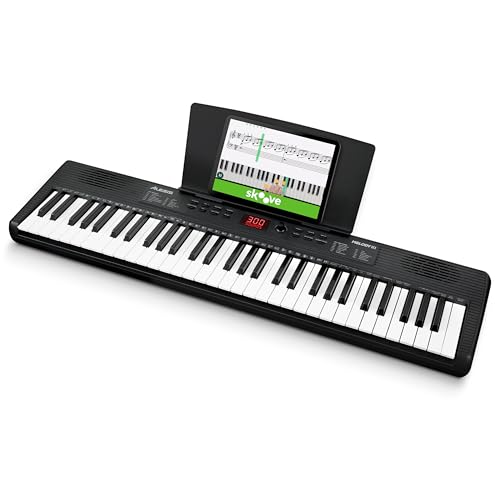
The Alesis Melody 61 MK4 is tailored for beginners, offering 61 keys and a built-in sound library of 300 tones plus auto-chord accompaniment rhythms. It ships with a full back sheet music/tablet stand, power adapter, and access to online piano lessons from Skoove and Melodics. It’s designed to help new players build finger strength and familiarity with musical notation.
Best for: Students and self-learners who benefit from guided lessons and a robust sounds library in a ready-to-use package.
Caution: The emphasis on bundled lessons means you may rely on online platforms; check your preferred lesson sources for compatibility.
JIKADA 61 Key Portable Keyboard With Lighted Keys

The JIKADA 61-key keyboard features lighted full-size keys, an LCD display, microphone input, and built-in speakers. It supports audio input/output and USB, includes note stickers for learning, and offers three teaching modes with memory for saving tone and rhythm settings. The kit includes a stand and stool option for home practice.
Best for: Night-time practice or singing along, thanks to built-in speakers and a microphone input; learners who benefit from teaching modes and note stickers.
Caution: Built-in speakers are adequate for practice but not as powerful as standalone monitors for performance settings.
M-AUDIO Keystation 61 MK3

The M-AUDIO Keystation 61 MK3 offers 61 full-size velocity-sensitive keys with a natural feel, designed for expressive performances. It provides total control with a volume fader, transport and directional buttons, and pitch/mod wheels. It is a plug-and-play USB MIDI controller, compatible with Mac, PC, and iOS devices (with an adapter sold separately), making it a versatile choice for software-based productions.
Best for: Digital musicians and producers who want precise MIDI control and easy integration with software without requiring additional drivers.
Caution: As a MIDI controller, it relies on compatible software for audible sound and may require a separate sound source or virtual instrument.
Novation FLkey 2 61 Keyboard Controller

The Novation FLkey 2 61 is a MIDI controller designed for FL Studio users, featuring semi-weighted keys, pitch and modulation wheels, 16 drum pads, and an arpeggiator. It includes six months of FL Studio and emphasizes tight integration with the FL Studio workflow, making it a strong choice for beat-making and music production workflows.
Best for: FL Studio users and beat makers who want direct DAW integration, hands-on control, and a compact 61-key layout.
Caution: Designed around FL Studio; users of other DAWs may not leverage the same level of integration without additional configuration.
Buying Guide: 61-Key Keyboard Keys
- What will you use it for? Prioritize all-in-one beginner kits if you want teaching functions and bundled accessories. Choose MIDI controllers if you plan to integrate with software and virtual instruments.
- Key feel and response? Velocity-sensitive and semi-weighted keys provide a more piano-like feel. If you primarily need keys for practice, non-weighted keys may suffice and save cost.
- Portability vs. features? Portable models are ideal for travel and small spaces; feature-rich kits offer rhythm, tones, and lessons but may be heavier.
- Learning tools and ecosystem? Bundled lessons (Skoove, Melodics, or FL Studio) can accelerate progress. Confirm compatibility with your preferred apps or platforms.
- Expansion and compatibility? If you plan to expand into software, ensure USB MIDI compatibility and required adapters for iOS or specific operating systems.
- Voice variety and rhythms? A larger library of tones and rhythms supports experimentation across genres. For beginners, a broad library helps maintain engagement.
- Price vs. value? All-in-one kits deliver value through bundled accessories; MIDI controllers may offer better long-term versatility for software-based work.
Frequently Asked Questions
- What does 61-key mean? It refers to keyboards with 61 keys, offering a compact range suitable for beginners and mid-level players, while maintaining full-size keys for a piano-like feel.
- Is a 61-key keyboard enough for learning? Yes, for beginners and many intermediate players, especially when learning is paired with teaching modes, lessons, or software.
- Do I need a power supply? Many kits include a power adapter; some offer battery power for portability. Use a power supply for stable practice sessions.
- Are MIDI controllers useful without built-in sounds? Yes. They control software synths and DAWs, allowing you to create, sequence, and mix music entirely in software.
- What should I choose for music lessons? Look for kits with bundled lessons and a library of tones and rhythms that align with your learning style.
- Can these keyboards connect to apps on tablets or phones? Most offer USB MIDI compatibility and may support iOS with adapters; check each model’s compatibility requirements.