
Best 7 String Guitar Capo: Top Picks for Quick, Buzz-Free Key Changes
Answering the question, these capos are designed for 7-string guitars or adaptable for standard 6-string setups when needed. The best options balance quick adjustments, neck protection, and consistent tuning across the fretboard. Ideal buyers include live performers who change keys often, recording players seeking precise tension, and beginners who want hassle-free clipping. The following selections prioritize reliability, ease of use, and compatibility with both electric and acoustic instruments.
The table below summarizes the five selected capos, highlighting who they’re best for, key feature focuses, and ideal use cases.
| Product | Main Benefit | Best For | Notable Feature |
|---|---|---|---|
| Ernie Ball Axis Dual Radius Capo | Ergonomic, fast single-handed changes | Players needing quick, precise tuning on flat or curved necks | Dual Radius; Reversible design |
| D’Addario NS Tri-Action Capo | Micrometer tension control | 6-string players seeking buzz-free, in-tune performance | Aircraft-grade aluminum, even tension |
| D’Addario Pro Plus Capo | FlexFit radius adaptation | 6- or 12-string guitars or octave-string setups | Flexible radius adaptation |
| G7th Performance 3 Capo | Adaptive Radius Technology for consistent pressure | Acoustic and Electric players needing tuning stability | ART technology, safe silicone grip |
| TANMUS 3in1 Metal Capo | All-in-one kit with accessories | Players who want a compact, multifunction capo | Clip top holder, included pin puller |
Ernie Ball Axis Dual Radius Capo, Black Satin

The Ernie Ball Axis Capo emphasizes ergonomic operation and versatile fretboard compatibility. Its dual-radius design clamps buzz-free on both electric and acoustic guitars, and the reversible shape fits flat and curved fretboards. Best for players who switch keys quickly during performances and need dependable intonation across the neck. Caution: ensure the clamp’s pressure is balanced to avoid slight string offset on very wide radiuses.
WINGO Guitar Capo for Acoustic Electric Guitars—Rosewood
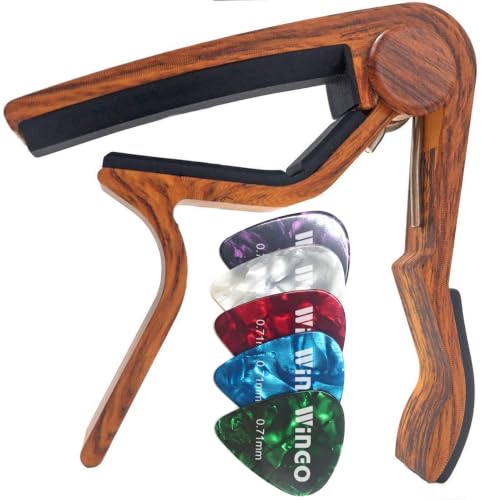
The WINGO Rosewood capo is designed for quick releases and easy one-handed operation. It suits steel-string acoustics and electrics, as well as other stringed instruments, with a strong spring that keeps pressure even and reduces buzz. Best for players who perform live and need fast key changes without retuning. Limitation: multiple instruments in a performance may require readjustment for optimal tension each time you switch guitars.
D’Addario NS Tri-Action Guitar Capo, Black

This micrometer-tensioned capo uses Tri-Action geometry to reduce required force while maintaining buzz-free sustain. Designed for 6-string electric and acoustic guitars, it’s constructed from aircraft-grade aluminum for durability with minimal neck weight. Best for players who demand consistent tuning stability with varying neck radii. Caution: may feel slightly stiffer to those used to lighter capos; adjust tension gradually to avoid neck slip.
D’Addario Pro Plus Guitar Capo, Black

The Pro Plus Capo features FlexFit Technology that automatically adjusts to any fretboard radius, delivering optimal pressure across all strings. Best for 6- and 12-string guitars, or instruments with octave string sets. It minimizes fret buzz and supports stable tuning. Choose this if you frequently switch between guitars with different radii and want a single reliable capo. Limitation: heavier necks may feel slightly more pressure than lighter designs.
TANMUS Guitar Capo 3in1 Metal Capo

CREATIVE TRINITY and SIMPLE TO USE highlight this metal 3in1 capo kit. It includes a compact capo and a guitar pin puller, plus a clip-top carry feature and 360° pin holder. Best for players who want a compact, all-in-one solution and reliable performance. Limitation: metal construction may feel heavier compared to lighter composite capos, which could affect rapid changes for beginners.
Buying Guide: How to Choose a 7 String Guitar Capo
What neck radius does your guitar have? Choose a capo with adaptive or dual-radius design to reduce buzzing on both flat and curved fretboards. If you switch between macro radii, consider models with micrometer tension or adjustable pressure for precise tuning stability.
Is quick release important? For live performances, capos with easy one-handed operation and adjustable pressure help you move between keys rapidly without retuning. Some models offer instant squeeze or clip mechanisms that suit fast transitions.
What instruments will you use it on? If you play both acoustic and electric guitars, look for a universal capo with safe silicone padding and a design that protects the neck from marks or dents. For octave string setups on 12-strings, pick a model that distributes pressure evenly across strings.
Durability and weight matter. Aircraft-grade aluminum capos are light yet sturdy, ideal for frequent gigging. Heavier metal capos may offer robust clamping but can feel cumbersome during rapid changes. Consider the balance that matches your playing style.
Budget and maintenance. While higher-end capos often deliver smoother operation, many affordable models provide excellent performance for beginners and hobbyists. Regular cleaning and inspection of springs and padding help maintain consistent tone and tension.
FAQ
- What is the main advantage of a dual-radius capo?
- How do I prevent fret buzz when using a capo on a 7-string guitar?
- Can I use a standard 6-string capo on a 7-string guitar?
- Which capo is best for quick key changes during live performance?
- What should I check if the capo causes tuning instability?
- Are there capos designed specifically for octave strings?
Answers: A dual-radius capo accommodates flat and curved fretboards for buzz-free performance. Use even, moderate pressure across all strings to prevent buzz; some capos feature micrometer or adaptive tension to help. A 6-string capo can be used on a 7-string with careful pressure, but dedicated 7-string-capable models yield better intonation. For live gigs, look for quick-release or one-handed mechanisms. If tuning wanders, recheck clamp temperature and string tension, and ensure padding is not worn. Some models cater to octave strings on extended-range guitars for stable performance.